In many businesses, a large portion of the workday is spent on repetitive tasks such as updating task statuses, sending deadline reminders, compiling information from multiple sources, or constantly switching between tools to track progress. These tasks may not be highly complex, but when repeated continuously, they can make workflows fragmented, reduce team focus, and gradually lower operational efficiency over time.
That is also why AI workflow automation is becoming a growing trend among businesses. Instead of requiring employees to manually handle every step in a process, AI can automate many routine tasks, helping workflows run more smoothly and significantly reducing operational pressure on teams.
AI workflow automation is more than just “automation”
When people think about automation, they often imagine fixed workflows operating based on predefined rules. However, AI workflow automation goes much further than that.
Rather than simply following preset instructions, AI can analyze data, understand context, and take appropriate actions based on patterns within the workflow. This makes systems more flexible when handling real-world tasks - where things do not always happen according to a rigid process.
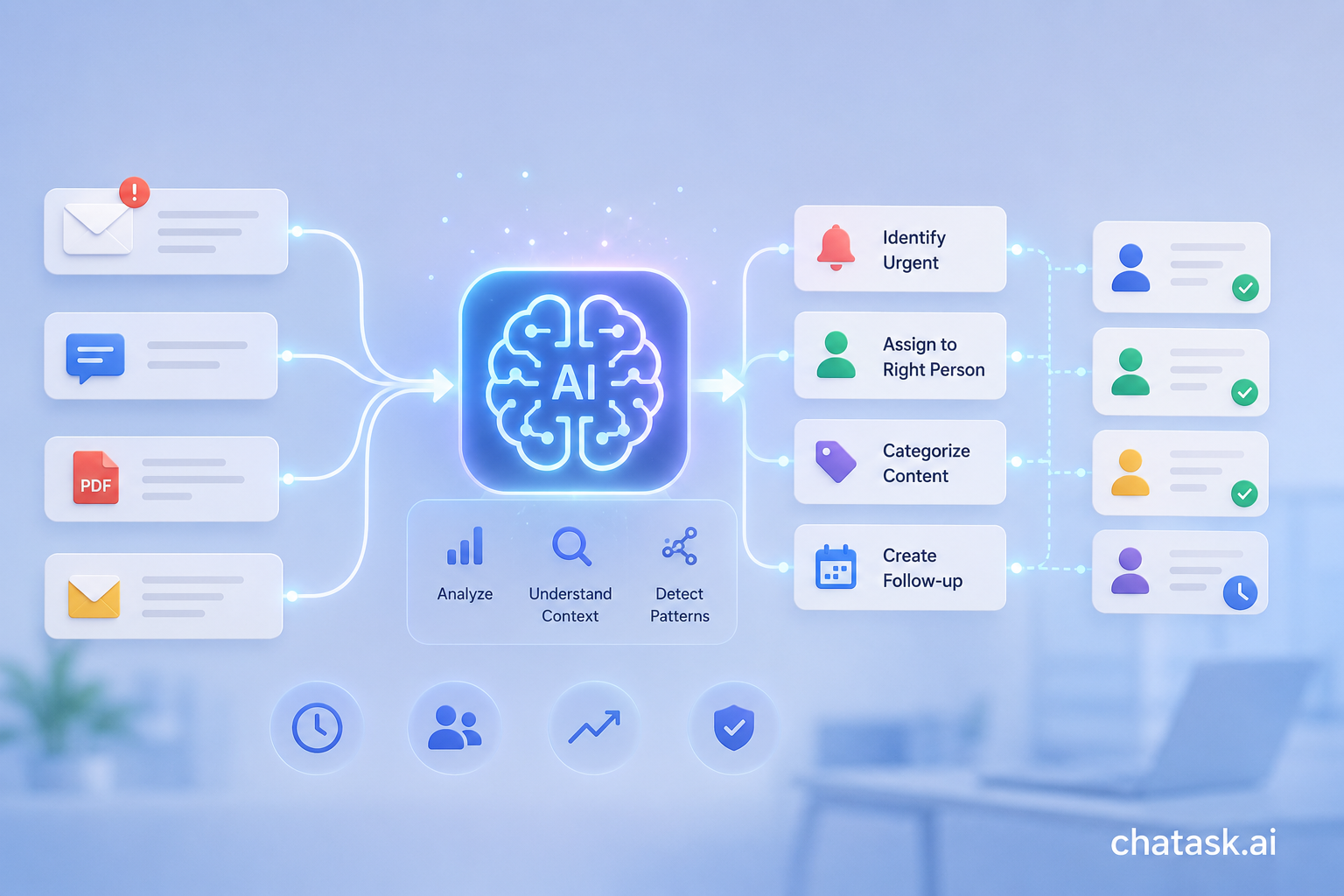
For example, instead of employees manually reading emails to determine priority levels, AI can automatically categorize content, identify urgent requests, assign them to the right person, and create appropriate follow-up reminders. Small actions like these, when automated, can save teams a significant amount of time during daily operations.
Why do manual workflows easily become bottlenecks?
In the early stages, many businesses can still manage work manually. However, as the number of projects, tasks, and team members grows, workflows begin to develop “invisible bottlenecks.”
Information scattered across chats, emails, and documents makes it difficult for teams to track progress. Repetitive tasks such as updating tasks or compiling reports consume a lot of time without creating much strategic value. At the same time, relying heavily on manual processes increases the risk of missed deadlines and delayed responses.
This is where AI workflow automation becomes valuable. AI helps connect workflows more seamlessly, reduces unnecessary intermediate steps, and allows teams to focus on more important work instead of constantly “chasing operations.”
How is AI workflow automation being applied?
One of the most common applications is task management and progress tracking. AI can help send deadline reminders, update task statuses, identify tasks at risk of delays, and suggest priorities based on the team’s current workload. This gives project managers a clearer overview without requiring them to manually check every small task.
In internal communication, AI also helps significantly reduce information loss. Instead of rereading entire message threads or manually taking notes after meetings, AI can automatically summarize key discussions, generate action items, and send follow-up reminders at the right time. As a result, collaborative workflows become clearer and less fragmented.
In addition, data- and document-related work is another area where AI workflow automation is being widely adopted. Tasks such as data entry, file classification, information extraction, and report generation - all of which traditionally consume a large amount of time - can now be handled much faster with AI support. This is especially useful for operations, finance, HR, and customer support teams, where large volumes of data need to be processed every day.

AI helps teams work faster - but the bigger value lies in collaboration
Many businesses implementing AI workflow automation initially focus on the “time-saving” aspect. However, the greater value of AI lies in helping workflows operate more synchronously across individuals and departments.
In reality, many projects are delayed not because teams lack capability, but because information is not transferred at the right time, task ownership is unclear, or workflows break between departments. AI can help connect these processes by automatically syncing data, generating reminders, and making task statuses easier to track for everyone involved.
As workflows become more transparent and connected, teams also spend less time on repetitive communication or resolving issues caused by missing information.
Where should businesses start with AI workflow automation?
One common mistake is trying to automate the entire workflow from the beginning. In reality, businesses should start with the processes that consume the most time or involve too many repetitive manual actions every day.
This could include workflows related to task updates, report generation, customer follow-ups, or internal request handling. Once these workflows are optimized, teams can more easily see the practical benefits and become more willing to expand automation into other operational areas.
At the same time, workflows should be standardized before introducing AI into operations. If current processes are unclear or rely too heavily on manual handling, AI will struggle to deliver its full value. Clearly defining collaboration methods, work flows, and team responsibilities remains an essential foundation for effective automation.
AI workflow automation does not replace people
Although AI is capable of handling more and more tasks, the goal of workflow automation is not to completely replace humans in the workplace. The biggest role of AI is to reduce repetitive operational work so teams can spend more time on creative thinking, strategic planning, and decision-making.
When operational tasks are handled more efficiently, teams gain more space to focus on work quality, improve customer experiences, and build more flexible workflows for the future.
As work moves faster and workloads continue to grow, AI workflow automation is gradually becoming an essential part of modern business operations - not just to work faster, but to collaborate more effectively and sustainably in the long run.