When a sales opportunity is lost, the first reaction of many businesses is to look for reasons in the market, competitors, or the product itself.
The customer chose another solution. The price was not competitive enough. The product lacked certain features. The competitor had a stronger brand.
All of these reasons can be valid.
However, in reality, many sales opportunities are lost for a much simpler reason: they were forgotten.
The customer never said no. The competitor never appeared. But the proposal was not sent on time. The follow-up call never happened. A commitment made during a meeting was never tracked. Eventually, the opportunity quietly disappeared from the pipeline.
This is one of the largest hidden costs in modern sales operations.
Most Deals Are Not Lost Overnight
Very few customers say “no” during the first conversation. In most cases, the sales process extends across multiple meetings, emails, and discussions involving various stakeholders.
Customers may say:
-
“Give me more time to review.”
-
“I’ll get back to you next week.”
-
“Please send us another proposal.”
-
“We need to discuss this internally first.”
In these situations, the sales opportunity is still alive. However, if nobody tracks the commitments and next steps, the deal gradually falls into silence. After several weeks or months, the opportunity disappears, and nobody truly knows why.
The problem is not the product quality or the capability of the sales team. The problem is that nobody remembers what the next action should be.

Sales Teams Are Managing Too Many Things at Once
A salesperson does not manage just one customer. They may be handling dozens or even hundreds of opportunities simultaneously.
Each opportunity comes with:
-
Multiple conversations
-
Multiple meetings
-
Multiple documents
-
Multiple tasks
-
Multiple stakeholders
Meanwhile, most commitments are still tracked manually. Some people write them in notebooks. Others keep them in email. Some mark them on personal calendars. Others simply try to remember everything.
As workload increases, missing an important task becomes almost unavoidable.

The Most Dangerous Risk Is Not Knowing a Deal Is at Risk
Not every deal disappears in an obvious way. Many opportunities remain in the pipeline and still carry an “In Progress” status, while in reality there has been no activity for weeks.
These are the most dangerous deals.
The team still believes the opportunity exists, while the customer has already shifted their attention elsewhere.
Without a proactive tracking mechanism, it is extremely difficult to detect these warning signs in time.
80% of Sales Require at Least Five Follow-Ups, Yet Most Salespeople Stop Too Early
When sales operations are small, relying on memory to track customers may still work.
However, as a business grows, the sales process needs to be supported by systems rather than individual memory.
This is one of the reasons why more and more organizations are introducing AI Agents into their sales workflows.
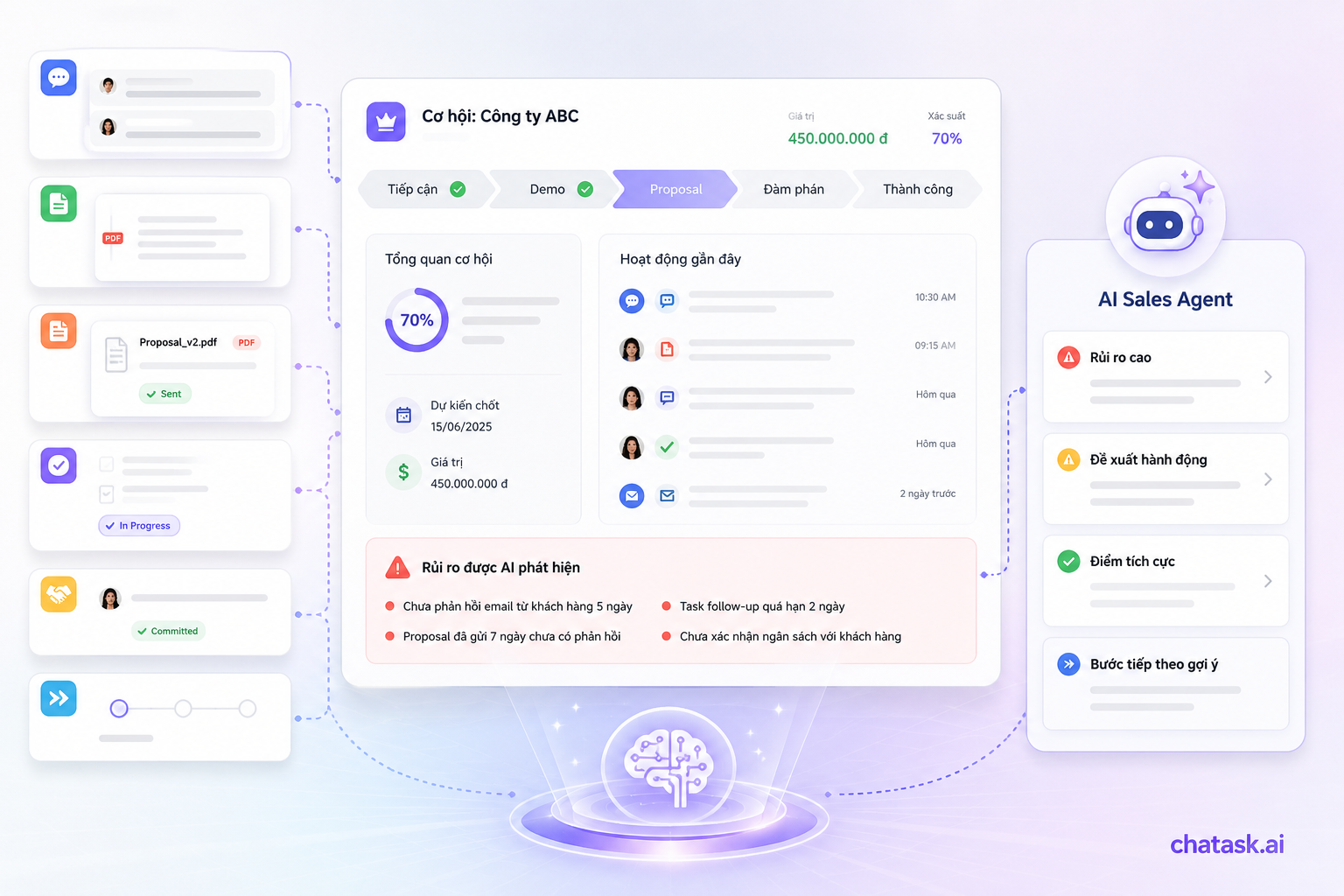
Instead of merely storing information, AI can actively monitor what is happening across the workflow and identify unusual patterns before they become problems.
Task Follow-Up Agent: Monitoring Work Progress Every Day
In sales environments, most work begins with conversations involving customers, colleagues, or managers.
As the number of tasks grows, tracking progress and identifying emerging issues becomes increasingly difficult.
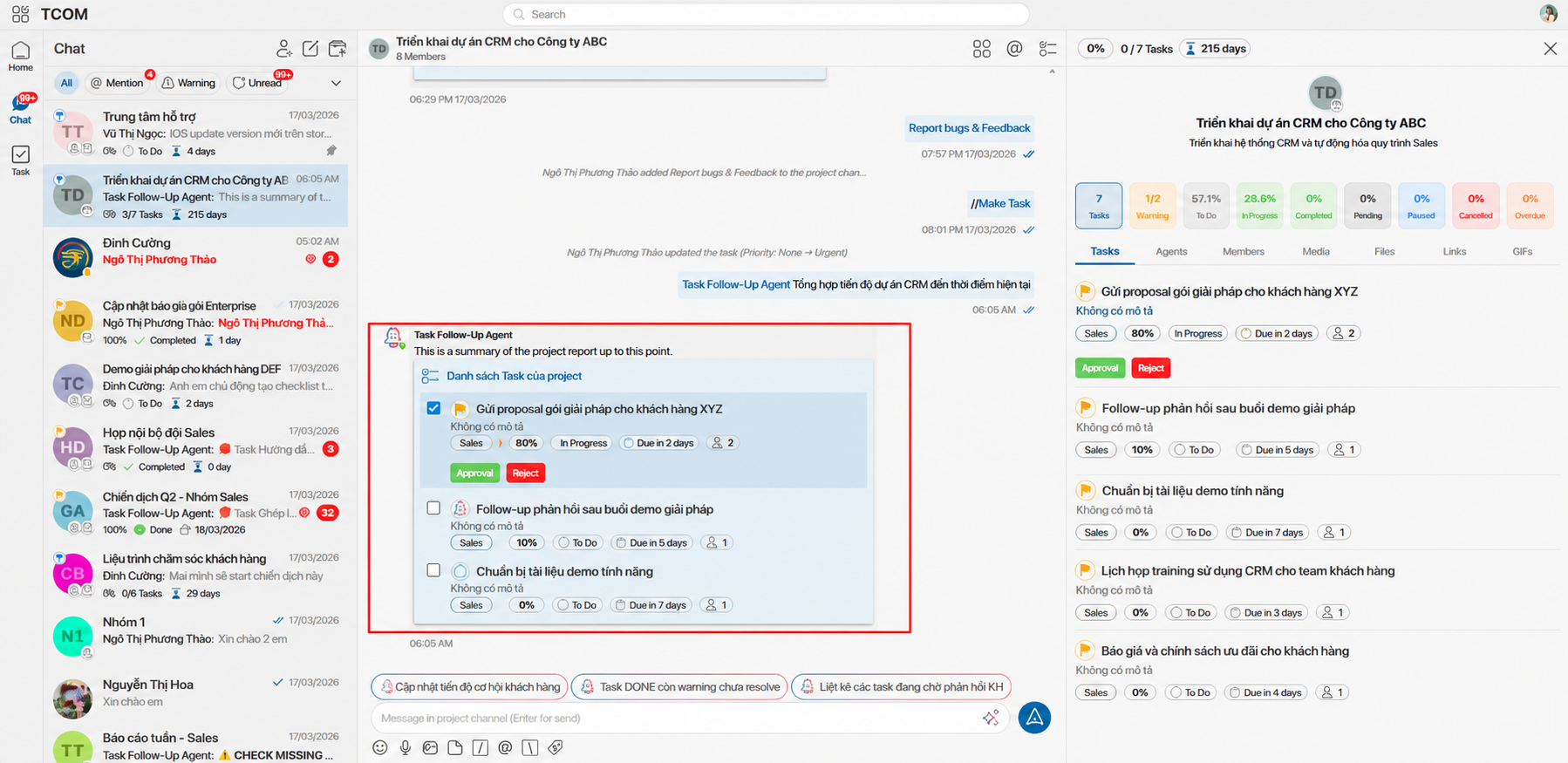
Task Follow-Up Agent in ChaTask is designed to continuously monitor task status and proactively identify tasks that are missing information, lack an assigned owner, have not been updated for an extended period, or are at risk of missing deadlines.
Instead of requiring users to constantly open dashboards, review task lists, or switch between multiple tools to understand project status, AI delivers daily follow-up notifications and alerts directly within the conversation associated with the task.
As a result, everyone stays informed within the context where work is actually happening, reducing the risk of overlooked tasks and ensuring sales opportunities are tracked until completion.
Label Warning: Turning Issues Into Things That Cannot Be Forgotten
In real-world work environments, many important action items emerge from conversations.
A customer may report an issue that needs attention. An important request may not yet have an owner. A technical problem may be waiting for responses from multiple stakeholders.
These issues often arise directly within conversations, but they can easily disappear as discussions continue.
Label Warning in ChaTask is designed to mark important issues directly where they occur.
Warning labels are attached directly to messages containing information that requires action or additional follow-up.
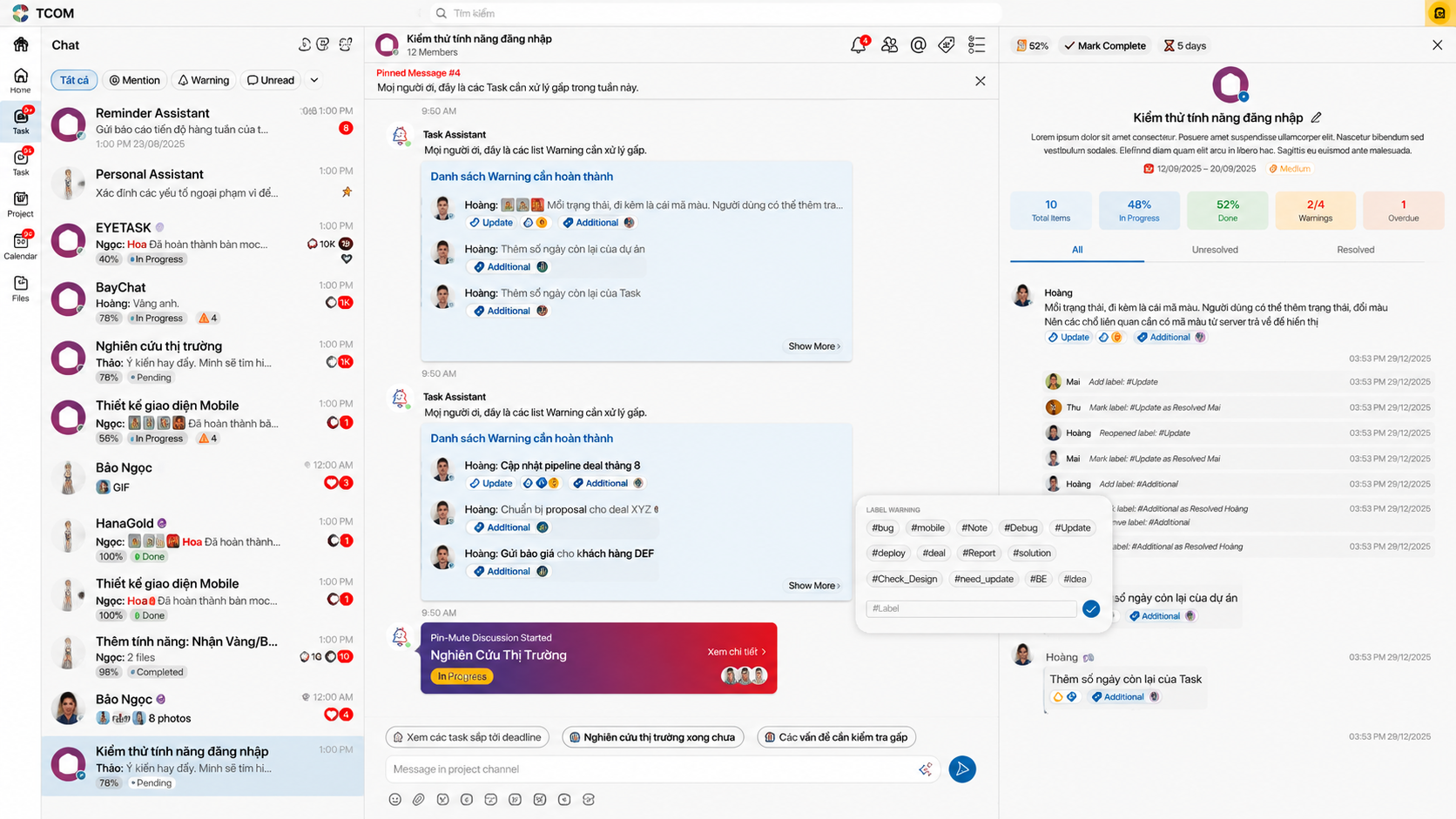
Once a Warning is created, the system continuously monitors its status and proactively sends reminders and alerts within the same conversation every day until the issue is resolved and officially confirmed.
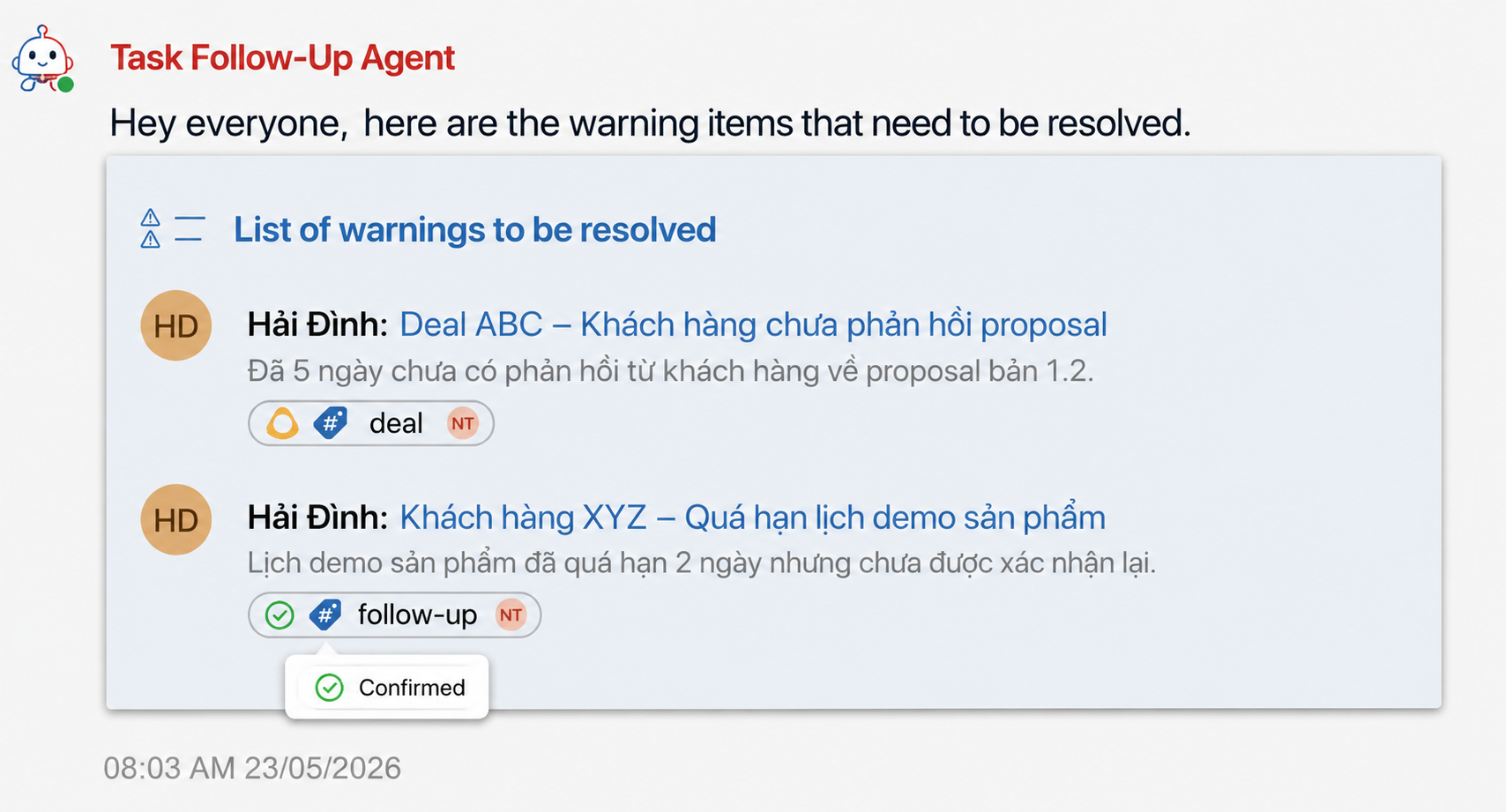
As a result, important issues no longer disappear into chat history or depend on someone remembering them. Everyone involved in the conversation can clearly see unresolved Warnings and work together until they are completed and confirmed.
Reminder Assistant: Preventing Important Commitments From Getting Lost in Conversations
Throughout the sales process, teams constantly need to remember important milestones such as upcoming meetings, proposal deadlines, customer response dates, or product demos.
Traditionally, these reminders are sent as messages in group chats or stored as personal notes.
However, as conversations continue, reminder messages are easily buried, and by the time action is required, nobody remembers them anymore.
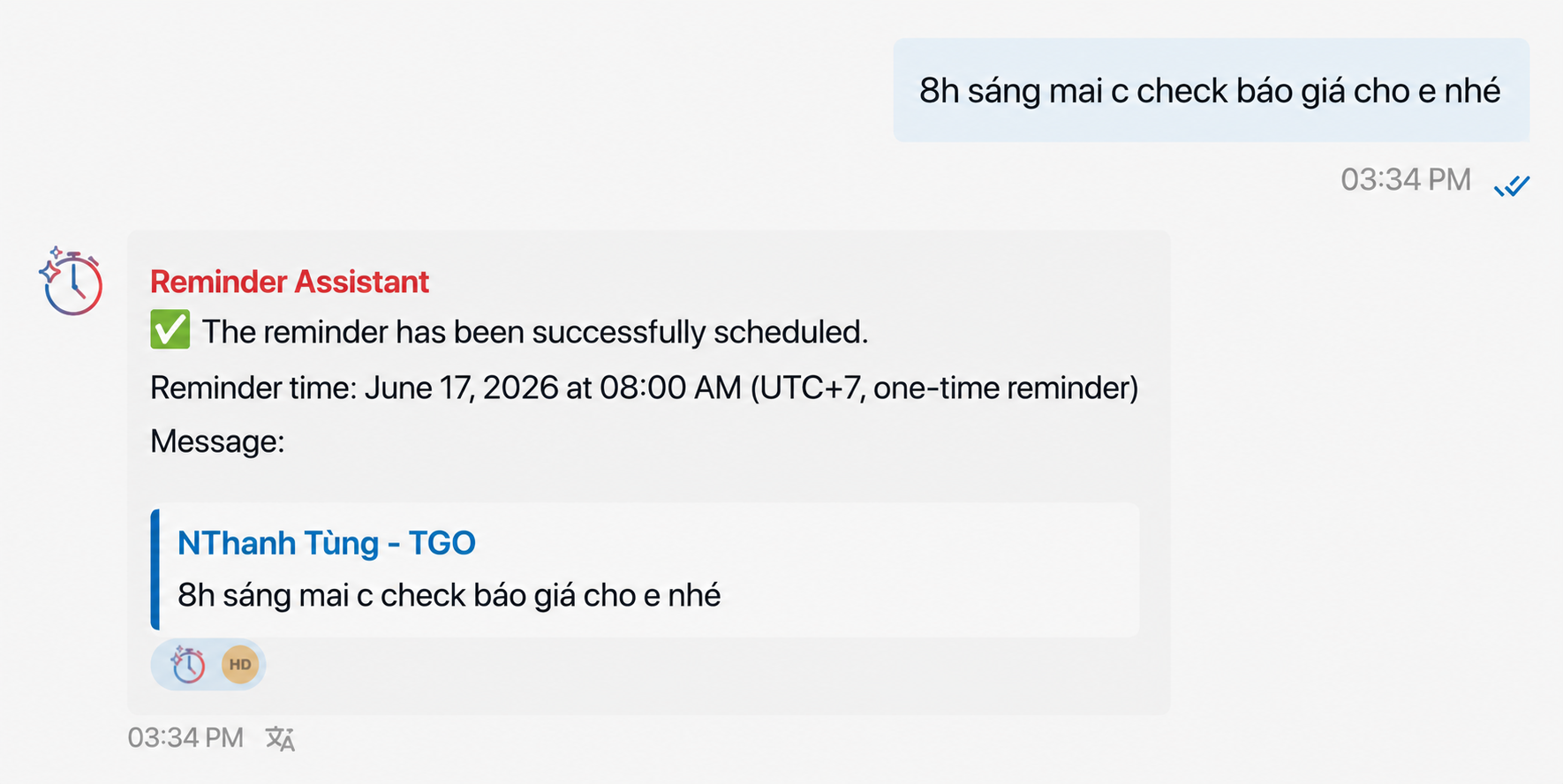
With Reminder Assistant in ChaTask, users can create reminders directly within conversations using a simple command.
At the scheduled time, AI automatically posts the reminder back into the same conversation so that everyone involved can see it and stay informed.
This allows sales teams to avoid switching to separate calendar or reminder applications while significantly reducing the risk of missing meetings, deadlines, or important customer commitments.
From Task Tracking to Opportunity Management
The biggest difference between AI Agents and traditional AI tools is not that they provide smarter answers.
The difference lies in their ability to monitor workflows.
A sales opportunity is not just a record in a CRM system.
It is a combination of:
-
Conversations
-
Documents
-
Proposals
-
Tasks
-
Commitments
-
Next actions
When AI can see this entire picture, it becomes capable of identifying risks that humans can easily overlook.
Human + AI Agents in the Sales Process
The future of sales is not about AI replacing sales teams.
Customers still buy from people. Trust is still built by people. Important decisions still require human judgment.
However, AI can become a teammate working behind the scenes.
While sales representatives focus on customers, AI can monitor progress, track commitments, identify risks, and ensure that no important action item is forgotten.
Conclusion
Many businesses believe they lose deals because competitors are stronger.
In some cases, that is absolutely true.
But many sales opportunities are lost for much simpler reasons: proposals sent too late, forgotten follow-ups, or important commitments that were not fulfilled at the right time.
These are exactly the types of problems that AI Agents can help solve effectively.
When Task Follow-Up Agent, Label Warning, and Reminder Assistant work together within a unified AI Workspace, sales teams not only manage work more effectively but also significantly reduce the risk of losing opportunities that could have become signed contracts.
Because sometimes, what determines the outcome of a deal is not who has the better product.
It is who remembers to take action at the right moment.