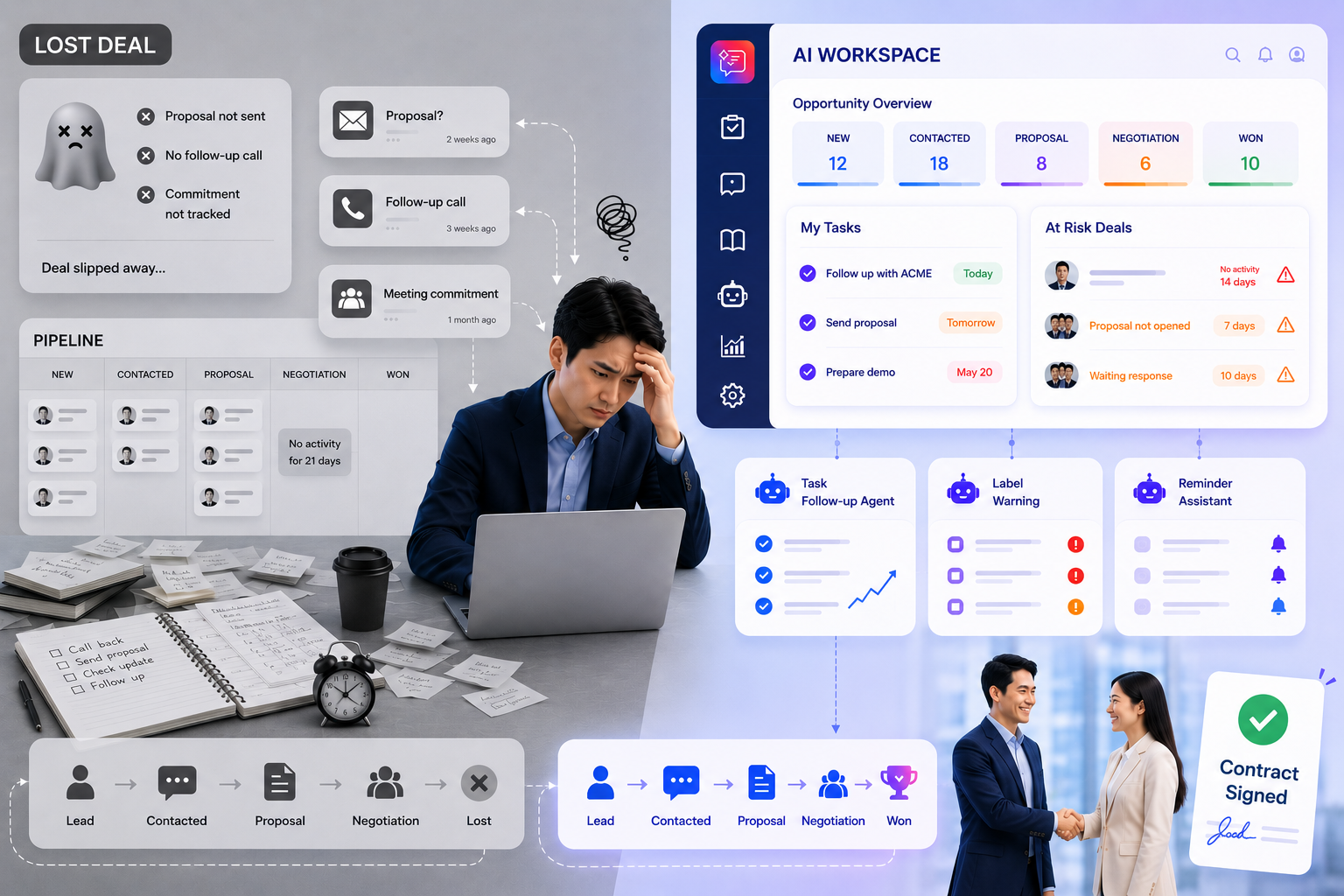
Many companies invest significant time and resources in implementing CRM systems. Sales processes are standardized, data fields are carefully configured, and sales teams are required to update customer information after every interaction.
However, after some time, a familiar problem often emerges. The data in the CRM is always behind reality. Meeting notes remain incomplete. Some sales opportunities have already moved forward, but their status in the system remains unchanged. Sales managers find themselves constantly reminding team members to update information.
Interestingly, in most cases, the problem is not the CRM itself. The real issue is that sales teams are spending too much time maintaining the system when they should be meeting customers, managing opportunities, and closing deals.
Sales Don't Hate CRM. They Hate Data Entry and Reporting
The interesting thing is that most sales professionals do not actually dislike CRM systems. They understand why businesses need customer data management. They recognize the importance of tracking sales pipelines and maintaining a history of customer interactions. The challenge is that CRM systems often require them to perform a large number of administrative tasks throughout the customer journey.
After a customer meeting, a sales representative may need to send a follow-up email, coordinate with the technical team, prepare a proposal, revise a quotation, and handle various customer requests. When the to-do list is already long, going back into the CRM to update notes, change deal stages, or fill in additional data fields rarely becomes the top priority.
Simply put, these activities do not directly help them move closer to signing a contract.
When Sales Teams Spend Too Much Time on Operational Work
In many organizations, salespeople do far more than just sell.
They spend time searching for documents, compiling meeting notes, tracking internal tasks, following up with other departments, updating CRM records, and preparing periodic reports for management. All of these activities are necessary to keep the business running smoothly.
However, as operational responsibilities continue to grow, the amount of time available for customers naturally decreases.
Instead of spending an extra hour understanding customer needs or preparing for the next meeting, many sales representatives spend their time entering data, consolidating information, or updating task statuses across multiple systems.
The problem is not that these tasks are unimportant. The problem is that they consume too much of the time of people whose primary responsibility is to generate revenue.

The Data Already Exists, but It's Scattered Everywhere
Most of the information businesses want to see in a CRM already exists somewhere else.
It can be found in customer emails, meeting notes, proposals, quotations, internal chat discussions, and the tasks that sales teams work on every day.
This creates a paradox. Businesses want more complete and accurate data, but the more they require manual data entry, the more sales teams perceive CRM as an administrative burden. As a result, information is often updated late, lacks context, or no longer reflects the actual status of a sales opportunity.
Are We Solving the Right Problem?
When CRM data is incomplete, the most common response is to ask sales teams to update the system more frequently.
Many organizations introduce additional processes, create new forms, or even tie CRM updates to KPIs. However, these solutions often address only the symptoms rather than the root cause.
Perhaps the better question is not, "How can we get sales teams to update CRM more often?" but rather, "How can data be created naturally as work happens?"
If data is generated during the course of work itself, salespeople no longer need to spend extra time re-entering information they have already created elsewhere.
When Work and Data Live in the Same Space
This is an approach that many organizations are beginning to explore as AI becomes increasingly integrated into business operations.
Instead of separating where work happens from where data is stored, all activities are brought together into a unified workspace. Customer meetings, internal discussions, documents, task checklists, and activity histories become connected within the same environment.
In this model, data is no longer something that needs to be updated after work is completed. Data is generated naturally while the work is being done.
This is also the philosophy behind ChaTask's "Work in Chat" approach.
How ChaTask Helps Sales Teams Focus on Customers Again
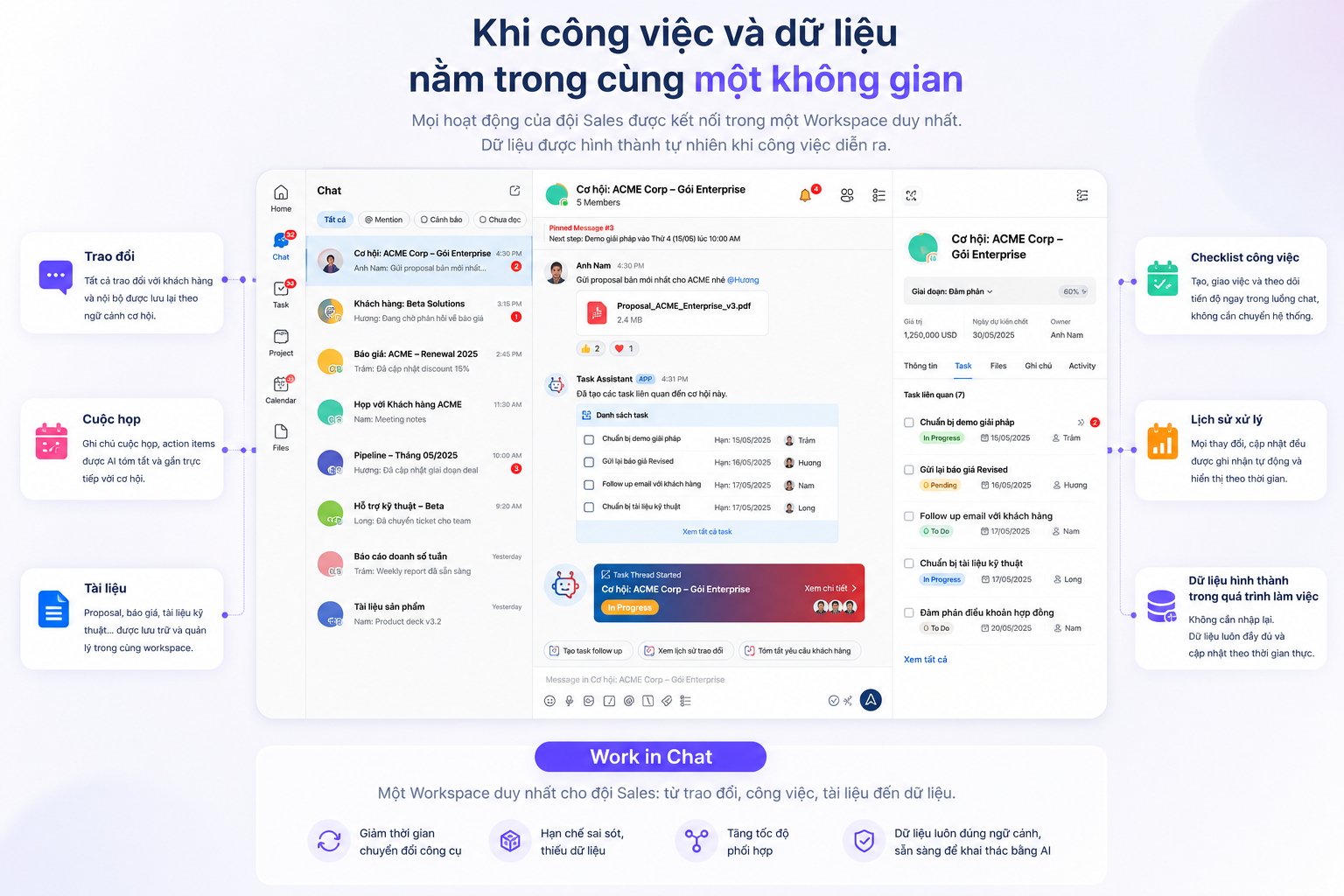
In ChaTask, every sales opportunity can be managed as a dedicated Task Thread. Customer conversations, meeting notes, proposals, quotations, and related tasks are all stored within the same context.
After a meeting, AI can automatically summarize discussions, identify key customer requirements, and create actionable task checklists. Instead of switching between multiple tools to take notes, manage work, and search for documents, sales teams can handle most of their activities within a single workspace.
This not only reduces the time spent on data entry but also minimizes the risk of losing information or context throughout the sales process.
Reporting Shouldn't Be a Weekend Job for Sales Teams
One of the most time-consuming tasks for many sales professionals is reporting.
At the end of each week or month, they often have to review emails, meeting schedules, task lists, and pipeline updates to prepare reports for management. This process is both time-consuming and prone to missing important details.
When work is carried out within a single workspace, the necessary data already exists within the system. ChaTask's AI Insight Widget can automatically consolidate activities, analyze progress, and generate reports in just a few minutes. Instead of spending hours preparing reports, sales teams can dedicate that time to serving customers and pursuing new opportunities.
More importantly, managers gain more than just numbers. They can understand what is actually happening behind the pipeline, identify deals that may be at risk of delay, and recognize where additional support is needed.

Perhaps the Problem Was Never CRM
CRM remains an essential tool for most businesses. However, if sales teams continuously postpone updating information, the issue may not lie with the system or the employees themselves.
It may be that organizations are asking their salespeople to spend too much time on administrative work instead of revenue-generating activities.
Rather than focusing on getting sales teams to enter more data into CRM systems, a different approach is to allow data to be created naturally as work happens. When work, data, and AI coexist within a single AI Workspace, sales teams can focus on what they do best: building customer relationships and generating revenue for the business.