Agentic AI is becoming an important step in the development of artificial intelligence. It no longer stops at responding to a single question. An agent-based AI system has the ability to operate like an autonomous entity that can identify goals, plan, execute a sequence of actions, and adjust its strategy based on feedback from the environment. As a result, artificial intelligence moves closer to supporting complex processes that previously required continuous human involvement.
However, the higher the level of autonomy, the greater the risk. When an agent can make decisions on its own and call external tools, even a small deviation in the reasoning process can lead to serious consequences in the following steps. Common problems include drifting away from the original goal, misunderstanding requirements, losing state between processing steps, or performing unnecessary actions that waste resources.
For this reason, five core design patterns for building robust agent-based AI systems act as an architectural foundation that helps control the behavior of the system. Instead of allowing the agent to operate spontaneously, these design patterns define structure, interaction rules, and recovery mechanisms when errors occur. A system built on a clear architecture will be easier to scale, easier to monitor, and more efficient to optimize over the long term.
Applying the correct design patterns improves stability and reduces operational costs. When a system can store recovery points, separate tasks appropriately, and perform cross-evaluation of outputs, organizations can limit risks and increase reliability when deploying agent-based AI in critical processes.
What Agentic AI is and why robust system design is necessary
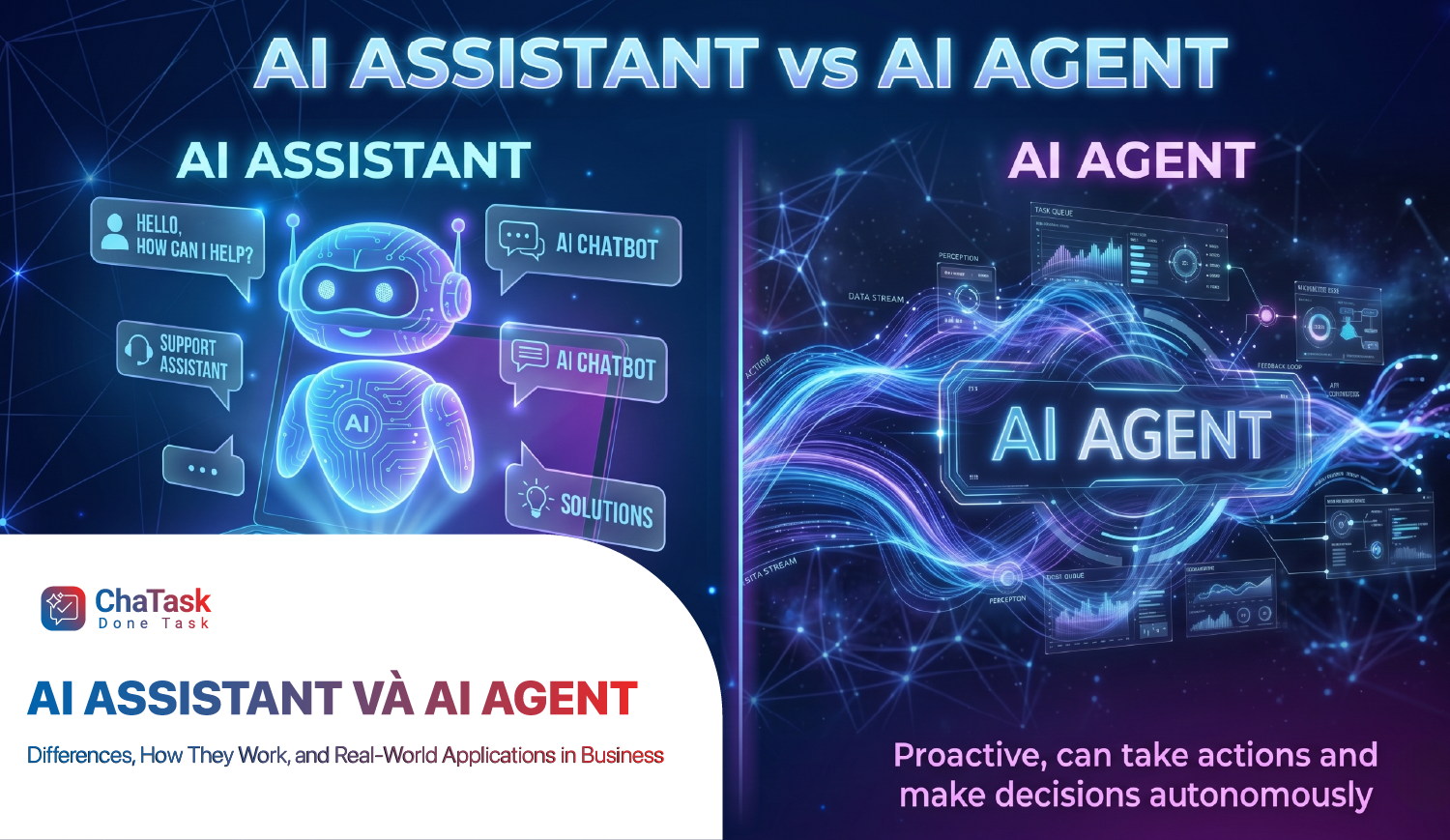
Agent-based AI is a system that can act on behalf of users to accomplish a specific objective. Instead of only generating content or providing a single response, the agent can interact with databases, search tools, internal application programming interfaces, or other systems to execute tasks.
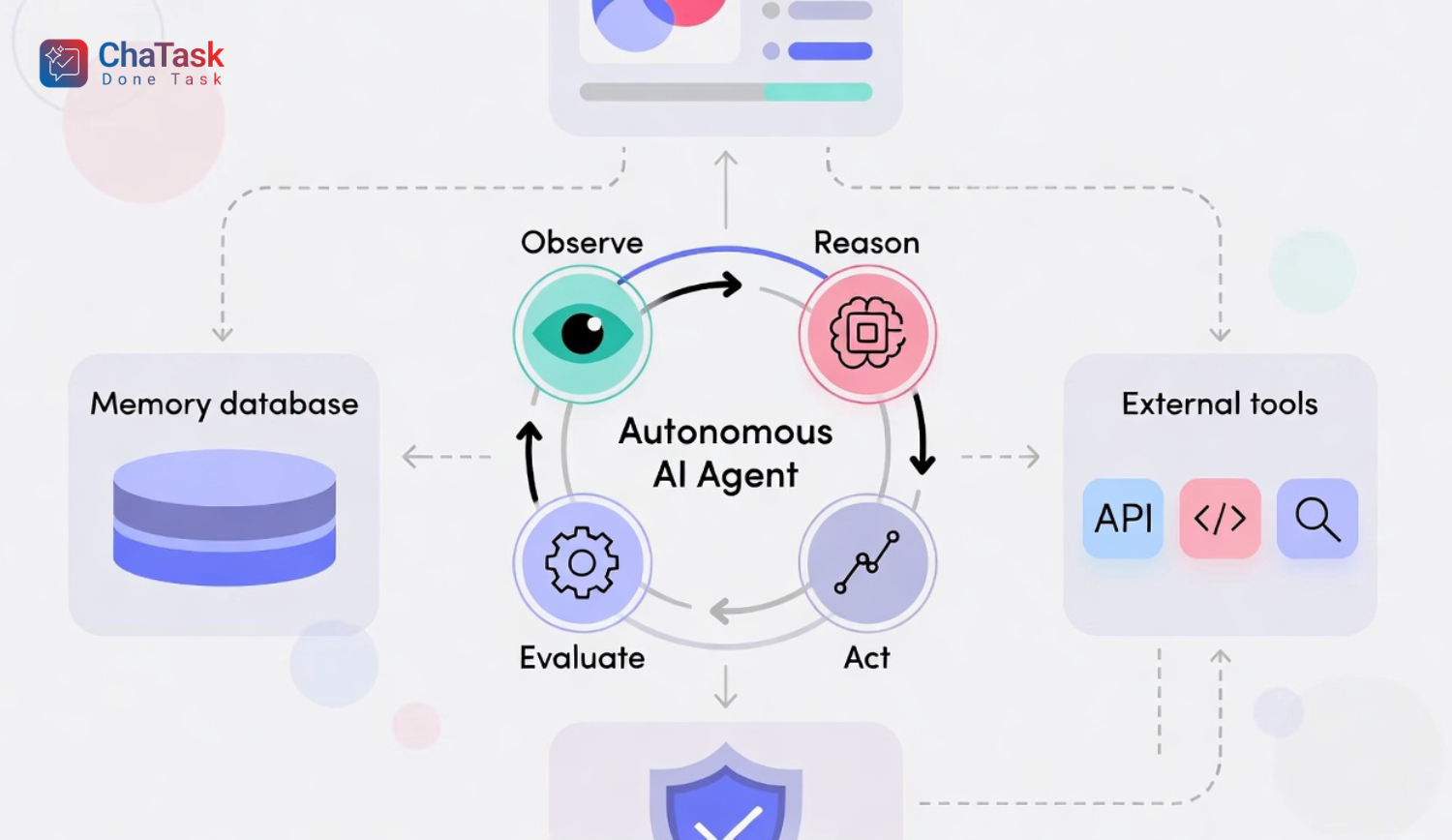
A typical agent-based AI system can understand an overall objective, break the objective into smaller steps, select appropriate tools to perform each step, evaluate the results obtained, and adjust its strategy when necessary. The key difference between agent-based AI and traditional response models lies in the sequence of actions. In a single-step system, errors only appear at the moment a response is produced. Errors in a multistep system can grow over time and spread if they are not closely monitored.
Robust system design helps minimize risks caused by incorrect reasoning, increases the ability to track state, supports recovery when incidents occur, and ensures that the final result meets the required standards. This is the reason why design patterns for building robust agent-based AI systems have become a central topic in modern AI architecture.
Design Pattern 1: The ReAct model with a loop of reasoning and action
The ReAct model builds an agent around a repeated cycle of reasoning and action. Instead of planning everything from start to finish, the system continuously updates its understanding after each execution step. First, the agent analyzes the current state, produces a temporary reasoning step, performs an appropriate action, observes feedback from the environment, and then adjusts its interpretation before continuing.
This approach is particularly effective in environments with high variability. When data changes or tools return unexpected results, the agent can adjust its direction instead of rigidly following the original plan. This makes the system more adaptable and lowers the possibility of cascading failure.
However, this model must be controlled with loop limits and clear stopping conditions. Otherwise, the system may consume excessive resources or fall into a state of infinite reasoning repetition.
Design Pattern 2: Sequential multi-agent workflow
The sequential multi-agent workflow divides a task into multiple steps, with each step handled by a specialized agent. Instead of one agent carrying the entire responsibility, the system separates roles to increase transparency and control.
Typically, one agent receives and standardizes the request, another agent analyzes the data, one agent performs the main task, and a final agent evaluates and refines the output. This structure helps isolate errors within each stage and prevents them from spreading across the entire system.
A key advantage of the sequential model is modularity. When upgrades or adjustments are required, a single agent can be modified without redesigning the entire architecture. However, to achieve high efficiency, the mechanism for transferring data and context between agents must be carefully designed to avoid misunderstandings or the loss of critical information.
Design Pattern 3: Parallel multi-agent execution and aggregation mechanisms
In many situations, subtasks can be processed independently. The parallel multi-agent model allows multiple agents to operate at the same time, after which their results are aggregated to produce the final output. This approach increases processing speed and improves horizontal scalability.
When parallel execution is implemented, the system needs a sufficiently strong aggregation mechanism to handle cases where results conflict or differ. Evaluation, scoring, or selecting the optimal option plays an important role in ensuring output consistency. A poorly designed aggregation step can become a bottleneck for the entire system.
Design Pattern 4: Central orchestration and state management
A central orchestrator manages the workflow and the state of the entire system. This component tracks the progress of each step, stores important recovery points, and handles failures when they occur. As a result, if a step fails, the system does not need to restart from the beginning but can continue from the most recent state.
In real-world environments, recovery capability is a critical factor. A system without centralized state management can easily lose the entire process when a small failure occurs. In addition, storing the history of actions supports auditing, root cause analysis, and performance optimization over time.
The orchestrator also helps control access rights and allocate resources among agents, ensuring that the system operates stably as it scales.
Design Pattern 5: Critic evaluation model to ensure quality
The critic evaluation model adds an independent verification layer after the main agent completes its task. The critic agent analyzes accuracy, logical consistency, and the degree to which requirements are satisfied before accepting the result.
This mechanism reduces errors and improves system reliability, especially in applications that require high precision. In addition, feedback from the critic agent helps the system gradually improve over time. However, the number of feedback cycles must be limited, and acceptance criteria must be clearly defined to avoid unnecessary repetition.
Combining design patterns to build robust agent-based AI systems
In real life, a good system usually uses more than one design pattern instead of just one. The reasoning and action loop can be applied to increase flexibility, the sequential multi-agent workflow can divide tasks into manageable parts, parallel mechanisms can optimize speed, a central orchestrator can manage state, and a critical evaluation layer can control output quality.
This combination creates a balance between flexibility and control and between speed and reliability. As scale increases, an architecture based on clear design patterns makes expansion easier and reduces operational risk.
Conclusion
Agentic AI marks the transition from single-response models to autonomous multistep systems that can act within real-world environments. However, to operate sustainably, such systems must be built on a robust architectural foundation.
The five core design patterns, including the reasoning and action loop model, sequential multi-agent workflow, parallel mechanisms, a state-managing orchestrator, and a critic evaluation model, form an important reference framework for building stable agent-based AI systems. When implemented correctly, these patterns improve reliability, scalability, and operational efficiency, creating a foundation for moving agent-based AI from the experimental stage to real-world applications at a large scale.