Translator Agent - ChaTask: Breaking Down Language Barriers in Multinational Work Environments
Imagine you are working in a multinational team, with a marketing member in Vietnam, a product member in Japan, and a business member in Germany. All of them are collaborating on a new product launch, working toward a shared goal - but not always truly understanding each other.
In a multinational work environment, language barriers are not just about “not understanding words.” They appear in every message, every task request, where a single sentence can be interpreted in multiple ways. An idea can be misinterpreted, a requirement can be misunderstood, and a decision can be made based on incomplete understanding.
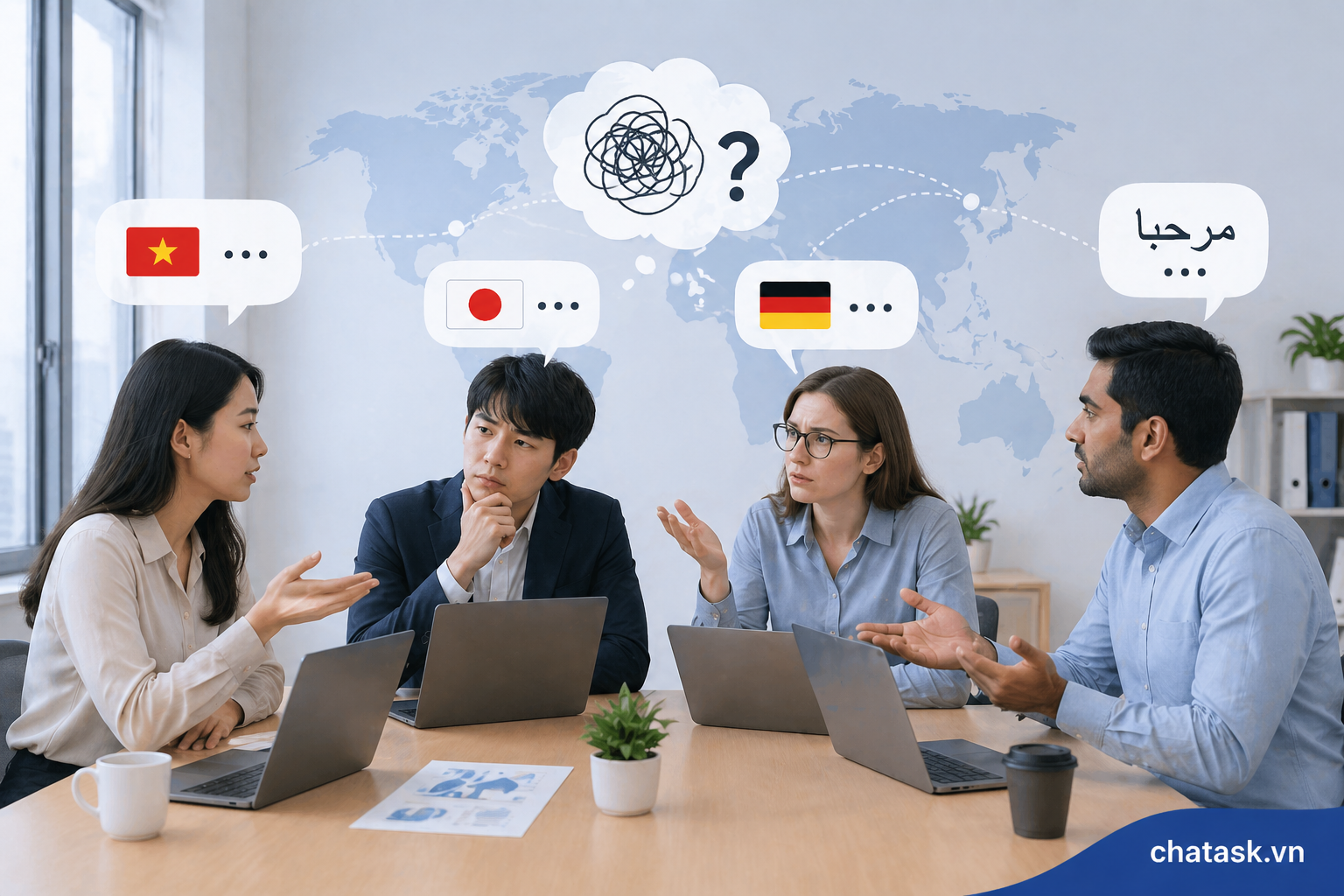
This is the challenge that most multinational companies face as they expand globally: how to ensure that everyone, despite using different languages, can understand correctly and work effectively together.
Language barriers are not just about “not understanding each other”
Language barriers are often understood as differences in language between individuals. However, in reality, the problem goes beyond vocabulary. The bigger challenge lies in how content is interpreted based on context, expertise, and communication culture.
In this product launch project, when the product team used the phrase “optimize lead time,” the marketing team simply interpreted it as “reduce time,” and proposed shortening a few steps in the process.
However, the original intention of the product team was to optimize the entire process from input to output - a small difference in interpretation that led to two completely different execution approaches.
Similarly, when the business team used the term “recognize revenue,” the marketing team understood it as money already received and started planning communication campaigns. In reality, this refers to revenue recognition under accounting standards, which is not related to cash flow.
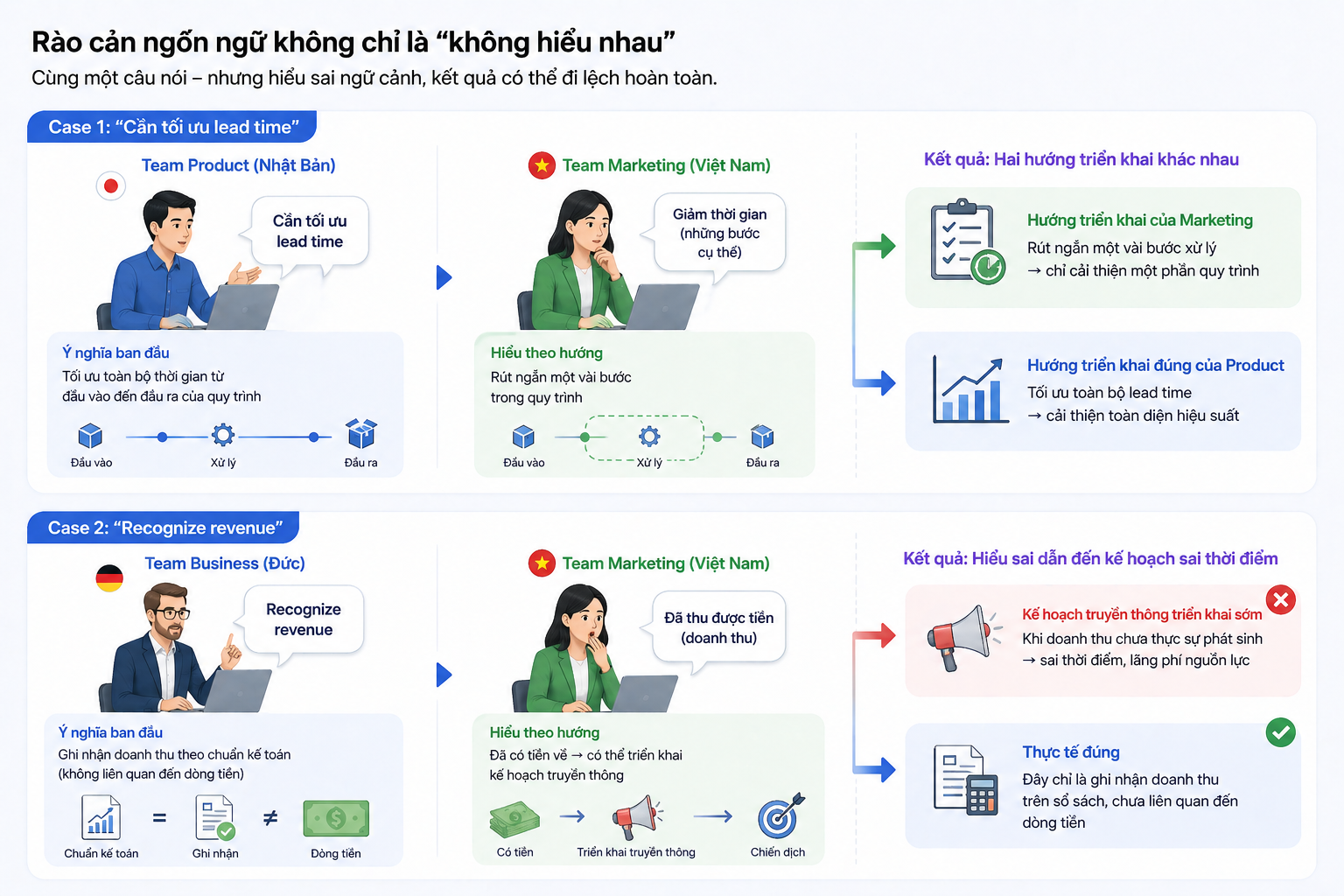
Even when everyone uses a common language like English, small differences in expression can still lead to significant misunderstandings and directly impact how work is executed.
In multinational organizations, coordination across departments and countries is critical. These small misunderstandings can accumulate, reduce efficiency, create uncertainty, and affect the entire operational process.
These issues are not just anecdotal - they are backed by research. A survey by Rosetta Stone shows that 67% of global employees work with colleagues who speak different languages. Meanwhile, Harvard Business Review reports that 75% of cross-border business teams face communication challenges due to language differences. These barriers not only cause misunderstandings but also affect trust-building - a core factor in the effectiveness of multinational teams.
Limitations of traditional approaches
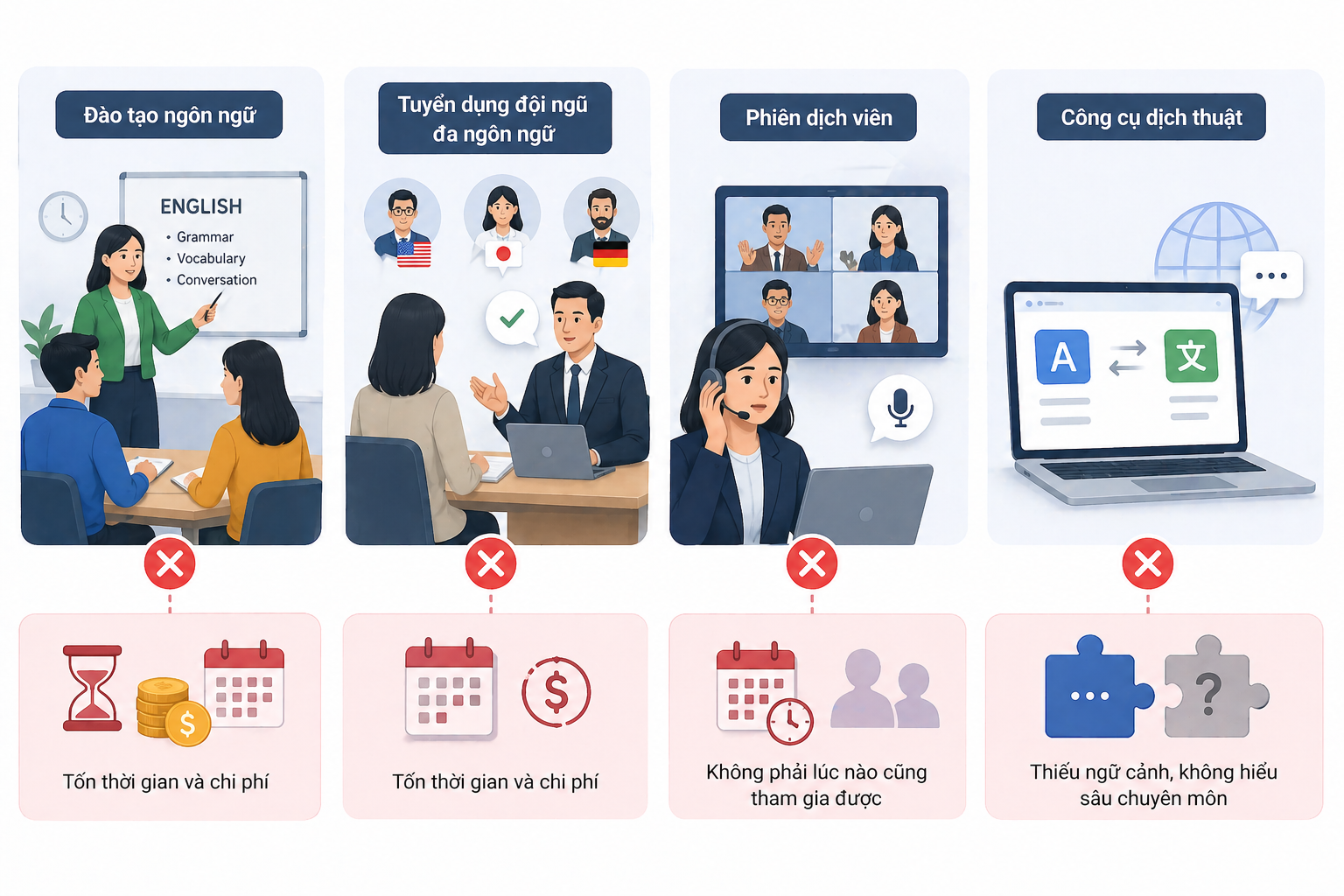
To address language barriers, many organizations have adopted solutions such as language training for employees, hiring multilingual teams, or using interpreters and translation tools.
However, these approaches come with limitations. Training and hiring require significant time and cost, while interpreters are not always available for every interaction.
Traditional translation tools can convert languages quickly, but they lack deep contextual understanding - especially in specialized fields where each term carries not just meaning, but also usage, intent, and precision.
When technology goes beyond “translation”
The advancement of AI has made language translation faster and more accessible than ever. However, a key question remains:
How can translations be not only linguistically correct, but also contextually accurate?
This is exactly where conventional translation tools still fall short.
ChaTask and a new approach to multilingual communication
To resolve misunderstandings during collaboration, the team began using the Translator Agent in ChaTask directly within their daily conversations.
See how to use Translator Agent in practice
Instead of switching between multiple tools, team members can translate content directly within the chat, maintaining the flow of conversation without interrupting the workflow.
Whenever information is exchanged in the chat, each member can select relevant skills such as Business, Marketing, or Technology to ensure that the interpretation aligns with their professional context.
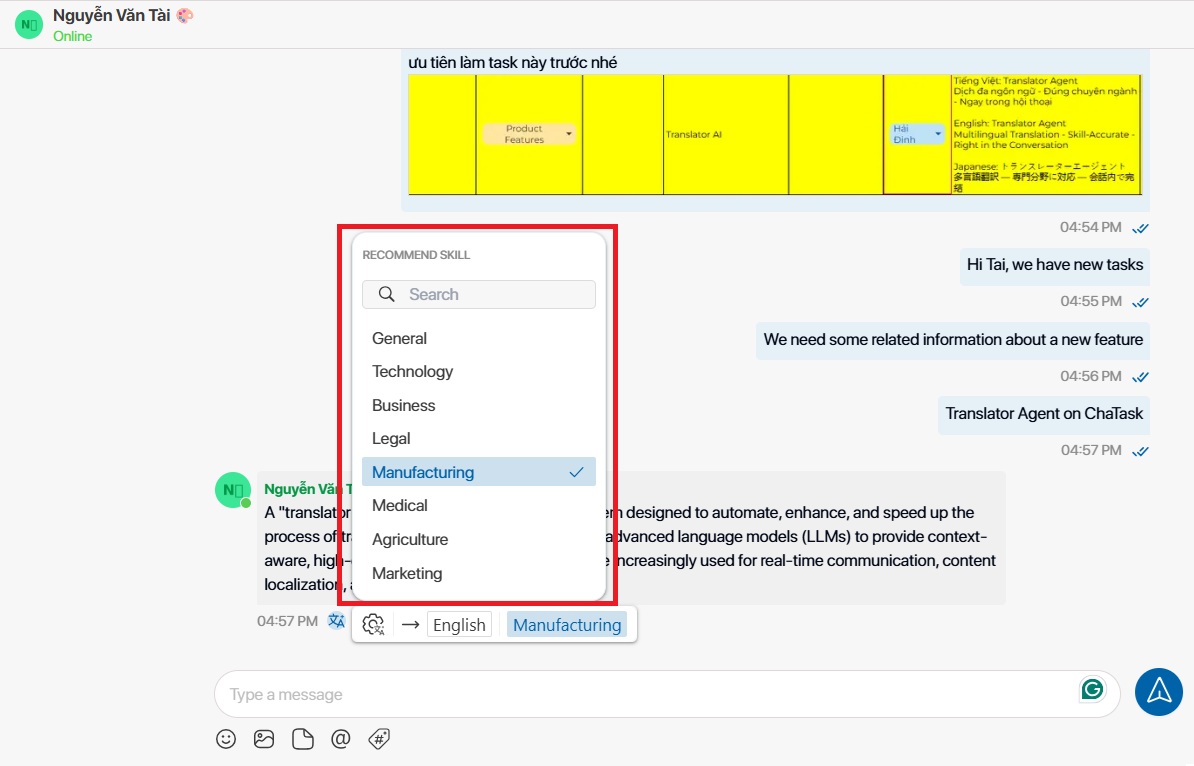
As a result, the same piece of content can be understood correctly by each person according to their expertise, while still being based on a shared source of information.
Results after using Translator Agent in ChaTask
Reducing misunderstandings in communication
After using Translator Agent, terms like “lead time” and “recognize revenue” are understood correctly within their professional context, eliminating misinterpretation across teams.
Increasing work speed and decision-making
Previously, the team had to copy content into external translation tools, often with inconsistent results. Now, everything happens directly within the chat, enabling faster responses and quicker decision-making.
Ensuring accuracy across domains
Selecting the appropriate skill ensures that translations use the correct terminology in fields such as business, technology, and legal - especially important for high-precision content.
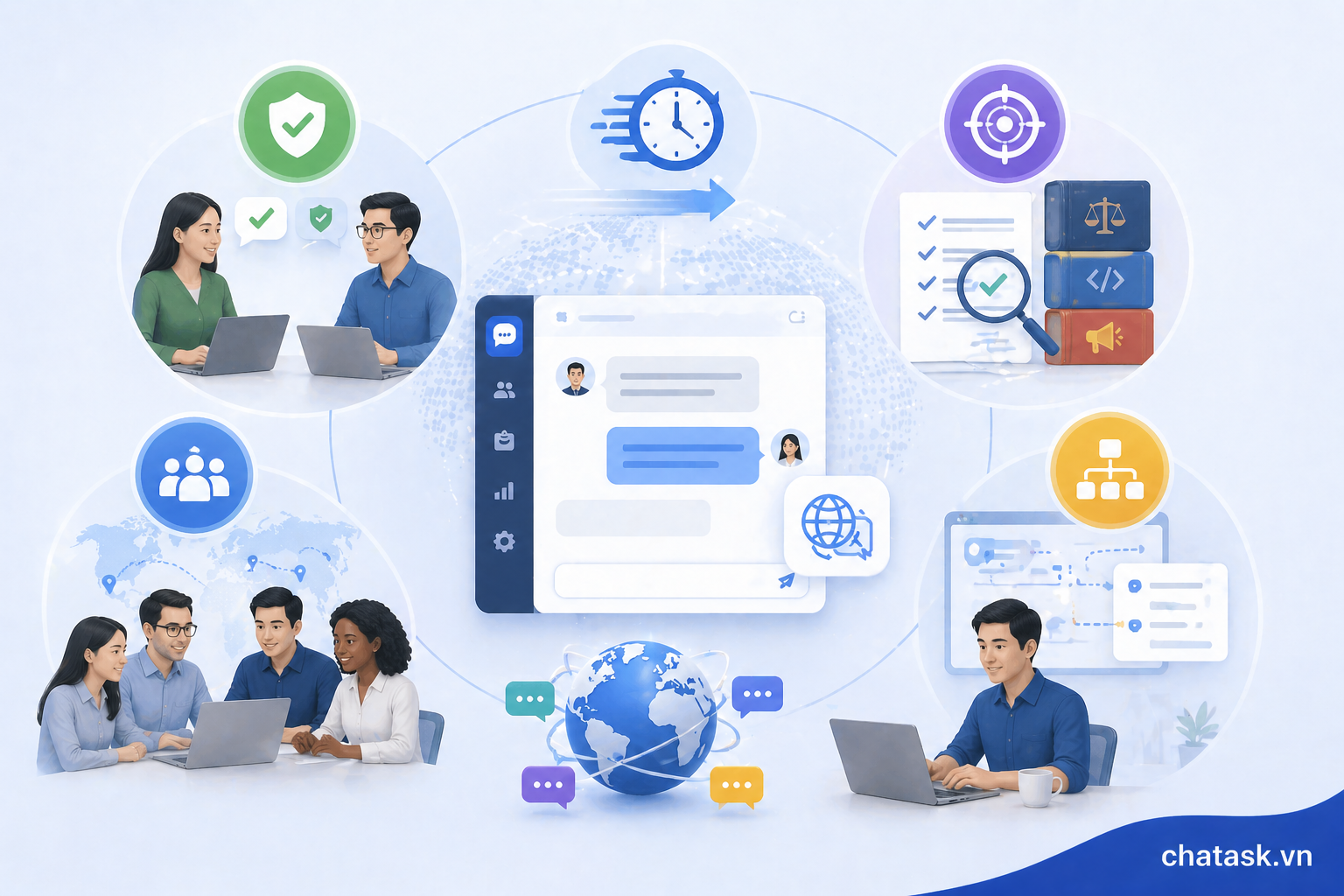
Maintaining conversation flow and workflow
The entire translation process happens within the conversation, without disrupting the workflow.
Enabling effective collaboration in multinational teams
Each member can use their preferred language while still understanding the shared content accurately - improving collaboration and significantly reducing the need for repeated explanations.
From “translating to understand” to “understanding to work”
Before using Translator Agent, the team spent significant time verifying and re-explaining important information.
After adopting it, communication became clearer, faster, and more accurate.
In today’s increasingly global work environment, overcoming language barriers is no longer a competitive advantage - it is a necessity for effective operations.
ChaTask not only helps translate content across languages, but also ensures that each translation reflects the correct professional context and communication intent.
At that point, language is no longer a barrier - and more importantly, people can truly understand each other to work more effectively.