For most businesses, reporting is a familiar activity, but it is often accompanied by pressure. At the end of each week, month, or project phase, teams begin gathering information to prepare reports for managers and executives. These reports are essential for evaluating progress, measuring performance, and identifying priorities for the next stage of work.
However, if we take a closer look at the process, we may notice something interesting. The most time-consuming part of reporting is usually not writing the report itself. What consumes hours - or even days - for an entire team is the process of collecting, validating, and consolidating data from multiple sources.
Reporting Often Begins with Searching for Data
In many organizations, the reporting process still follows a familiar pattern. Team leaders send messages asking for progress updates, team members summarize what they have completed during the week, and additional information is gathered from project management tools, Excel spreadsheets, emails, and various internal systems.
This process often leads to multiple rounds of follow-up communication. Some tasks require status verification. Some figures need to be cross-checked across different sources. Risks or issues may not have been fully documented and require additional clarification. By the time all relevant data has been collected, the team is only then ready to begin writing the report.
What is even more challenging is that despite all this effort, the final report may still fail to fully reflect reality. Some information may be missing. Some data may have changed during the collection process. Important decisions may be scattered across conversations and never make it into the final report.

The Problem Is Not That Writing Reports Is Too Slow
Many people believe AI will help businesses create reports faster. While that is true, it is not the biggest advantage.
In reality, writing a report does not take much time when all the necessary data is already available. The most difficult part is finding the data, validating its accuracy, and connecting information from multiple sources into a coherent picture.
When work is managed in one system, documents are stored in another, discussions take place on a separate platform, and reports are compiled elsewhere, teams spend a significant amount of time simply connecting the dots.
In other words, many organizations do not spend hours writing reports. They spend hours preparing to write reports.
When Data Is Continuously Updated Throughout the Workflow
Imagine a work environment where every activity is captured as part of the operational process itself. Tasks are updated in real time. Progress at each stage is reflected through Checklists. Emerging issues are recorded through Warning Widgets. Important approvals and decisions are stored within Approval Widgets.
In this environment, data does not need to be collected at the last minute. It is continuously created and updated throughout the workflow. When it is time to generate a report, organizations are not starting from scratch-they already have the data foundation they need.
The missing piece is no longer information. The missing piece is the ability to consolidate that information and transform it into meaningful insights that support management and decision-making.
AI Insight Widget Changes the Way Businesses Think About Reporting
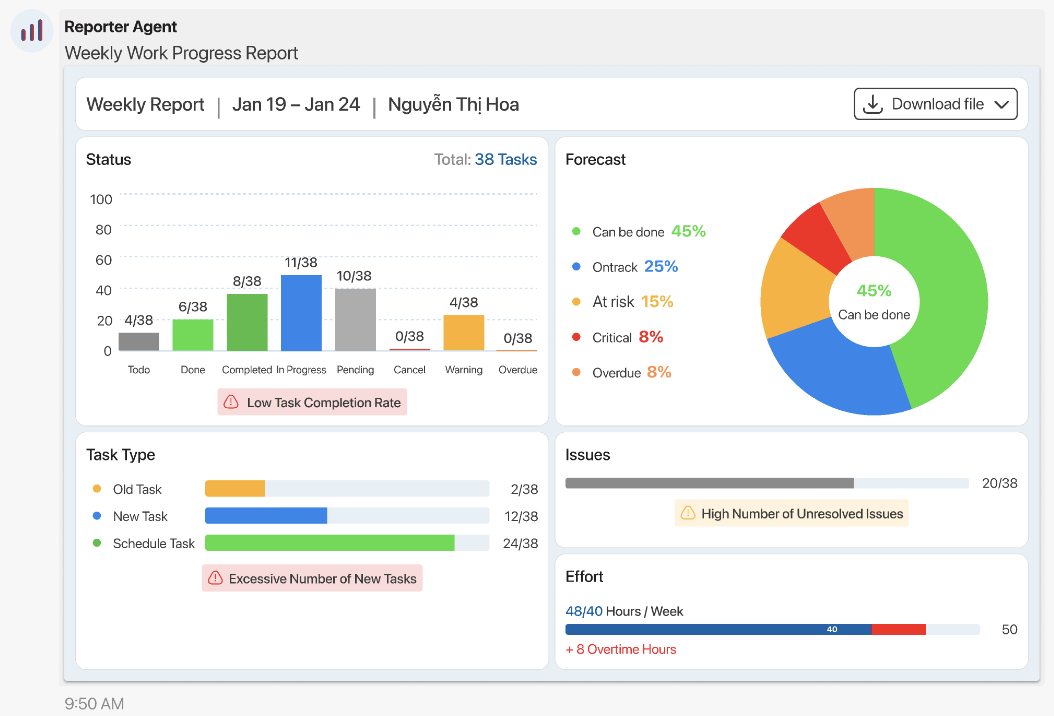
This is where AI Insight Widget comes into play. Rather than functioning solely as a question-and-answer tool, AI can continuously monitor operational data, analyze work progress, identify emerging trends, and detect unusual patterns within the system. When all work takes place within the same context, AI no longer needs to search across multiple sources for information - it can directly observe what is happening.
AI Insight Widget helps transform these observations into reports, analyses, and management insights that are easy to understand and act upon. Managers no longer need to open multiple dashboards, send countless messages asking for updates, or manually consolidate information from various systems. The information they need has already been prepared throughout the course of daily operations.
From Periodic Reporting to Real-Time Visibility
One major limitation of traditional reporting is that it typically reflects what has already happened. Weekly reports summarize the previous week. Monthly reports review the previous month. By the time a report is completed, some of the issues it describes may have already existed for days or even weeks.
AI Insight Widget introduces a different approach. Instead of simply looking backward, AI can continuously monitor the current state of operations and identify important signals as soon as they emerge. Risks of project delays, workflow bottlenecks, or signs of team overload can be detected much earlier than with traditional reporting methods.
As a result, reporting becomes more than a tool for summarizing activities. It becomes a tool for managing operations in real time.
Creating Reports in 5 Minutes - Why Not?
When people hear about generating reports in just a few minutes, they often assume AI is simply helping write reports faster. In reality, the biggest change is not the speed of writing - it is the elimination of the preparation work that traditionally consumes the most time.
When data is continuously updated as work progresses, when tasks, discussions, and decisions all exist within the same context, AI does not need to wait until the end of the week or month to begin gathering information. The report is effectively built piece by piece throughout the entire workflow, and AI simply transforms that information into valuable insights for managers.
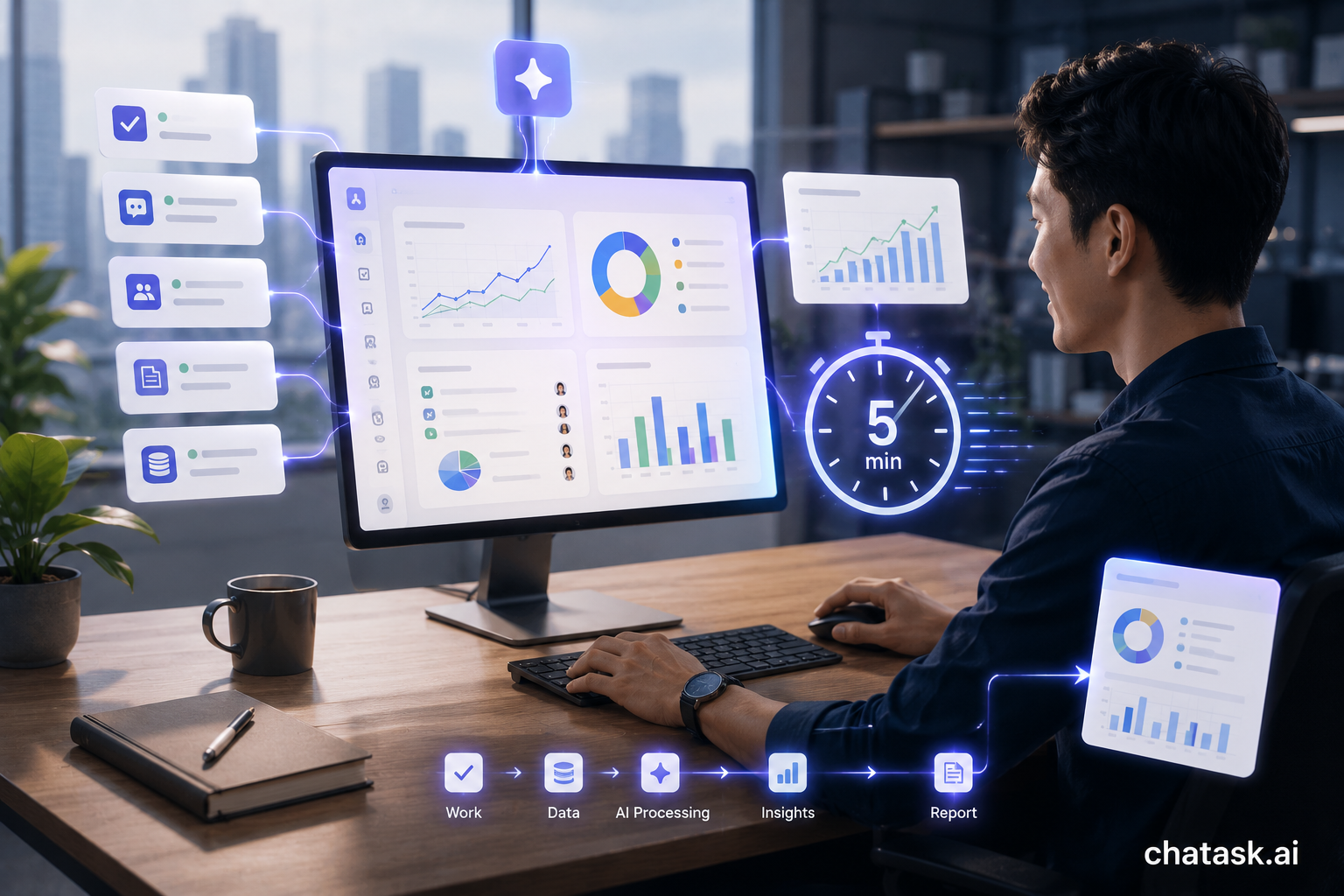
This is why AI Insight Widget does more than help businesses create reports faster. More importantly, it transforms reporting from a periodic administrative task into a natural part of daily operations. And when data is always available, generating a report in five minutes no longer seems unrealistic.
Because the hardest part of reporting has never been writing. It has always been finding the right data to write about.