During each admissions season, schools may receive hundreds of applications from many different sources. Some parents register through the school website, while others leave their information after an Open Day, contact the school through social media, call directly, or visit the school for consultation.
From the moment parents begin the application process until their child officially enrolls, each application must go through multiple stages. If even one step is not closely tracked, documents may be missing, assessments may be delayed, interview appointments may be missed, or follow-ups may not happen at the right time.
Therefore, school admissions management is not simply about how many applications a school receives. More importantly, the school needs to know where each application currently stands, what is still missing, and what needs to happen next.
What Does School Admissions Management Include?
School admissions management is the process of tracking the entire student journey, from the moment parents first show interest and submit an application, through document completion and assessment, until the student meets the requirements and officially enrolls.
Throughout this journey, schools need to manage student information, application documents, appointments, assessment results, tuition payments, communication with parents, and related internal tasks at the same time. Admissions management, therefore, is much more than simply managing a list of students.
As the number of applications grows, an Excel spreadsheet may tell the school how many applications it has, but it can be difficult to see the complete status of each individual case. This is where the admissions process needs to be organized into clear stages.
A Student Application Actually Goes Through Many Steps
A student's journey may begin when their parents leave their contact information after a school event. After receiving consultation, the parents submit an application, provide the required documents, add any missing paperwork, have their child participate in an assessment, and finally complete the enrollment process.
A basic admissions workflow might look like this: Interest → Application → Documents Complete → Assessment → Accepted → Enrolled
Problems arise when each step is managed in a different place. The application list may be stored in Excel, documents in folders, interview schedules shared through chat, while assessment results are updated by another department.
The information still exists, but answering the question, "What stage is this student's application currently at?" may require the admissions team to check several different sources.

How Can Schools Avoid Missing Admissions Applications?
To reduce the risk of applications being overlooked, each application needs a clear status, an assigned person, and a defined next step. Whenever the status changes, the information should be updated throughout the process so that everyone involved can see the latest situation.
With ChaTask, schools can organize the entire admissions season within a Project and manage applications according to each stage. By looking at the workflow, the admissions team can see which students have just applied, which applications are complete, which cases are under assessment, and which students have confirmed their enrollment.
The important point is that the team does not simply see a list of applications. They can also see how each application moves through the entire admissions journey.
Some Applications Are Not Lost, but They Become "Stuck"
A student may have applied but still not submitted a birth certificate after three days. Another application may already be complete but has not yet been scheduled for an interview, while an accepted student may still have unfinished enrollment procedures.
These applications are still on the list, so technically, they have not been "lost." However, without a mechanism for tracking status, they can remain stuck in the process without the admissions team noticing in time.
When there are hundreds of applications, remembering every individual case is nearly impossible. The system needs to help the person in charge identify which applications are delayed, which require action, and which tasks should be prioritized.

Missing Documents Should Be Identified as Early as Possible
Checking application documents is one of the most time-consuming parts of the admissions process. Depending on each school's requirements, an application package may include many different documents and forms.
If applications are checked manually only at the end of the process, missing documents may be discovered too late. The admissions team then has to contact parents, request additional documents, and wait for updates before the application can move forward.
An AI Agent can help compare submitted documents against the school's application requirements. Cases with missing documents, incomplete information, or items requiring additional submission can be identified earlier, allowing staff to address them while the admissions process is still underway.
How Can AI Support the School Admissions Process?
AI in admissions can help review applications, retrieve information, track cases that require attention, and summarize data for management purposes. Instead of operating as a separate chatbot, AI can participate directly in specific steps of the admissions workflow.
For example, AI can help identify applications with missing documents, compile student lists by status, or answer questions based on updated admissions data. This allows staff to spend less time on manual checking and focus on cases that genuinely require attention.
AI does not replace decisions made by the admissions team or school leadership. Its value lies in helping people identify issues earlier and access the information they need to make decisions.

Don't Let Important Admissions Milestones Exist Only on the Calendar
An admissions season usually includes many important dates: Open Days, application deadlines, interview dates, assessment sessions, result announcement dates, and tuition payment deadlines.
Each milestone is more than just a date on the calendar. It also comes with a series of tasks that need to be completed. Before an interview day, for example, the school needs to know which students will attend, whether their applications are complete, and whether their parents have received the necessary information.
When schedules, applications, and tasks are connected, the admissions team can see not only which deadlines are approaching, but also what needs to be completed before those deadlines arrive. Cases requiring follow-up can also be flagged or reminded instead of relying entirely on individual staff members' memory.
What Can an Admissions Funnel Tell a School?
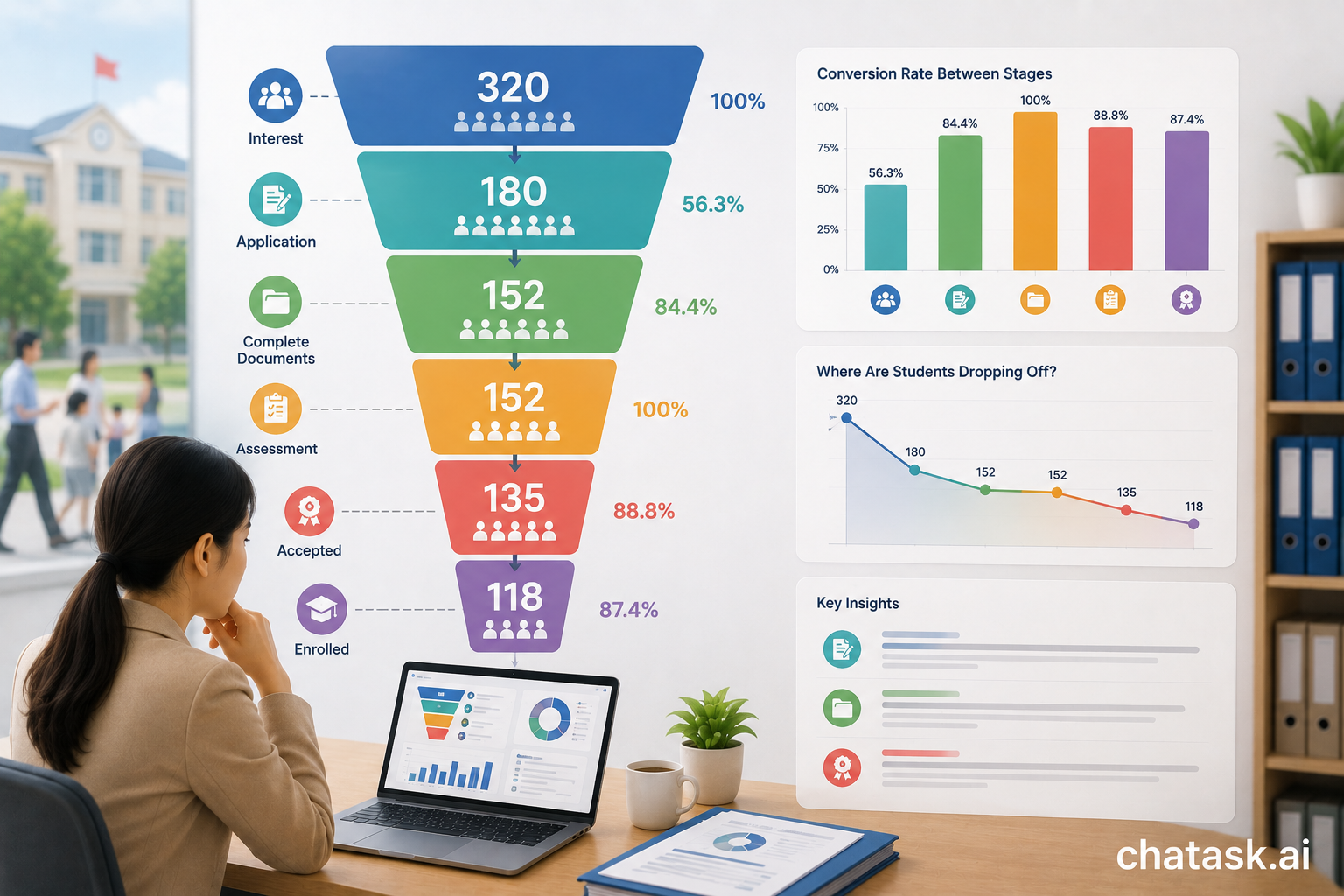
An admissions funnel shows how many students move through each stage of the admissions process, from initial interest to final enrollment. It helps schools understand not only the total number of applications but also the conversion rate between stages.
For example, an admissions season might look like this:
320 interested → 180 applied → 152 completed applications → 152 assessed → 135 accepted → 118 enrolled
If many parents show interest but only a small number submit applications, the school may need to review its consultation process. If many students apply but do not complete their documents, the issue may lie in document instructions or the follow-up process.
If many students are accepted but do not ultimately enroll, that indicates a different issue altogether. Looking at the admissions funnel helps schools identify where the largest drop-off occurs, rather than focusing only on the final enrollment number.
Do School Leaders Need to Wait for Reports to Understand Admissions Progress?
When admissions data is updated as work happens, reporting does not necessarily have to begin with manually compiling another Excel spreadsheet. A dashboard can show the number of applications at each stage, document status, and cases that currently require attention.
School leaders can monitor the overall picture while the admissions team continues working with individual applications. The same data source can support different roles at the level of detail each one needs.
AI can also help summarize data and answer questions such as "How many applications are still missing documents?", "How many students are waiting for assessment?", "Which accepted students have not yet enrolled?", or "Which stage currently has the lowest conversion rate?"
From Managing Individual Applications to Optimizing the Entire Admissions Season
When applications, statuses, tasks, schedules, and results are connected, the data does more than support the current admissions season. Schools can also review the entire journey to understand how effectively their admissions process is working.
Which sources generate the most applications? How many parents move from initial interest to submitting an application? At which stage are applications most often delayed? What is the conversion rate from acceptance to enrollment? These insights can become a foundation for improving the admissions process in the next season.
With ChaTask, the goal is not simply to move an admissions list from Excel into another system. It is to connect applications, tasks, conversations, schedules, documents, AI, and reports into one continuous journey from application to enrollment.
As a result, schools do not have to wait until parents ask for an update to discover that an application is incomplete, nor do they have to wait until the end of the day to understand the current admissions situation. Each application can have a clearer status, next step, and responsible person, helping reduce the risk of applications being overlooked throughout the admissions season.