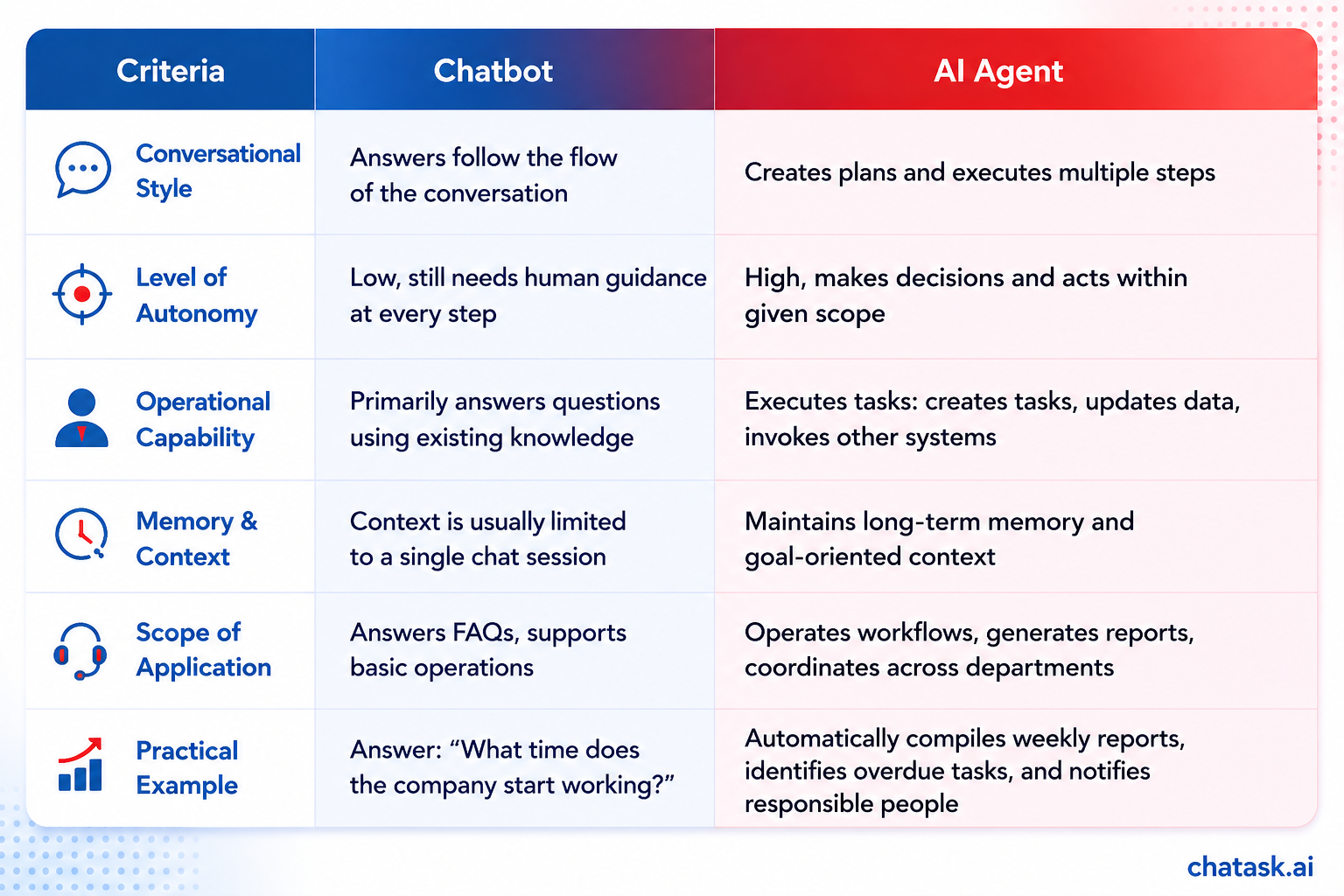
An AI Agent is an AI system capable of independently planning, making decisions, and executing multi-step tasks without requiring human intervention at every step, while a Chatbot primarily answers questions based on predefined scripts or individual conversational turns. Simply put: a Chatbot “talks,” while an AI Agent “works.” This is the fundamental difference driving more businesses to move from chatbot-based assistance toward AI Agents for true process automation.
In this article, ChaTask will explain what an AI Agent is, provide a detailed comparison with Chatbots, and show when businesses should use each tool.
What Is an AI Agent?
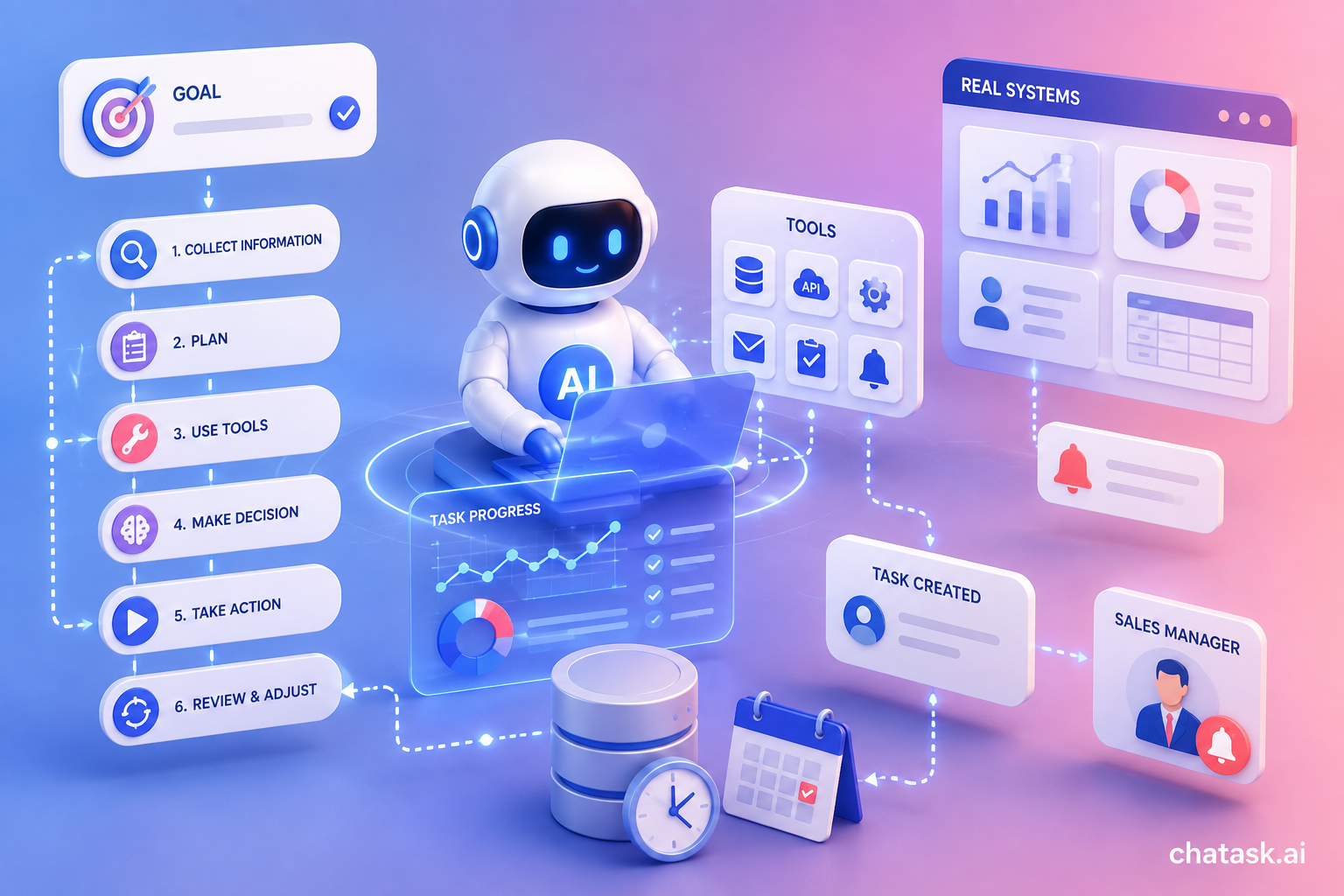
An AI Agent is an AI program given a certain level of autonomy to achieve a specific goal through multiple steps: gathering information, planning, using tools, making decisions, and taking actions in real-world systems - then evaluating the results and adjusting its approach when necessary.
Three characteristics define a true AI Agent:
-
Autonomy: An AI Agent can break down a complex request into smaller steps and execute them sequentially without requiring human guidance at every stage.
-
Tool use: An AI Agent can query data, call APIs, update systems, create tasks, and send notifications - meaning it can take action in real systems rather than simply generate text responses.
-
Context retention and self-adjustment: An AI Agent can track work progress, compare results against the original goal, identify errors or missing information, and adjust its course accordingly.
For example, instead of asking, “What is this month’s revenue?” and receiving a static answer, an AI Agent can be assigned a task such as: “Monitor this week’s revenue. If it drops by more than 10% compared with last week, create an alert task for the Head of Sales.” The AI Agent can then execute the entire sequence of actions on schedule without anyone having to remind it.
What Is a Chatbot?
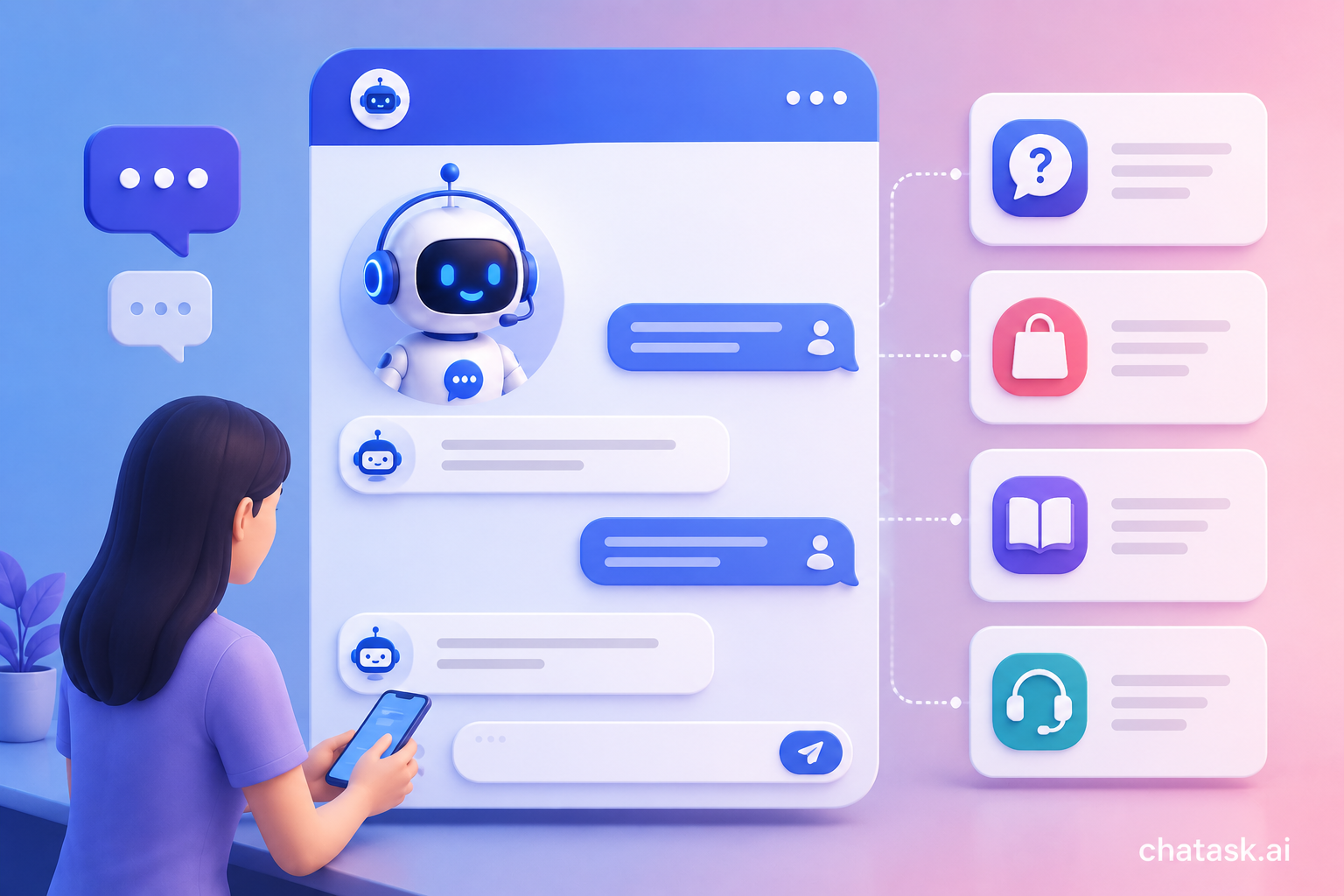
A Chatbot is a program designed to simulate conversations with users. It typically operates based on predefined rules or language models to answer questions within the scope of its training. A Chatbot generally handles each question-and-answer interaction independently, does not autonomously plan multi-step processes, and usually cannot proactively take action in other systems unless it has been specifically programmed for a particular scenario.
Chatbots are well suited to repetitive tasks with a clearly defined scope, such as answering FAQs, providing basic product advice, offering usage instructions, and handling first-level customer support.
AI Agent vs. Chatbot Comparison
When Should Businesses Use a Chatbot, and When Should They Use an AI Agent?
Use a Chatbot when:
-
You need quick answers to repetitive questions, such as FAQs, policies, or usage instructions.
-
The task is simple and does not require accessing or modifying data in other systems.
-
You want a fast, low-cost deployment for a specific scenario.
Use an AI Agent when:
-
You need to automate a multi-step process, for example: receiving a request → checking data → creating a task → tracking progress → compiling a report.
-
You need AI to proactively identify problems and take action instead of waiting to be asked.
-
You want to reduce repetitive operational work for managers and employees rather than simply support information retrieval.
In practice, many businesses do not choose one or the other. Instead, they combine both: the Chatbot handles the first layer of user interaction, while the AI Agent works behind the scenes to carry out actual tasks based on those requests.
Applications of AI Agents in Business
-
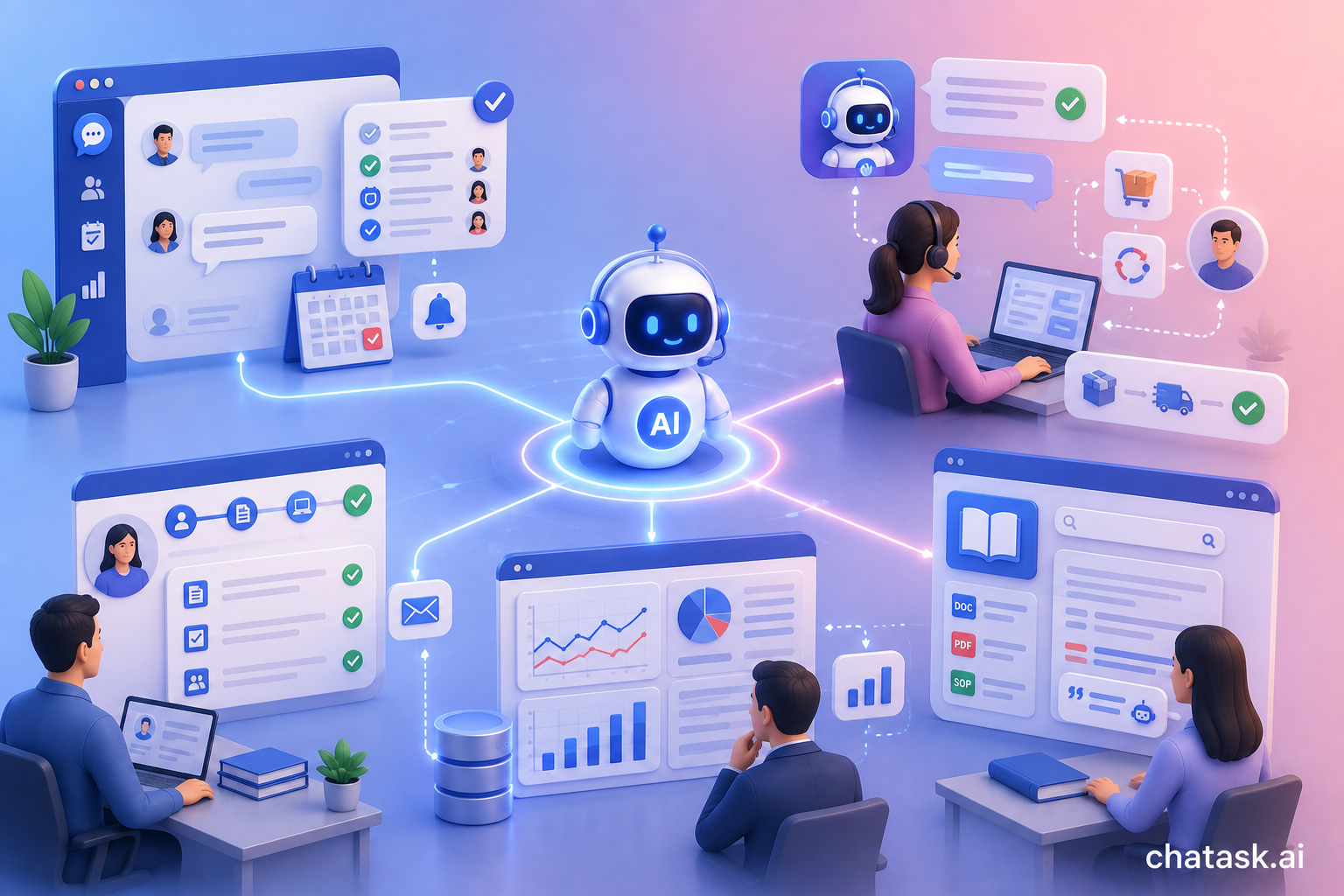
Task & project management: AI Agents automatically create tasks from chat conversations, assign responsible team members, send deadline reminders, and summarize progress without managers having to wait for manual reports.
-
Advanced customer service: Instead of simply answering questions, AI Agents can automatically look up orders, update processing statuses, and escalate cases to the appropriate person when they fall outside the Agent’s scope.
-
Human Resources (HR): AI Agents can automate onboarding processes—from sending documents and creating work checklists for new employees to reminding them of important milestones and deadlines.
-
Data analysis and reporting: AI Agents connect directly to business data, automatically compile information, and answer management questions whenever needed instead of waiting for end-of-week reports.
-
Internal knowledge management (Wiki): AI Agents can search internal documents and SOPs and provide answers with source citations, enabling employees to find information independently without repeatedly asking colleagues.
Benefits of Implementing AI Agents in Business
-
Reduce time spent on repetitive operations: Manual and time-consuming tasks such as compiling reports, sending reminders, and categorizing requests can be handled automatically by AI Agents.
-
Make decisions faster: Managers can get answers when they need them without waiting for data to be manually compiled.
-
Reduce accountability gaps: AI Agents help ensure that every task has a clearly assigned owner and is tracked through completion, reducing situations where everyone assumes “someone else is handling it.”
-
Scale without proportionally increasing operational headcount: A single AI Agent can handle multiple workflows simultaneously, making it suitable for fast-growing businesses.
This is also why the AI Workspace model - where Chat, Task, AI Agents, and Wiki are integrated into a single workspace - is becoming an alternative to using multiple disconnected tools. AI Agents in ChaTask operate directly within a company’s daily conversations and workflows: tracking progress, automatically creating tasks from conversations, and supporting decision-making based on the organization’s actual data.