In many businesses today, chat has become the primary communication tool in daily work. Employees communicate through internal messaging platforms, group chat applications, or even personal messaging tools. These conversations usually happen quickly and conveniently, allowing people to respond almost immediately. However, that same convenience also creates a common problem in business operations. People discuss many tasks in chat but later forget, overlook, or fail to carry them out as originally intended.
This phenomenon is often called “lost tasks in chat." A task is mentioned in a conversation; everyone understands that it needs to be done, but afterward no one tracks it, no one is clearly responsible, and eventually the task disappears among hundreds of other messages. For many businesses, this type of behavior is not a minor issue but one of the main reasons why work progress slows down, projects are prolonged, and productivity declines.
To understand why this happens, it is necessary to look at how organizations communicate and operate work in the digital environment.
The explosion of communication tools is causing information to become increasingly fragmented
Recently, businesses have been using more and more different communication tools. Employees may receive information through email, internal chat, video calls, project groups, or other messaging applications. Each tool has its own role, but in reality the boundaries between them are often unclear, leading to confusion and potential miscommunication among employees regarding which tool to use for specific tasks.
Research on communication in the workplace shows that employees now spend an average of about 20 hours per week using digital communication tools such as email, chat, or online meetings. At the same time, nearly half of workers say their productivity is affected by ineffective communication.
When work-related information appears across many different channels, tracking it becomes much more difficult. A work request might be mentioned in a meeting, repeated in a group chat, and then sent again through email. Without a clear management system, employees can easily overlook or misunderstand their tasks.
In that context, chat becomes the place where most discussions happen quickly but without structure. Work is mentioned as part of a conversation rather than as a formal task that needs to be tracked.
The huge volume of messages causes important information to sink
One of the biggest reasons tasks get lost in chat is the massive volume of messages. When a team communicates continuously, important information can easily be pushed upward and disappear from everyone’s view.

Surveys on workplace communication show that about 78 percent of employees feel overloaded by the number of notifications from communication tools. Many people have to deal with between 21 and 40 notifications each day, and sometimes even more in technical or support roles.
In such an environment, keeping track of every conversation becomes almost impossible. A work request sent in the morning may sink among dozens of other messages within minutes. If the recipient does not remember or record it in time, the task can easily be forgotten.
This phenomenon has also been observed in research on workplace chat platforms. As the number of channels and messages increases, identifying which information is important becomes more difficult. Essential information is sometimes hidden by less important discussions.
As a result, many tasks are mentioned but not carried out simply because they disappear within the message stream.
Traditional chat tools such as Zalo or Telegram were not designed for task management
Another core issue lies in the nature of chat itself. Chat is designed for fast communication, not for managing work.

In a conversation, people usually speak in chronological order. New messages constantly appear and push older content downward. This works well for instant communication but is not suitable for storing or tracking tasks.
When a task is assigned through chat, it usually exists as a sentence within a conversation. For example, a manager might write, “Please send me the report this afternoon." That sentence is understood as a task, but no system records it as an official task.
If the recipient is busy with other work, does not reply immediately, or does not note it down, the task can easily be missed. After a few hours the conversation may have moved through dozens of messages, and no one sees the original request anymore.
Essentially chat stores information in conversational form, while work needs to be stored in the form of tasks with responsible owners, deadlines, and status. When these two things are not connected, losing tasks becomes almost inevitable.
The culture of quick responses interrupts execution
Another factor that causes tasks to be lost is the culture of always being online. In many organizations employees are expected to respond to messages almost immediately. This causes people to constantly check notifications instead of focusing on deep work.
Research on modern work environments shows that the always-connected culture leads to continuous interruptions. Some studies even indicate that workers face hundreds of interruptions every day from messages, emails, and meetings.
When people constantly switch between reading messages and doing work, their ability to focus decreases significantly. A task that has just been mentioned in chat can be forgotten shortly afterward when a series of new notifications appears.
In addition, the need to respond quickly often leads people to skim information. They might reply “ok” or “received” without actually remembering that it is a task that needs to be completed.
Lack of clear ownership
In chat, many discussions happen in groups rather than between two individuals. This allows everyone to stay updated but also creates another problem. Sometimes it is unclear who is responsible for carrying out the work.

For example, a message might say, “The marketing team, please review this content." In that case, many people read the message, but no one is certain that the task belongs to them.
This phenomenon is often referred to as diffusion of responsibility. When many people receive the same information, each person tends to assume someone else will handle it. As a result, in the end, no one does it.
Research on workplace communication also shows that poor coordination and communication are among the main causes of problems at work. As many as 86 percent of employees and managers say that workplace problems often stem from ineffective communication or collaboration.
In a chat environment, if there is no mechanism to clearly identify the person in charge, tasks can easily fall into a state where no one takes responsibility.
Misunderstandings in written communication
Chat is written communication, so it lacks many important elements of face-to-face communication, such as tone, facial expression, or context.
A recent study found that 66 percent of employees say they have experienced misunderstandings or confusion in workplace communication. Nearly half say these misunderstandings sometimes lead to missed deadlines or delayed project progress.
In chat, a short sentence can be interpreted in different ways. One person may think it is only a suggestion, while another understands it as a task that must be done immediately.
This ambiguity causes many tasks not to be carried out as originally expected.
Traditional chat leads businesses to confuse communication with task management
A bigger issue lies in how many businesses use their work tools. Many organizations use chat as the central tool for all activities. From discussion and information exchange to assigning work and tracking progress, everything happens within the same conversation stream.
This causes communication and task management to become mixed together. While communication can happen naturally and without structure, work needs to be managed clearly.
If a business relies only on chat to operate, it is using a communication tool for a purpose it was not designed to perform.
When lost tasks become a systemic problem
Many businesses consider forgetting a few small tasks to be normal. However, when this phenomenon happens frequently, it can become a systemic problem.
One forgotten task can delay the progress of an entire project. One missed piece of information can cause a team to work in the wrong direction for several days. When these situations repeat many times, the cost in time and resources becomes very significant.
In reality most of the problem does not lie with people but with how the work system is designed. When communication and work are not clearly connected, losing tasks becomes difficult to avoid.
Conclusion
Chat has become an indispensable part of the modern workplace. It makes communication faster, more flexible, and more convenient for distributed teams. However, when chat becomes the only place for discussion and task assignment, many problems begin to appear.
Large volumes of messages, lack of structure in information, misunderstandings in communication, and unclear responsibility are factors that cause many tasks to disappear after being mentioned in chat. As businesses increasingly depend on digital communication, redesigning the way work is managed becomes more important than ever. If communication and work are not connected within the same system, lost tasks will continue to occur and directly affect both progress and operational efficiency within organizations.
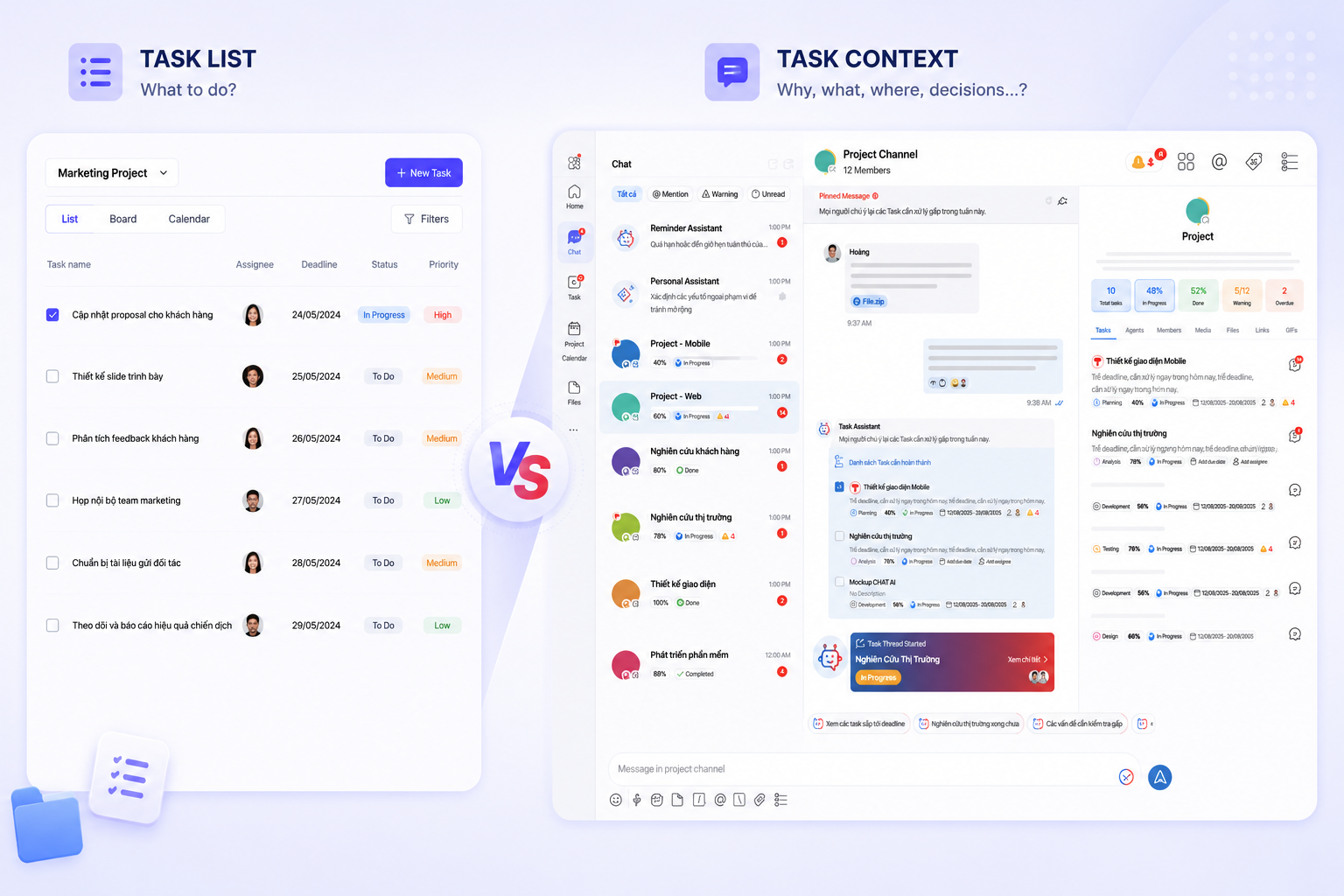
Therefore, ChaTask was built to solve exactly this problem. Instead of allowing tasks to exist only within conversations, ChaTask allows discussion content to be converted directly into tasks with clear owners, deadlines, and status right inside the conversation. As a result, important discussions do not stop at communication but can be tracked as concrete work, helping businesses reduce the problem of lost tasks and manage progress more effectively.
Register for a demo here.