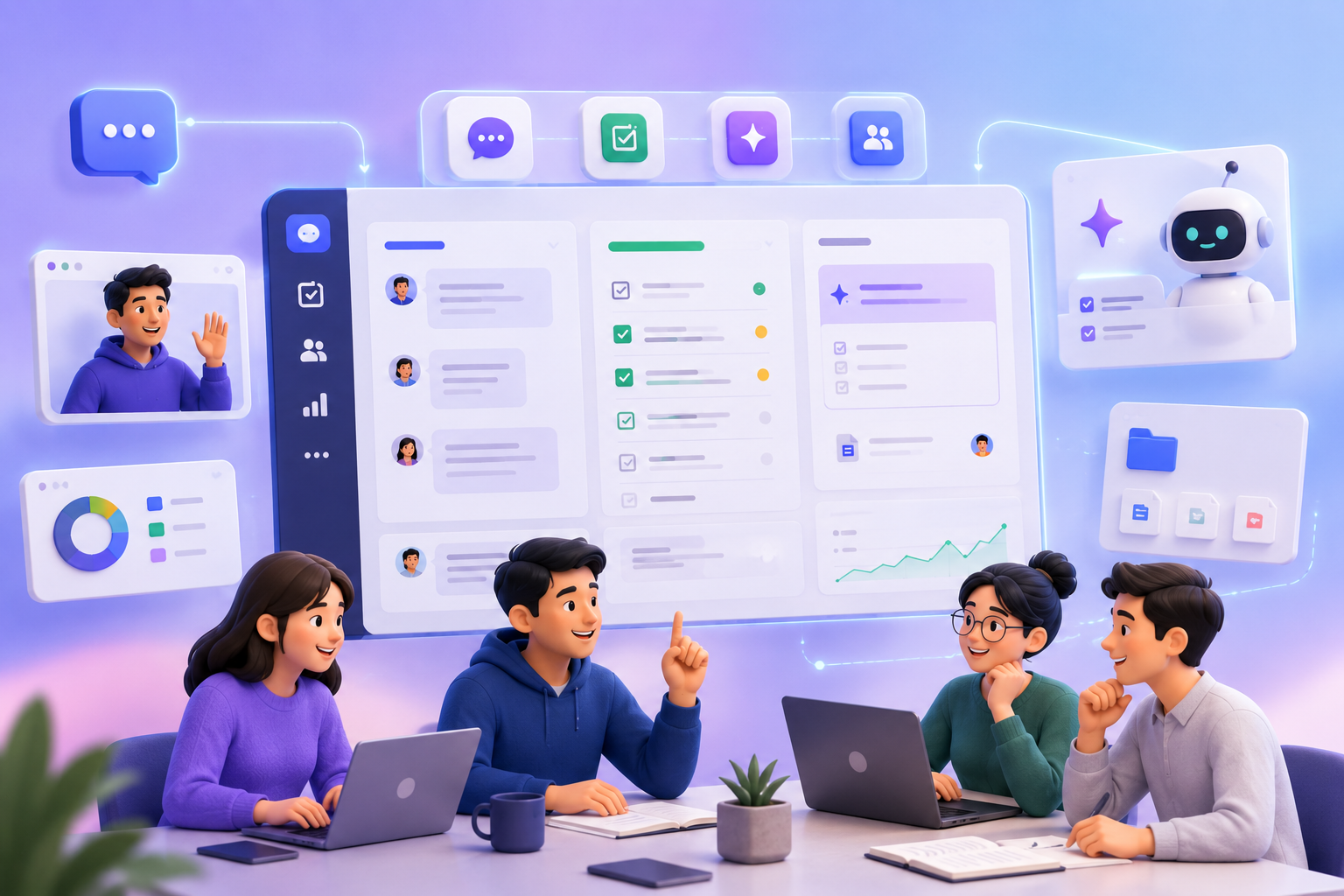
When an employee opens a new task titled "Update the proposal for the client," everything appears to be in place. The deadline has been set, the assignee has been assigned, and the task status has already been configured.
However, before they can actually begin working, they still need answers to several questions. What changes did the client request? Which points were agreed upon during last week's meeting? Where is the latest version of the document? Are there any special notes from the sales team?
The reality is that work often cannot begin the moment a task is created. In many cases, the most time-consuming part is reconstructing the context behind the task. The task itself already exists, but the context is scattered across chat conversations, documents, emails, or even stored in the minds of a few team members.
This is why more and more organizations are realizing that the problem is not a lack of tasks. The problem is that tasks have become disconnected from their context.
When Tasks Become Detached from Conversations
Most work within an organization begins with a conversation. It could be a customer message, an internal meeting, an email, or simply a discussion among team members.
The problem arises when the conversation exists in one place while the task is created somewhere else. Once the task is created, much of the original context is left behind. The person responsible for the work often sees only a task title, a deadline, and a brief description.
Over time, the gap between what was discussed and what needs to be executed continues to grow. Employees repeatedly search through old messages, ask colleagues for clarification, or switch between multiple systems to piece together the information they need.
Context Is What Drives Productivity
Many productivity studies have shown that the biggest cost in knowledge work is not execution itself, but context switching. Every time employees need to search for information or move between different tools, they spend additional time and mental energy rebuilding their understanding of the task at hand.
This is why two tasks with the same workload do not always require the same amount of time to complete. A task with complete context can often be finished much faster than a task where the employee must first reconstruct all the missing information.

Task Lists Help Track Work, Task Context Helps Complete Work
A task list is designed to answer one question:
"What needs to be done?"
But for work to actually get completed, organizations also need answers to questions such as:
-
Why does this task exist?
-
Who requested it?
-
What decisions have already been made?
-
Where are the relevant documents?
-
How does this task impact other work?
Those answers make up the task's context.
When context is lost, a task becomes nothing more than a line item in a system. When context is preserved, a task becomes part of a complete workflow that anyone involved can quickly understand and continue executing.
AI Agents Need Context Too
This is true not only for people, but also for AI.
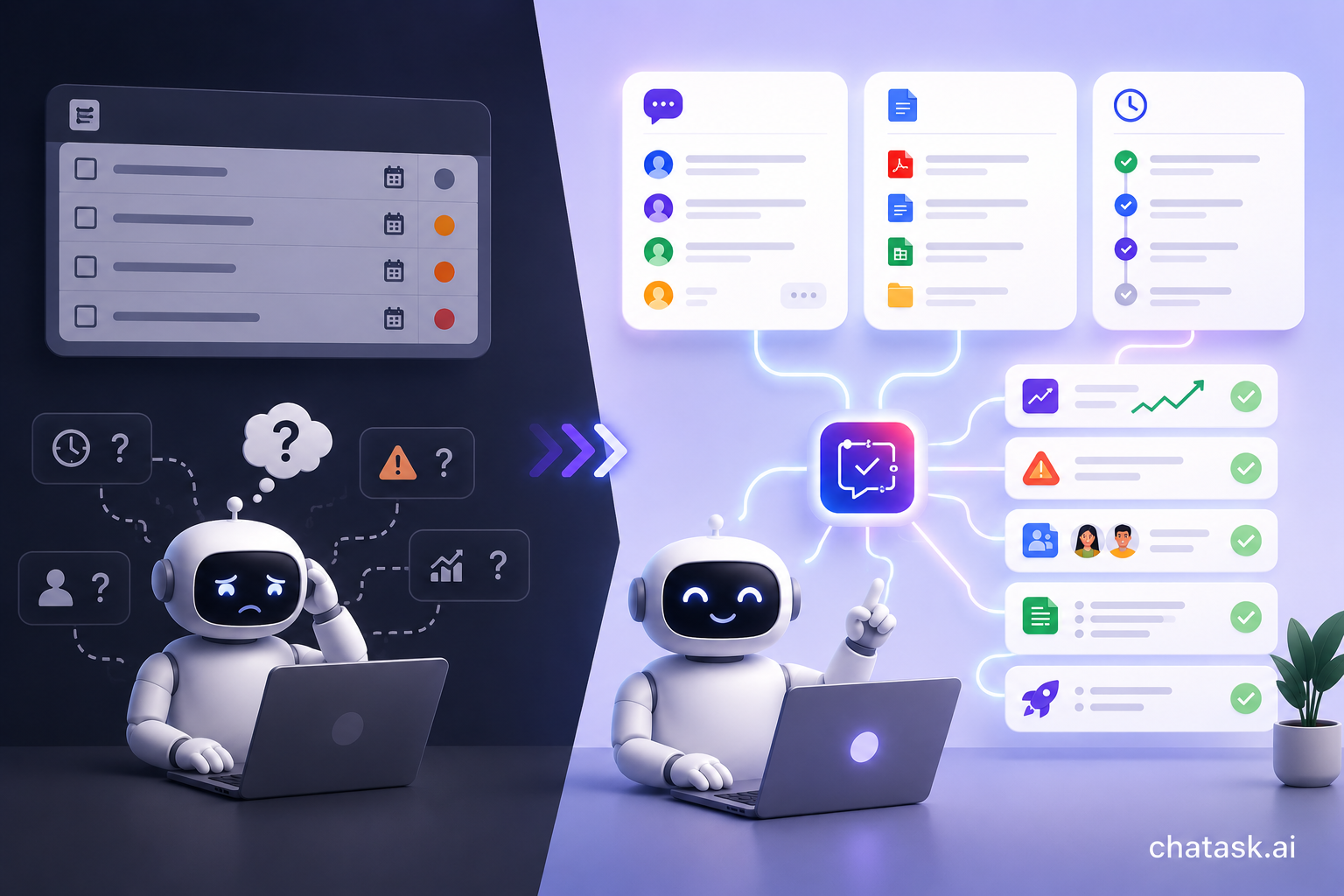
An AI Agent that only sees a list of tasks will struggle to understand real priorities, potential risks, or commitments that have already been made to customers.
On the other hand, if AI has access to conversations, documents, and the history of work execution, it can provide much more accurate and valuable assistance.
AI can automatically track progress, detect potential delays, remind the right people at the right time, summarize project status, or recommend next actions. All of these capabilities depend on context, not simply on a list of tasks.
From Task Management to Context Management
For years, work management software has focused on creating tasks, assigning owners, and tracking progress. These capabilities remain important, but they are no longer sufficient for modern work environments.
As organizations operate across multiple departments, projects, and increasingly collaborate with AI Agents, what needs to be managed is not only the task itself but also the entire context surrounding it.
That is why many organizations are moving from a Task Management mindset to a Context Management mindset. The goal is no longer simply to store work items, but to ensure that work remains connected to the conversations, documents, decisions, and data that give it meaning.
Conclusion
Tasks help organizations understand what needs to be done. Context helps people and AI understand how to do it.
In an increasingly complex work environment, a task list alone is no longer enough. Organizations need a system where tasks remain connected to conversations, documents, and the history of work execution.
The future of workflow is not about creating more tasks. It is about preserving the context of work from the moment an idea is discussed until the final outcome is delivered.