A few years ago, enterprise AI adoption often began with a chatbot that answered questions. Today, AI Agents can become more deeply involved in work: reading and summarizing documents, analyzing data, creating tasks, tracking progress, sending reminders, or preparing reports for managers.
Therefore, the question businesses ask is no longer simply, “Does AI work?” What they need to determine is: What value does an AI Agent create, what is the actual cost, and how long will it take the business to recover its investment?
Why Should ROI Be Calculated Before Implementing AI Agents?
AI is being used more widely, but enterprise-wide financial value remains uneven. McKinsey’s State of AI 2025 survey shows that 88% of organizations regularly use AI in at least one business function, yet nearly two-thirds have not moved into the enterprise-wide scaling stage.
For AI Agents, 23% of organizations reported that they had begun scaling deployment in at least one function, while 39% were still at the experimentation stage. Only 39% of survey respondents reported that AI had an impact on EBIT at the enterprise level. Organizations that generate substantial value tend not only to add an AI tool, but also to redesign the workflows surrounding it. McKinsey – The state of AI in 2025
This shows that “using AI” does not necessarily mean “generating ROI.” Without defining the business problem and measurement method from the beginning, a company can easily deploy numerous features without knowing which ones truly reduce costs or improve business outcomes.

AI Agent ROI Does Not Come Only From Reducing Headcount
A common approach is to convert the benefits of AI Agents into the number of work hours saved. However, measuring only this criterion can cause businesses to overlook other important sources of value.
AI Agent ROI generally comes from four groups of benefits:
1. Reducing the Time Spent on Repetitive Work
AI Agents can help compile reports, find information, classify requests, create tasks, or remind people about items approaching their deadlines. Employees no longer need to continually copy data, check multiple tools, or repeat the same actions every day.
This value can be measured by multiplying the number of hours saved each month by the hourly labor cost of the people involved in the process.
2. Reducing Costs Caused by Delays and Errors
A forgotten task, an untracked approval request, or the use of an outdated document version can all generate costs. AI Agents help identify cases requiring attention early, but a business can only recognize this benefit if it has clearly established the cost of errors before implementation.
For example, instead of measuring only how many reminders the Task Follow-up Agent has sent, the business should track the overdue-task rate, response waiting time, and number of interrupted work items before and after using the Agent.
3. Increasing Processing Capacity Without a Proportional Increase in Headcount
As workloads increase, businesses often need to hire more people or allocate additional overtime. AI Agents can take on part of the repetitive work, enabling teams to handle more requests with their existing workforce.
This benefit can be measured through the number of requests processed per employee, average processing time, or cost per request.
4. Improving Decision Quality
The value of AI Agents is not limited to execution speed. When work data is continuously consolidated, managers can identify overdue tasks, at-risk projects, or poorly distributed workloads earlier.
These values can be difficult to convert directly into money in the short term, but they can be measured through report preparation time, issue-response speed, and the on-time completion rate.
What Costs Does a Business Actually Have to Pay?
The cost of implementing AI Agents is not limited to platform subscription fees. To calculate ROI accurately, businesses need to consider the entire lifecycle, from data preparation to ongoing operations.
|
Cost category |
Items to include |
|
Platform |
Account fees, number of users, Agents, or level of AI usage |
|
Process setup |
Business analysis and the design of triggers, actions, and exception cases |
|
Data |
Document standardization, access control, and the removal of duplicate or outdated content |
|
Integration |
Connections with CRM, accounting software, data warehouses, or other tools currently in use |
|
Training and habit change |
User training and adjustments to cross-departmental coordination processes |
|
Operations |
Monitoring results, checking deviations, updating knowledge, and refining Agents |
|
Risk control |
Access permissions, action history, data security, and approval mechanisms |
The cost most likely to be overlooked is often the internal team’s own time. Business owners still need to review processes, standardize data, test results, and handle cases in which the Agent cannot yet make decisions independently.
If a business includes only the subscription fee in the formula, the calculated ROI will be higher than the actual result.
AI Agent ROI Formula for SMEs
Businesses can begin with the basic formula:
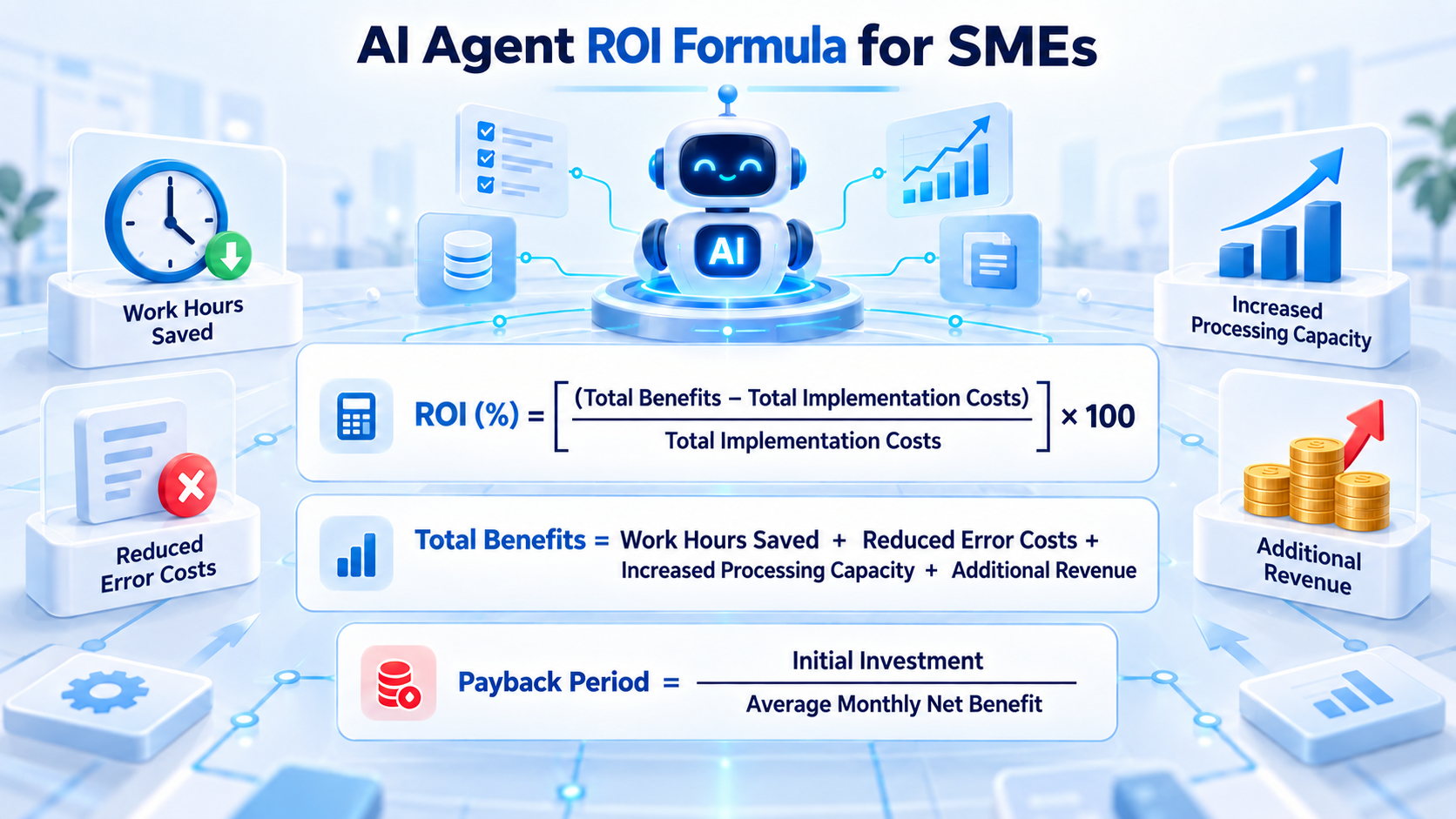
These two metrics should be used together. A project may have a high first-year ROI, but if it requires a very large initial investment, it can still create cash-flow pressure for a small business.
Example: Calculating ROI for a 15-Employee Service Company
Suppose a company implements AI Agents for three activities: answering questions based on internal documents, tracking tasks, and compiling weekly reports.
First-year costs include VND 36 million in platform fees, VND 15 million for data and process setup, and VND 9 million for training, monitoring, and adjustments. The total cost is VND 60 million.
After implementation, the company records the following results:
-
80 hours saved each month on finding documents, consolidating progress, and following up on work.
-
An average hourly labor cost of VND 80,000.
-
A reduction of approximately VND 2 million per month in costs caused by delayed processing, rework, or missed information.
The value generated in one year is:
80 × 80,000 × 12 = VND 76.8 million
76.8 + (2 × 12) = VND 100.8 million
The ROI is therefore:
ROI = ((100.8 − 60) / 60) × 100 = 68%
Accordingly:
ROI = [(100.8 − 60) / 60] × 100 = 68%
The average monthly net benefit is approximately VND 3.4 million after allocating the first-year costs. If the benefits are generated relatively consistently, the company can recover its investment within approximately 7–8 months.
This is only an illustrative calculation. When applying it in practice, businesses should use their own operational data and avoid including benefits that are difficult to verify.
An Agent With High ROI Is Not Necessarily the “Smartest” Agent
The most suitable process for the first implementation is usually not the most complex one. It should be work that occurs frequently, has relatively clear inputs, consumes considerable time, and produces outcomes specific enough to measure.
Businesses can evaluate each process using four criteria:
|
Criterion |
Question to answer |
|
Frequency |
How many times does the work occur each day or week? |
|
Time |
How many hours does the team currently spend processing it? |
|
Degree of standardization |
Are the inputs, rules, and expected outcomes sufficiently clear? |
|
Impact |
What does the business lose if the work is delayed or handled incorrectly? |
A weekly reporting process that takes four hours but is repeated across several departments may generate clearer ROI than a complex process that occurs only a few times each year.
Three Reasons AI Agent ROI Falls Short of Expectations
Choosing a Use Case Based on Features Instead of a Business Problem
Businesses can easily be attracted to an Agent capable of performing many actions without first determining which costs those actions are intended to address. As a result, the Agent is used during the trial stage and then gradually abandoned.
Each use case should begin with a baseline such as current processing time, overdue rate, number of errors, or cost per request.
Insufficiently Clear Data and Processes
An AI Agent cannot operate reliably if documents contain duplicate versions, access rights have not been defined, or each employee performs the work differently. In this situation, AI does not eliminate inconsistency and may instead allow the problem to spread further.
Businesses do not necessarily need to standardize all their data before getting started. However, the data used for the first use case must be sufficiently clean and accurate, with someone responsible for keeping it up to date.
Automating Everything From the Beginning
Not every action should be handed over entirely to an Agent. Decisions involving finance, human resources, contracts, or sensitive data still require human control points.
A safer path is for the Agent to make a recommendation, a human to approve it, and the system to execute it. Once accuracy has been verified, the business can expand the level of automation.

Measuring ROI in Three Stages
To avoid waiting until the end of the year to determine whether the project is effective, businesses should divide the evaluation process into three stages.
Before implementation, the business records baseline data: workload, total processing time, number of errors, overdue rate, and current costs.
After 30-60 days, the business evaluates adoption, the percentage of cases handled correctly by the Agent, time saved, and the number of cases requiring manual intervention. This is the time to adjust the data, rules, and scope of the Agent.
After 3-6 months, the business calculates ROI based on actual results. A use case that creates strong value can be expanded, while an ineffective one should be redesigned or discontinued to prevent further costs.
Why Might AI Agents Within an AI Workspace Be More Suitable for SMEs?
A standalone AI Agent often needs to connect to multiple systems before it has enough data to work. Businesses must build integration flows, synchronize access rights, and address information scattered across different tools.
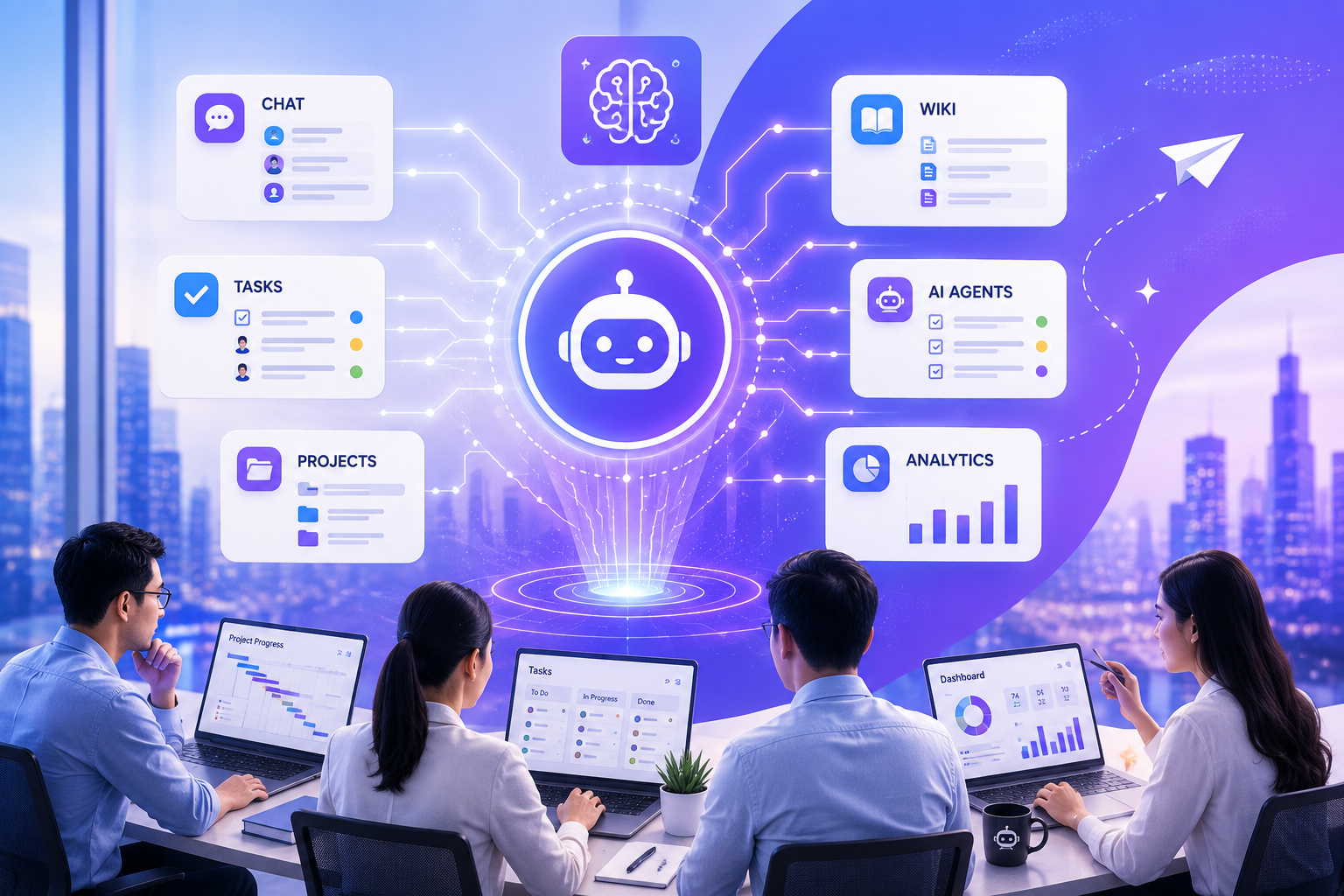
With an AI Workspace such as ChaTask, Chat, Task, Wiki, and AI Agents are placed within the same workspace. Agents can use data generated through conversations and work execution, reducing the need to re-enter or transfer data between tools.
For example, a message in a conversation can be converted into a task; the Task Follow-up Agent monitors points at risk of interruption; the Wiki QA Bot answers questions based on internal documents and provides source references; and the Report Agent consolidates task data into reports for managers.
This approach does not eliminate implementation costs. However, it can reduce the integration and operational costs that arise when each Agent resides in a separate tool, while also helping businesses observe which tasks AI is supporting and what results it is producing.

Checklist Before Investing in AI Agents
Before implementation, businesses should be able to answer the following questions:
-
Which process is consuming substantial time or frequently being interrupted?
-
Is baseline data available for comparison before and after implementation?
-
Do the total costs include setup, data, training, and operations?
-
Which actions may the Agent perform autonomously, and which require human approval?
-
Who is responsible for monitoring the quality of the Agent?
-
Which KPIs will be evaluated after 30 days, three months, and six months?
-
What conditions determine whether a use case should be expanded, adjusted, or discontinued?
If these questions cannot yet be answered, the business does not need to deploy AI Agents on a large scale. A small use case with a clear baseline is more suitable than a large project whose effectiveness cannot be demonstrated.
Conclusion
AI Agents can generate substantial benefits, but ROI does not come from simply owning another AI tool. Value emerges only when the Agent is placed within the right process, uses the right data, and is measured through indicators connected to business operations.
For small and medium-sized enterprises, a sensible implementation approach is to begin with a specific bottleneck, measure the results over 3–6 months, and only then expand. When Chat, Task, Wiki, and AI Agents are connected within the same workspace, businesses are also better positioned to reduce integration costs and bring AI closer to everyday work-instead of leaving it as an isolated experiment.