Agile, Scrum, and Kanban are often associated with software development, but their principles can also be applied to non-tech businesses. Marketing, HR, Sales, and Operations teams can adopt elements of Agile, Scrum, or Kanban to manage work more flexibly, as long as these methods are adapted to the realities of their workflows.
Businesses do not necessarily need to implement an entire framework or completely change how they work to become "Agile." What matters more is identifying the problems a team is facing and selecting the right principles to improve planning, collaboration, progress tracking, and the ability to respond to change.
What Is the Difference Between Agile, Scrum, and Kanban?
Agile is an approach that emphasizes adaptability to change, frequent value delivery, stronger collaboration, and continuous improvement in how work gets done. Agile is not a fixed process, nor is it synonymous with Scrum or Kanban.
Scrum is a framework that organizes work into short cycles called Sprints. Teams define a goal for each Sprint, select the work to be completed, regularly review progress, and evaluate results to make adjustments for the next cycle.
Kanban focuses more on the flow of work. Tasks are typically visualized according to their status, while teams can limit the amount of Work in Progress (WIP) to avoid starting too many tasks at once while completing too few.
This means a business can adopt an Agile mindset without fully implementing Scrum. A team can also use Kanban to manage its workflow without organizing work into Sprints.
Can Non-Tech Businesses Apply Agile?
Yes. Agile principles can be applied to many types of work beyond software development, particularly when priorities change frequently and teams need continuous feedback to adjust their plans.
For example, a Marketing team may plan a four-week campaign. After the first week, the data may show that one type of content is performing better than expected while another channel is underperforming, allowing the team to adjust its budget, content, and plans for the following weeks instead of continuing with the original plan unchanged.
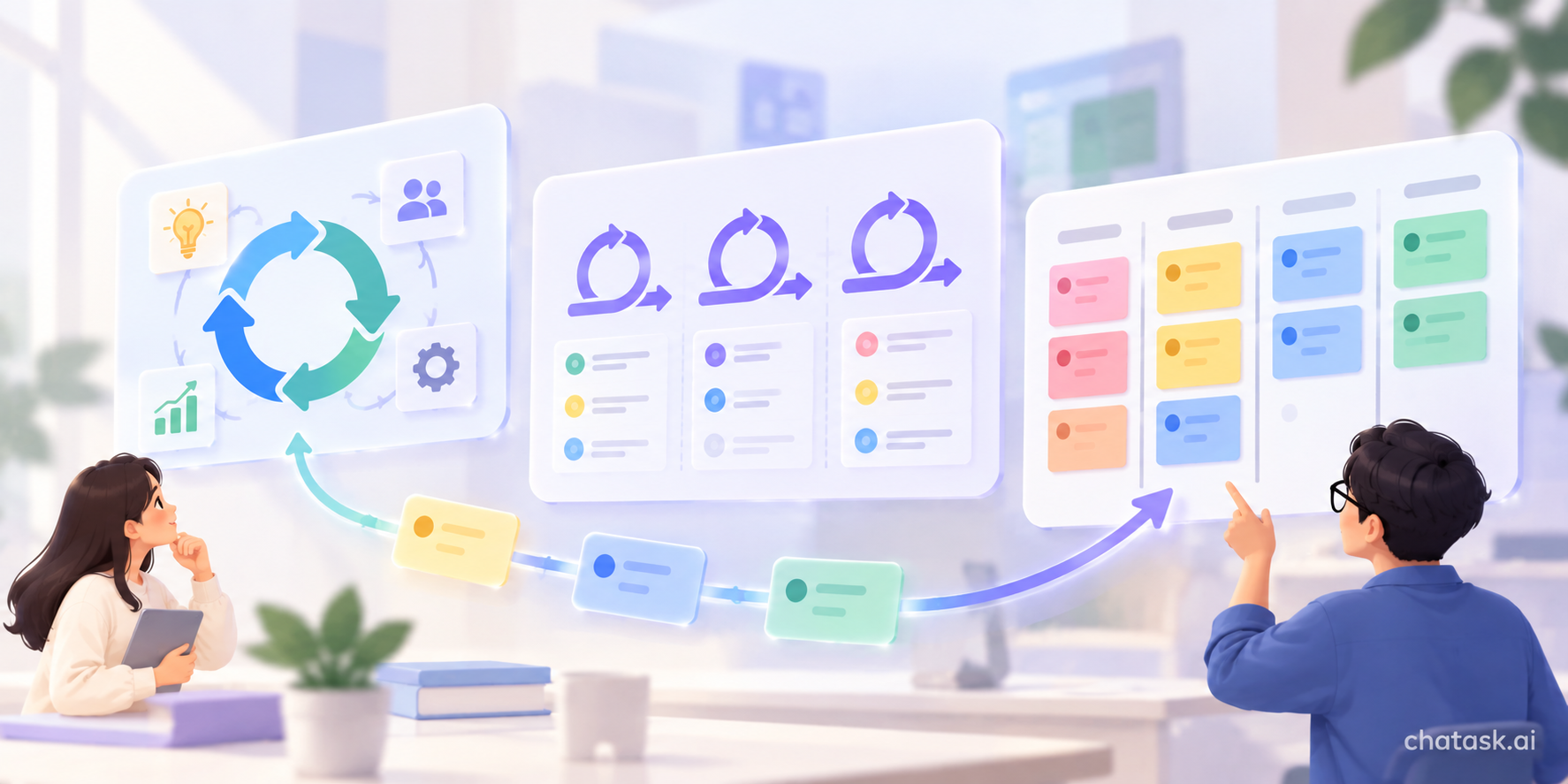
The workflow can then operate as a continuous loop: Plan → Execute → Observe Results → Adjust → Continue Execution. This approach is closely aligned with Agile thinking because it shortens the gap between execution, feedback, and adjustment.
Similarly, HR can regularly evaluate the effectiveness of different recruitment channels, Sales can adjust its approach based on customer feedback, and Operations teams can improve processes based on previously handled requests or incidents. Businesses do not necessarily need to call these activities "Agile"; the real value lies in being able to respond to change more quickly.
When Is Scrum Suitable for Non-Tech Businesses?
Scrum is better suited to work that can be divided into relatively clear cycles, with each cycle having a specific goal or expected outcome. As a result, some Marketing, Product Marketing, Creative, or project implementation teams may benefit from adopting certain elements of Scrum.
For example, a product launch campaign can be divided into three stages. The first Sprint may focus on market research and messaging, the next Sprint on producing the landing page, content, and communication materials, and the following Sprint on launching the campaign, monitoring data, and optimizing performance.
After each cycle, the team has a checkpoint to review results, identify unfinished work, understand current blockers, and determine what needs to change in the next plan. This structure helps teams identify problems earlier instead of waiting until the end of a project to evaluate the overall outcome.
However, not every type of work fits naturally into Sprints. Customer service, administration, and Operations teams often receive requests continuously and may find it difficult to predict their entire workload in advance, so forcing every request into a Sprint can make the workflow more complicated rather than more effective.
When Is Kanban More Suitable Than Scrum?
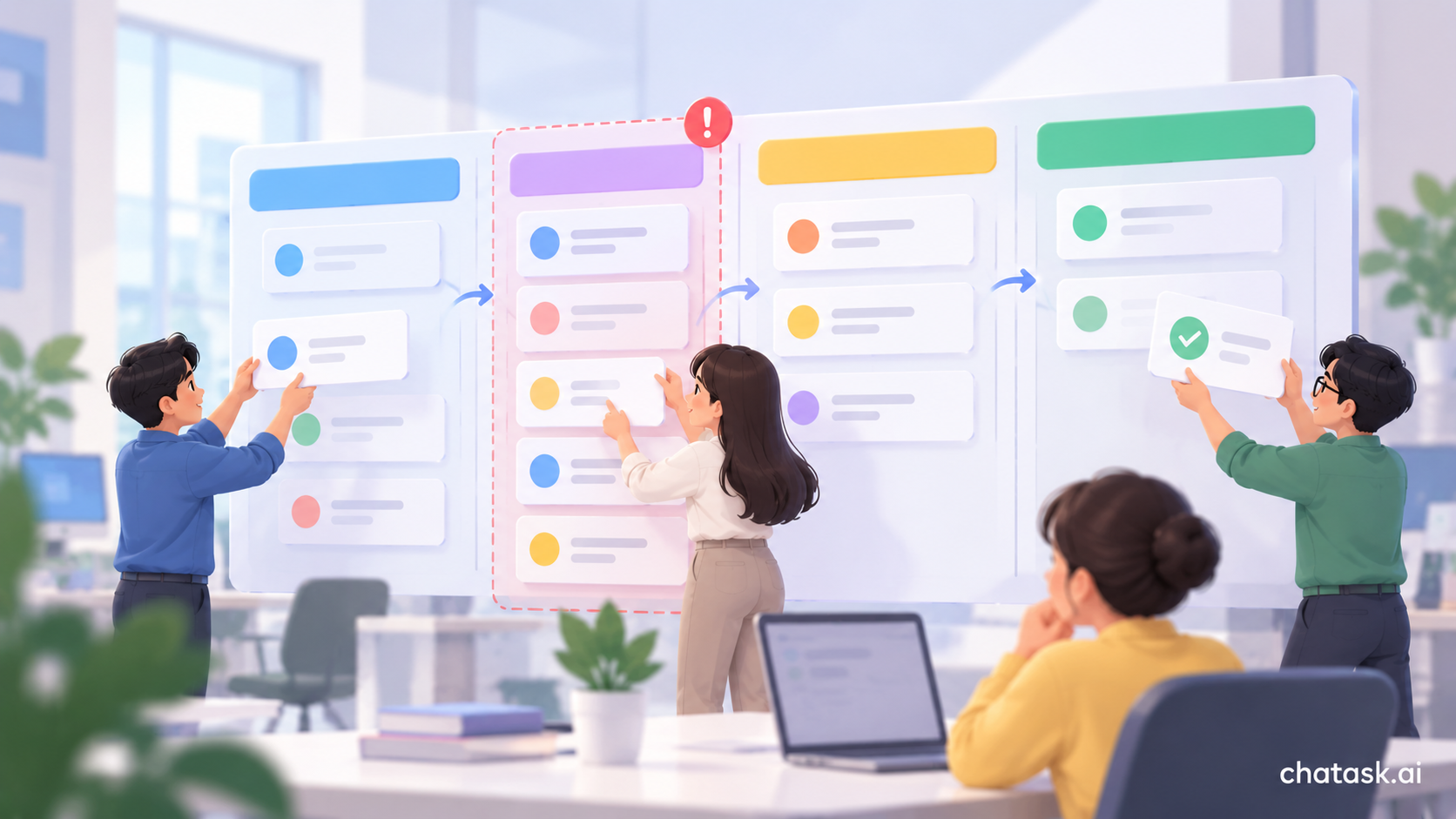
Kanban is often more suitable for teams with a continuous flow of incoming work, where each task moves through a relatively stable set of stages. Instead of waiting for a new Sprint to begin, teams can accept and process work based on their current capacity.
For example, HR can manage recruitment through the flow New Candidate → CV Screening → Interview → Offer → Completed. A Content team might use Idea → Writing → Review → Design → Scheduled → Published, while Procurement could track Purchase Request → Collect Quotations → Evaluation → Pending Approval → Order → Completed.
The key value of Kanban is not simply creating a board with multiple columns. Tracking flow and limiting Work in Progress helps teams identify bottlenecks, avoid starting too many tasks at once, and focus on moving work through to completion.
If a Content team has 20 articles in "Writing" but almost none are moving to Review, the problem may not be a lack of resources to start new work. The bottleneck could be in the review stage, or the team may simply be handling too many tasks in parallel.
Is Scrum or Kanban More Suitable for Marketing, HR, Sales, and Operations?
There is no single method that works for every department. Whether a team chooses Scrum, Kanban, or only selected Agile principles should depend on how work actually enters and moves through that team.
|
Characteristics of the Work |
Approach to Consider |
|
Work can be divided into cycles with clear goals |
Scrum or a Sprint-based approach |
|
Work arrives continuously |
Kanban |
|
Many ad hoc requests need to move through defined statuses |
Kanban |
|
Plans frequently change based on data and feedback |
Agile mindset |
|
Projects require checkpoints for review and adjustment |
Scrum |
|
Simple workflow with a small number of tasks |
A task list may be sufficient |
|
The team handles both projects and ad hoc work |
A combination of approaches |
Marketing, for example, may use short cycles for a campaign while using Kanban to manage daily content and design requests. HR can also plan recruitment on a monthly or quarterly basis while managing the candidate pipeline as a continuous flow.
Therefore, the key question is not necessarily "Should the team use Scrum or Kanban?" but rather "How does the team's work actually happen, and what problems need to be solved?" The framework should be selected based on the workflow rather than forcing the workflow to change simply to comply with a framework.
Do Businesses Need to Fully Implement Scrum or Kanban?
Not necessarily. For non-tech businesses, adopting an entire framework can introduce additional processes, terminology, and meetings that the team may not actually need.
A Marketing team, for example, may use Sprints to divide a campaign into shorter stages without adopting the entire Scrum structure. An HR team can use Kanban to visualize its recruitment pipeline without building a complex Kanban system.
A more practical approach is to start with the problem that needs to be solved. If the team struggles to see progress, visualize the workflow; if too many tasks are being worked on at the same time, control WIP; if plans frequently become outdated, shorten the planning and review cycles.
Even a Good Kanban Board Does Not Solve the Entire Workflow
Kanban helps teams see the status of work, but status is only one part of the context. In a real working environment, a task is often shaped by multiple conversations, files, feedback, and decisions before it reaches completion.
For example, a Marketing request may begin with a message from a manager. The team brainstorms in a group chat, a designer shares a file, the manager provides feedback, an employee makes revisions, and only afterward does someone update the status in the task management tool.
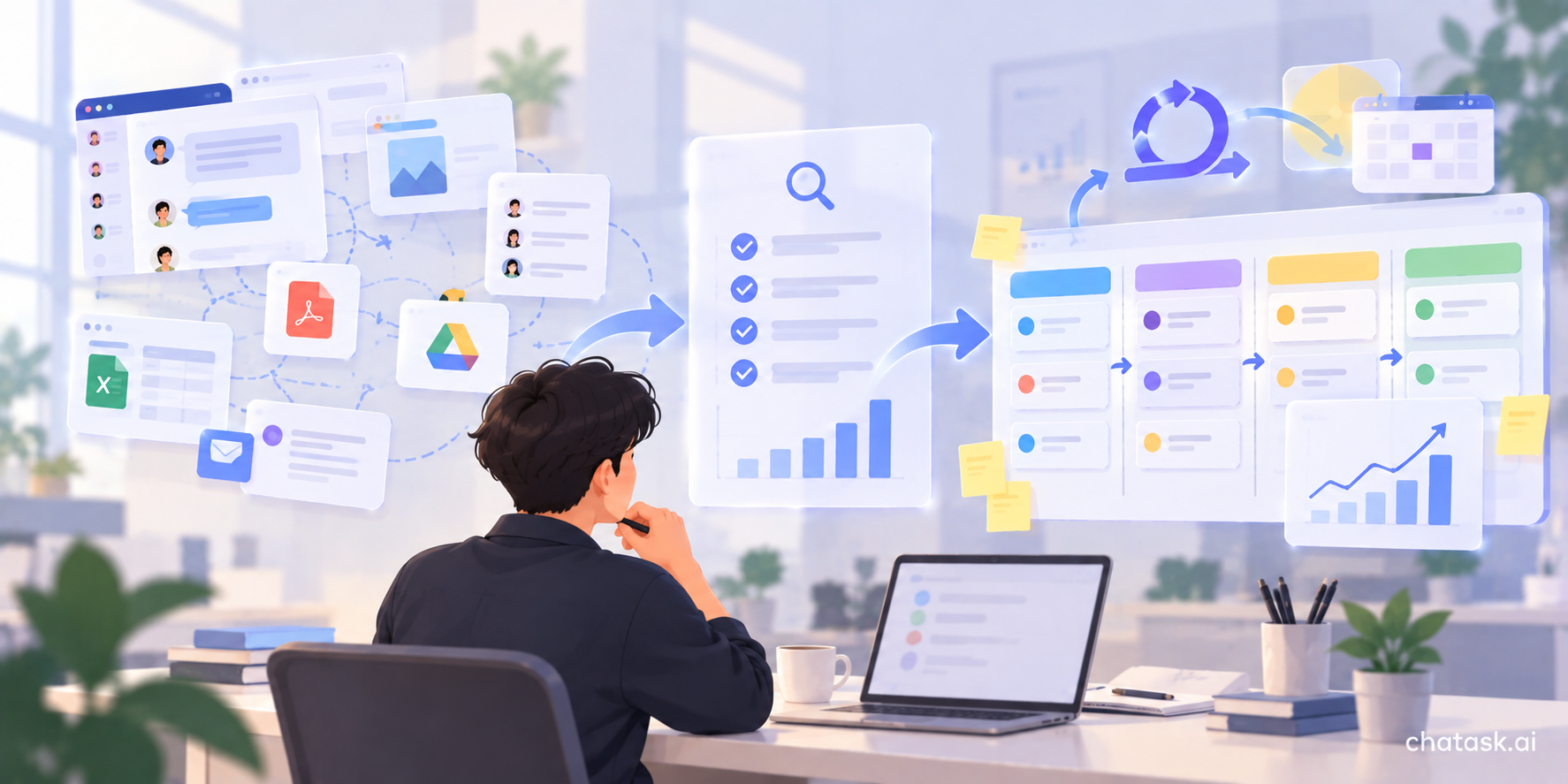
The actual workflow may therefore look like Conversation → Task → File → Feedback → Decision → Update. If each part lives in a different application, the team still needs to search for information and re-establish context even when the Kanban board itself is well organized.
Modern workflow management therefore needs to answer more than "What status is this task in?" Teams also need to know where the request originated, what decisions have been made, who is responsible, and what needs to happen next.

From Agile and Kanban to the Work in Chat Model
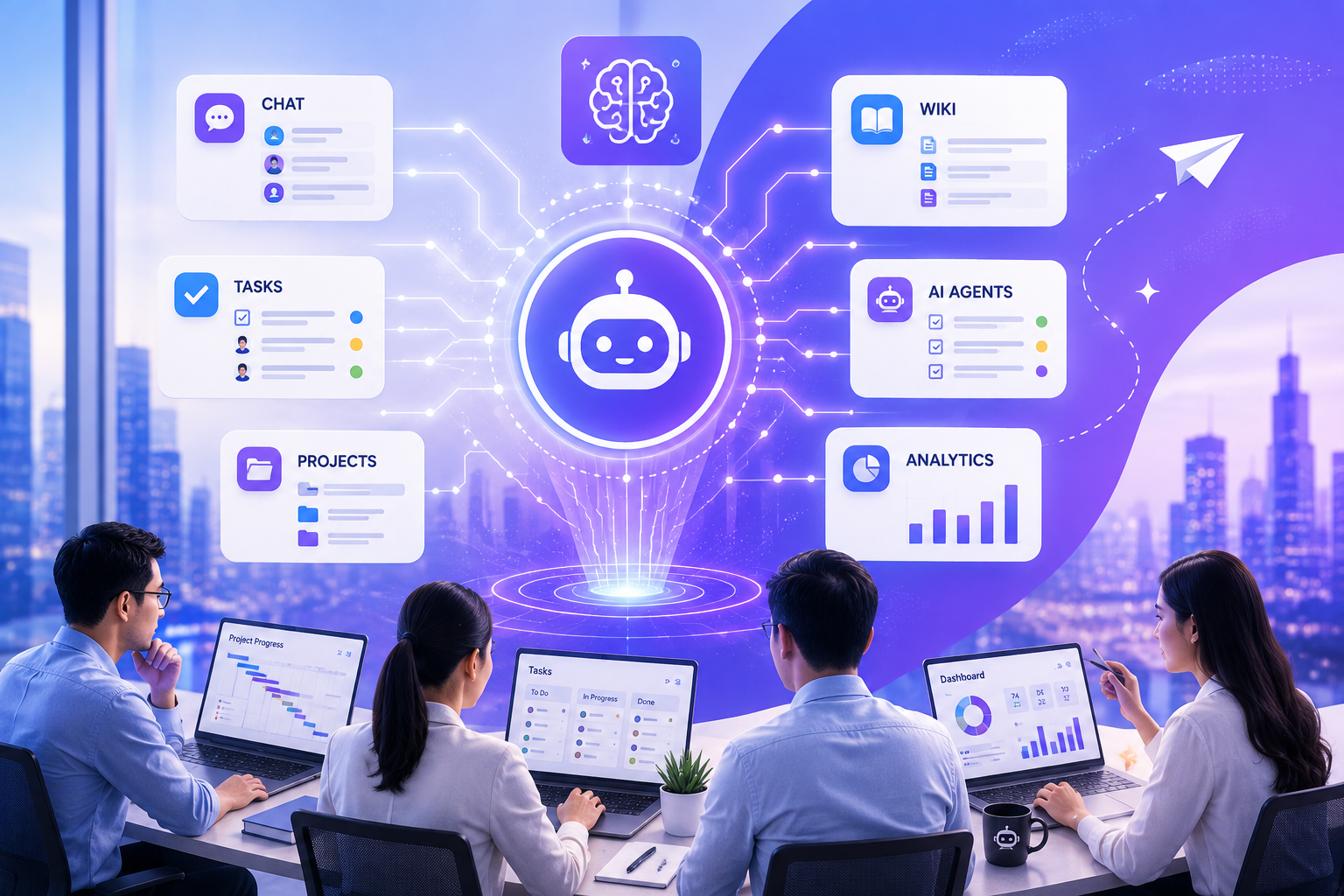
Another approach is to bring conversations and tasks closer together. This is also the direction ChaTask is taking with its Work in Chat model, where Chat, Task, Wiki, and AI Agents can operate within the same workspace instead of existing as separate layers of tools.
A request can begin in a Project Channel and be turned into a Task directly from the conversation. Further discussions can continue in the Task Thread, keeping feedback, decisions, and work context close to the task instead of scattering them across chat and task management tools.
AI Agents can also participate in the workflow to support appropriate parts of the work. Task Assistant supports task management, Reminder Assistant and Task Follow-Up help teams keep track of work that requires attention, while Report Agent can consolidate work data so managers can monitor progress and execution.
This approach does not replace Agile, Scrum, or Kanban. Instead, businesses can continue using principles such as work transparency, rapid feedback, flow management, and continuous improvement while organizing them around workflows that reflect how teams actually work.
How Should Businesses Start Applying Agile?
Instead of starting with the question, "Should we implement Scrum or Kanban?", businesses should first observe their current workflows. Identify where work typically begins, who is responsible, which stages frequently become bottlenecks, how many tasks are being worked on at the same time, and how often managers need to manually ask for progress updates.
If the problem is that plans change quickly, teams can start with shorter planning and review cycles. If work arrives continuously and bottlenecks are difficult to identify, teams can try visualizing the flow with Kanban and controlling the amount of work in progress.
If the larger problem is that conversations, tasks, files, and work data are scattered across multiple tools, changing the framework alone may not be enough. In that case, businesses need to reconsider how information and context move throughout the entire workflow.
Are Agile, Scrum, and Kanban Suitable for Non-Tech Businesses?
Yes, but non-tech businesses do not need to implement Agile, Scrum, or Kanban in exactly the same way as software development teams. Marketing, HR, Sales, and Operations teams can select principles that fit the nature of their work, from working in shorter cycles and visualizing workflows to limiting WIP and conducting regular reviews.
Frameworks are only a means to an end. The ultimate goal is to create a workflow where everyone knows what needs to be done, who is responsible, where the work currently stands, where the context is, and what needs to happen next.
As Chat, Task, Wiki, and AI become increasingly integrated into everyday work, workflow management is no longer just about managing a task list or a Kanban board. Businesses can move toward a work environment where communication, execution, knowledge, and AI operate together within one continuous workflow.