Beyond RAG: How Agentic AI Is Driving the Rise of Knowledge Graph Architectures
In recent years, Retrieval-Augmented Generation (RAG) has become one of the core architectures for enhancing the capabilities of large language models (LLMs). By combining language generation with data retrieval, RAG enables AI not only to “guess” but also to “look up” information before responding.
However, as AI systems enter the Agentic AI Era - where multiple AI agents collaborate to handle complex workflows - the limitations of traditional RAG are becoming increasingly apparent.
The shift from RAG to GraphRAG (graph-based RAG) is not just a technical upgrade; it reflects a deeper transformation in how we design AI architectures: from processing fragmented information to understanding and leveraging relationships within data.
The limitations of traditional RAG in real-world applications
Traditional RAG operates based on vector search - retrieving text chunks that are semantically similar to a query. This approach works well for simple, lookup-style questions such as “what is a workflow” or “what features does product A have.”
But in real-world enterprise scenarios, queries are rarely that simple. A question like “which team is responsible for deploying code to this system?” does not just require information - it requires connecting multiple layers of data: from service → repository → CI/CD pipeline → deployment environment → team.
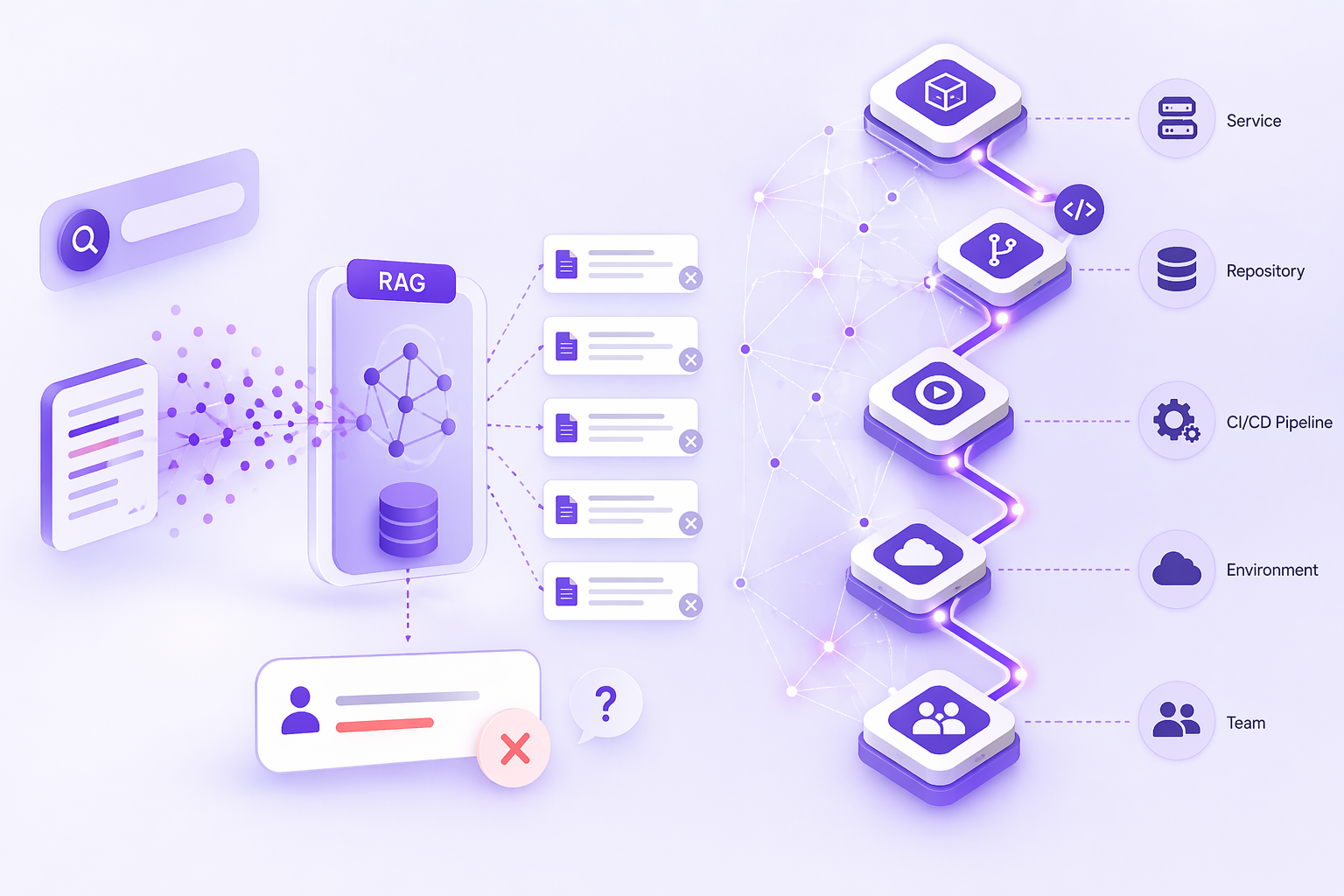
This is where traditional RAG reaches its limits. It does not understand relationships between entities; it only retrieves text that appears similar to the query. As a result, the information is often fragmented, lacks context, and can even be incorrect when multi-hop reasoning is required.
GraphRAG: When AI starts to “understand” relationships
GraphRAG was introduced to address exactly this problem. Instead of working with isolated text chunks, GraphRAG organizes data into a knowledge graph - where each entity and relationship is explicitly represented.
For example, instead of storing a sentence like “The revenue dashboard is built from sales data and managed by the Data team,” GraphRAG represents this information as a structured graph:
Revenue Dashboard → uses → Sales Dataset
Sales Dataset → processed by → ETL Pipeline
ETL Pipeline → owned by → Data Team
This representation allows AI not only to “read” information but also to traverse relationships for reasoning. When a query is received, the system identifies relevant entities, navigates the graph to find meaningful connections, and then synthesizes a response.
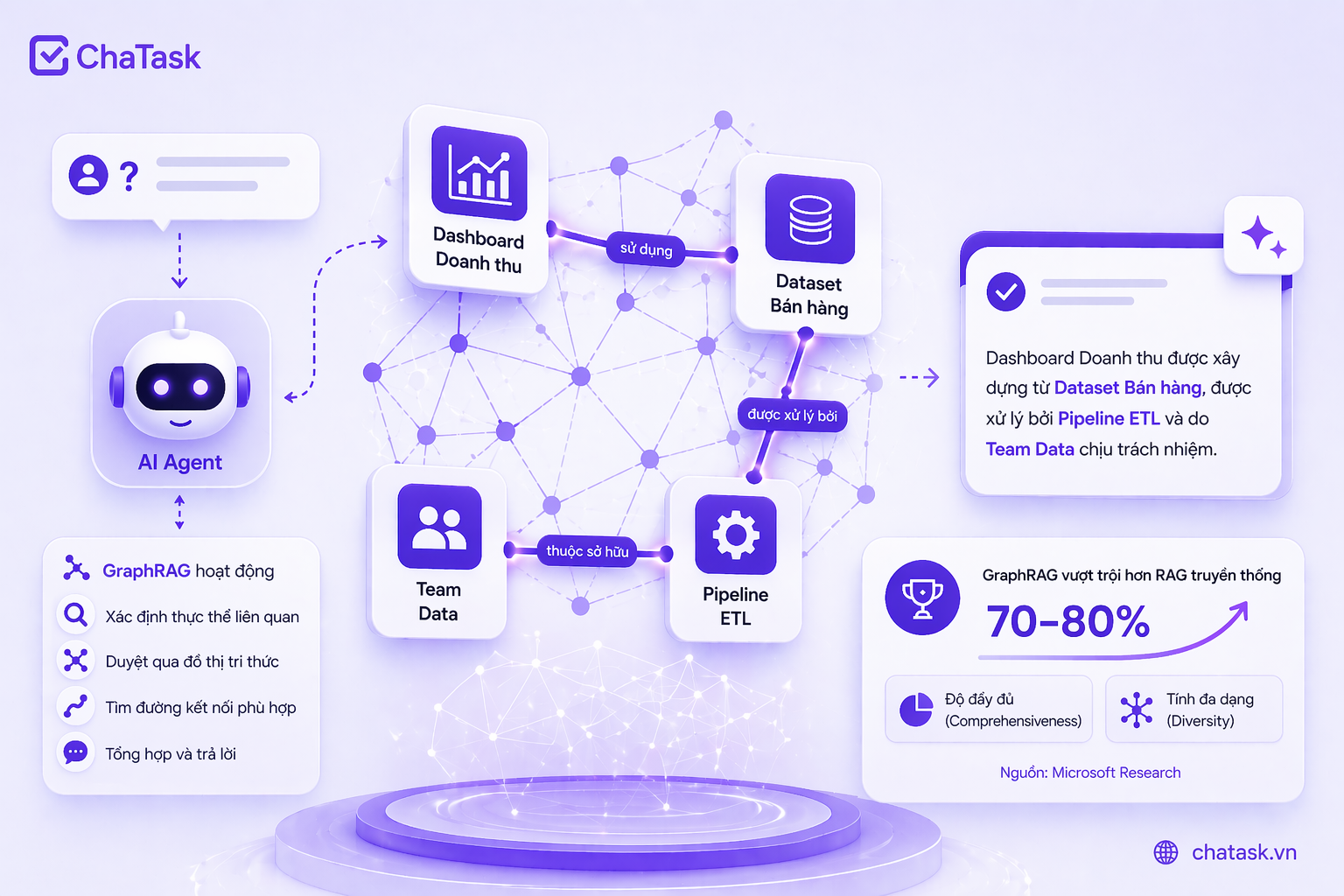
This capability makes GraphRAG particularly powerful for use cases that require linking information across multiple sources. Research from Microsoft Research shows that GraphRAG outperforms traditional RAG with a win rate of approximately 70–80% on metrics such as comprehensiveness and diversity in complex summarization and analysis tasks.
GraphRAG architecture: Not just retrieval, but reasoning
The most important difference of GraphRAG is not simply “better retrieval,” but its ability to create a foundation for reasoning.
A typical GraphRAG pipeline includes query processing, entity extraction, graph retrieval, data refinement, and answer generation. Among these, the most critical step is transforming raw data into entity–relationship pairs. This is where metadata plays a central role.
If the source data lacks clear definitions, consistent naming, or proper lineage, the system may generate duplicate or ambiguous nodes. In such cases, instead of improving understanding, the graph becomes a source of noise.
In other words, GraphRAG is not just an AI problem - it is also a data governance problem.
The Agentic AI era: Why GraphRAG matters
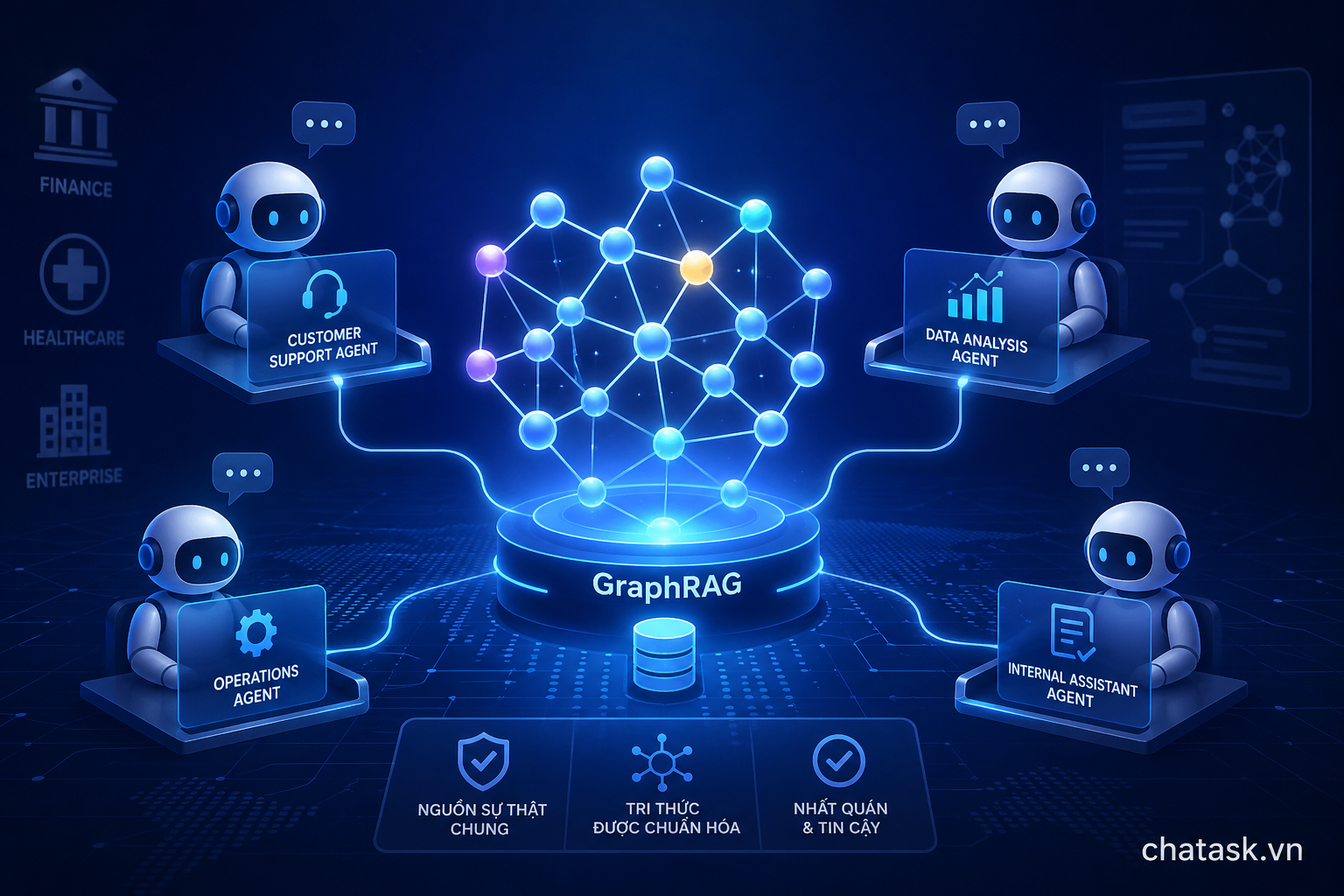
The rise of AI agents is fundamentally changing how AI systems operate. Instead of a single model, organizations are deploying multiple agents for different functions: customer support, data analysis, internal operations, and more.
In this context, a critical challenge emerges: how can all agents “understand” the same data system?
If each agent relies on its own vector search, inconsistencies are inevitable. In contrast, GraphRAG provides a shared source of truth in the form of a knowledge graph, where all entities and relationships are standardized.
This is especially important in complex domains such as finance, healthcare, or large enterprises, where even a small inconsistency in definitions can lead to incorrect decisions.
When should (and shouldn’t) you use GraphRAG?
GraphRAG is not a universal solution. In practice, it requires higher costs, longer implementation time, and deeper technical expertise compared to traditional RAG.
GraphRAG is most suitable when:
-
The problem requires tracing relationships (data lineage, ownership, dependencies)
-
The system involves multiple interconnected data sources
-
High accuracy and auditability are required (compliance, finance, healthcare)
On the other hand, if your dataset is small, queries are primarily semantic search, or your team lacks expertise in graphs and metadata, vector RAG remains a more efficient choice.
The transition from RAG to GraphRAG reflects a broader shift in AI - from processing information to understanding context and relationships. In the Agentic AI era, where multiple systems must collaborate and share knowledge, building a structured data foundation - such as a knowledge graph - will become essential.
GraphRAG is not the easiest path, but for the right problems, it does more than improve answer quality - it transforms how organizations leverage data. And that is the foundation for building intelligent, consistent, and truly useful AI systems in practice.
ChaTask and the shift from search-based AI to system-aware AI
ChaTask is being developed and positioned as an AI-integrated work platform, with a strong focus on embedding AI agents directly into operational workflows. Instead of merely supporting information retrieval, agents within ChaTask can participate in day-to-day tasks as “digital assistants” - from data analysis and information tracing to decision support.
In this context, the challenge is no longer just retrieving the right documents, but enabling AI to understand how different components within an organization are connected. This is where GraphRAG becomes highly relevant. When integrated, it allows AI agents in ChaTask not only to respond based on isolated data sources, but to follow relationships across data, processes, and people.
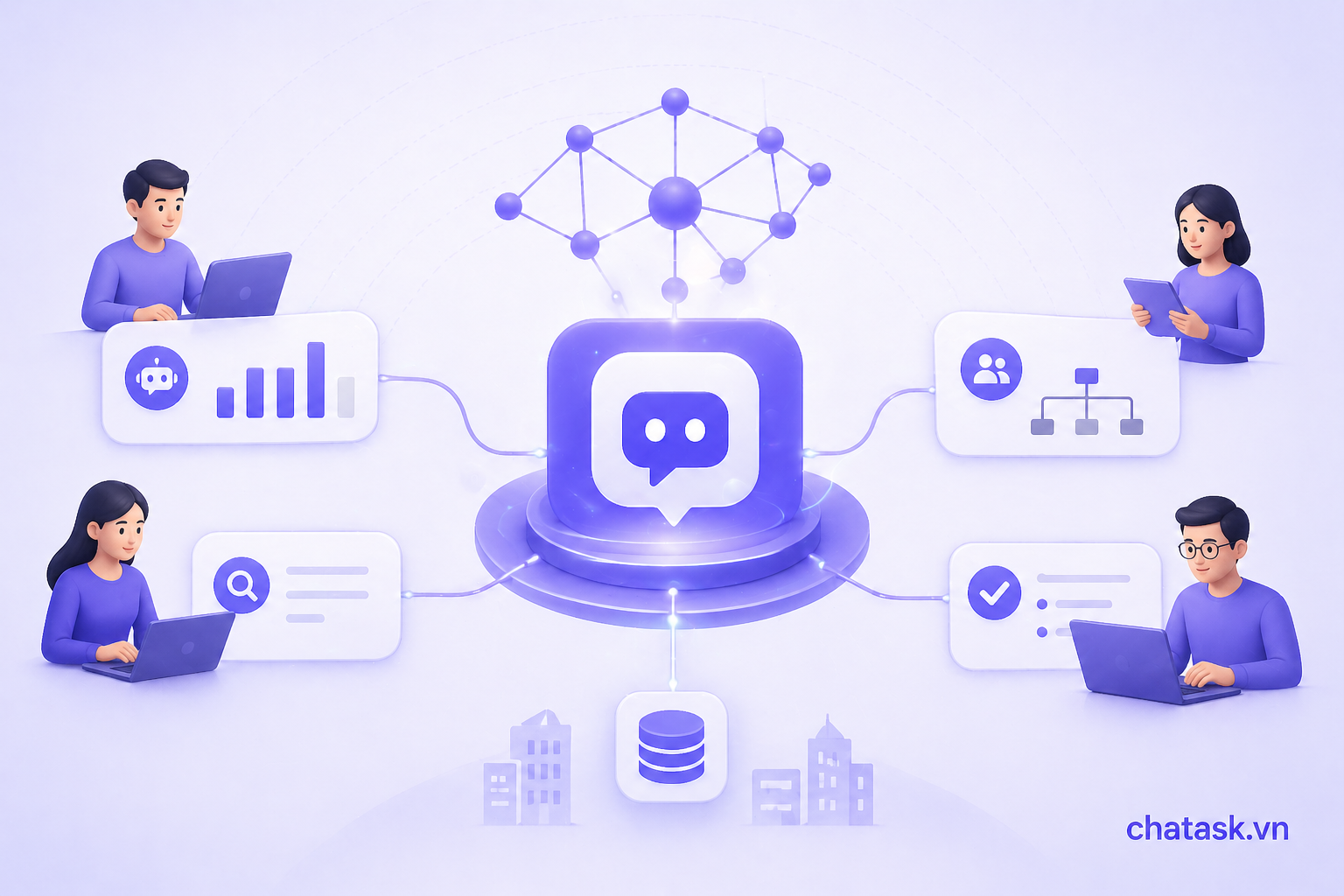
As a result, ChaTask can evolve beyond a traditional work management tool into a platform where AI actively participates in operations - understanding systems, coordinating across tasks, and supporting complex business problem-solving.