For many years, Kanban has almost become the default way teams manage work. From product and marketing to internal operations, the drag-and-drop workflow model with columns such as To do, In Progress, and Done has helped make work more visual and organized.
Kanban is undeniably effective at giving teams an overall view of progress. With just a quick look at the board, people can see which tasks are being worked on, who is responsible, and where bottlenecks are happening.
However, as work environments evolve faster, the number of workplace tools continues to grow, and collaboration becomes the center of modern workflows, many teams are starting to realize a major issue:
Boards help track work, but they are not necessarily where the real work actually happens.
That is also why “chat-based work” is gradually emerging as a new approach for the modern workplace.
Kanban Still Works - But Modern Workflows Have Changed
The issue with Kanban is not the board itself. The issue is that the way people work today has changed significantly.
Today, work is no longer just a series of linear tasks moving from one column to another. A single task can involve multiple discussions, several rounds of feedback, various files, important decisions, and collaboration across multiple teams.
But in traditional board-centric workflows, most of that context exists outside the board.
-
Tasks are in one place.
-
Discussions are somewhere else.
-
Files are stored elsewhere.
-
Meeting notes are in another tool.
As a result, many teams constantly have to “search for context” just to fully understand what is happening around a task.
And when workflows rely too heavily on switching between different tools, focus naturally becomes fragmented.
Boards Show Task Status, But Not the Collaboration Behind It
This is a limitation that more and more teams are starting to recognize.
Kanban is excellent at showing status. But status alone does not reflect the actual collaboration process happening behind a task.
A card moved to “Done” does not tell the team:
-
why a decision was made
-
which feedback was agreed upon
-
what issues occurred during execution
-
who discussed what throughout the process
In reality, the most important part of a workflow often exists inside conversations.
That is why many teams, even while using powerful task management tools, still return to chat apps to do the actual work. Brainstorming happens in chat. Reviews happen in chat. Issue handling also happens in chat.
Gradually, the board becomes a place to “update status” rather than the place where collaboration truly happens.
Chat-based Work Emerged From This Exact Problem
Unlike traditional workflows that place boards at the center, chat-based work places conversation at the center of work itself.
Instead of separating:
-
tasks
-
discussions
-
AI
-
files
-
updates
…everything is brought together into one unified workflow. This is also the direction that ChaTask is building toward.
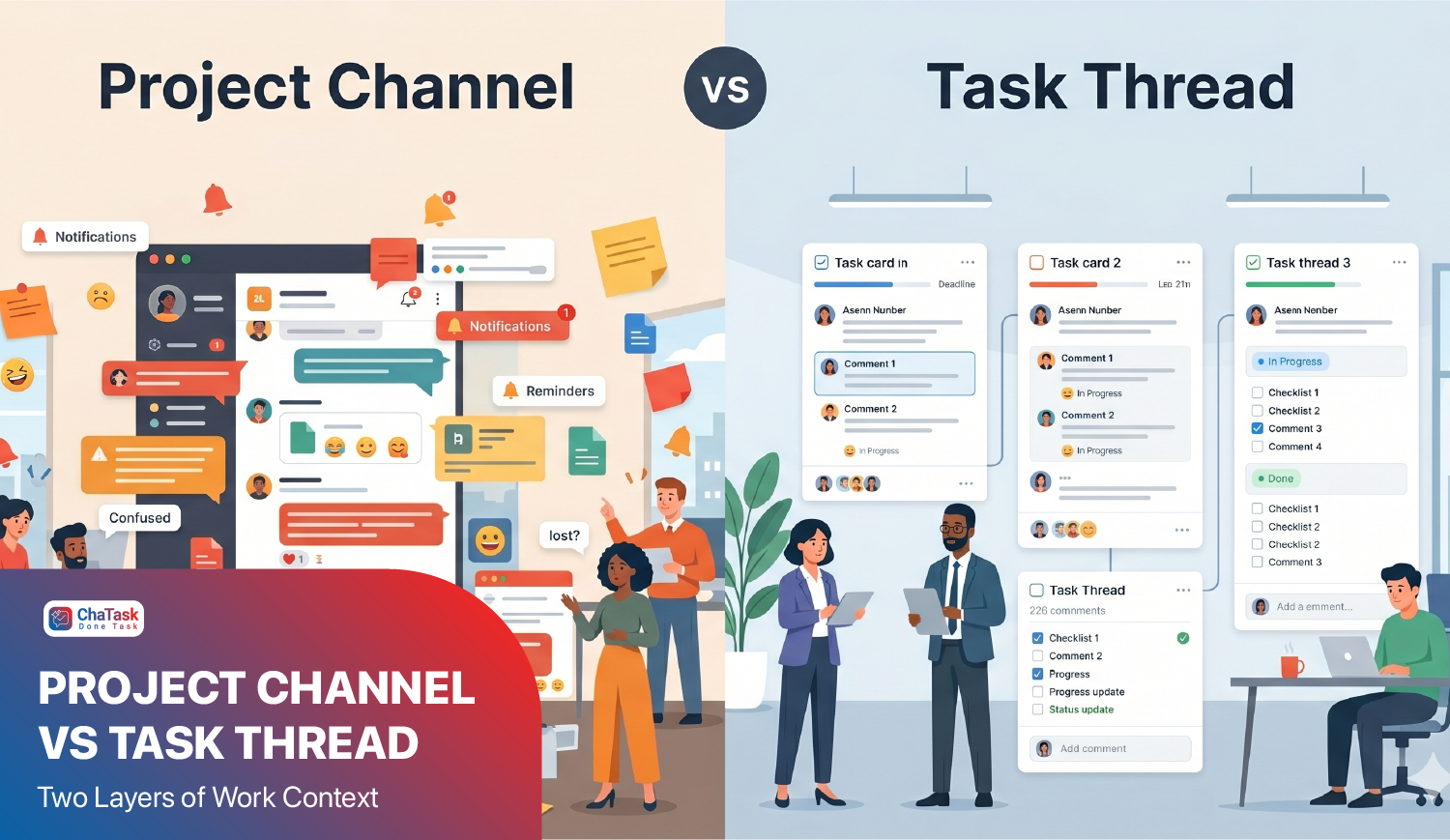
With ChaTask, each task is more than just a progress management card. Every task acts as its own collaborative thread, where discussions, updates, feedback, and context are all maintained within a single workflow stream.
This allows teams to stop constantly switching between chat apps and task management tools just to follow work progress.
Instead of: “Chat to discuss, then go back to the board to update tasks,”
…the workflow happens directly inside the task itself. This is one of the biggest differences between chat-based workflows and traditional Kanban models.
How Is ChaTask’s Chat-based Workflow Different From Traditional Workflows?
The interesting part of chat-based workflows is not about “replacing boards with chat.” It is about turning conversation into an actual part of the workflow itself.
In many existing tools today, chat mainly serves as a communication layer. After discussions end, people still need to manually:
-
create tasks
-
update statuses
-
summarize information
-
follow up on progress
But with ChaTask’s model, conversations and tasks are directly connected. Each work thread becomes both a collaboration space and a workflow space where teams can discuss, track progress, preserve context, and coordinate execution.
This is especially useful for high-speed teams or async teams, where maintaining continuous context is often more important than simply “moving cards.”
In addition, AI is integrated directly into the workflow instead of existing as a separate standalone tool. Teams can use AI directly inside tasks to summarize discussions, assist with content writing, generate checklists, or follow up on work without needing to copy data across different platforms. As a result, workflows become far more seamless.
Why Are More Teams Paying Attention to Chat-based Workflows?
The biggest reason is probably that modern work increasingly depends on real-time collaboration. Today’s teams:
-
work remotely more often
-
collaborate across functions more frequently
-
move faster
-
need quicker decisions
What they need is not simply “task management,” but a way to keep collaboration continuous and context-rich. Chat-based workflows address exactly that problem.
When all discussions are directly connected to tasks, new participants can still understand what happened previously. Decisions do not get lost. Files, feedback, and updates stay within the same workflow stream. Tasks are no longer just titles with checklists. They become true collaborative workspaces for teams.
Will Kanban Disappear?
Probably not. Kanban is still highly effective for high-level tracking, pipeline management, and workflows with clear operational structures. For many teams, boards remain the most visual way to monitor workload and progress.
However, the role of boards may start to change. Instead of being the “center” of workflows, boards may gradually become more of a progress visualization layer, while real collaboration happens within conversation layers.
That is also why many modern workplace tools are shifting from a “task management” mindset toward “workflow collaboration.”
The Future of Work May No Longer Revolve Around Task Management
For many years, most workplace software was built around one central question: “How can we manage tasks more efficiently?”
Today, that question is gradually changing into: “How can people collaborate more naturally?”
This shift is pushing modern workflows from being “board-centric” toward becoming “conversation-centric.” Because in the end, work is not just about tasks. It is about conversation. It is about context. It is about collaboration. And it is about how people move work forward together.