In many businesses, work usually starts from conversations rather than tasks. However, when chats, tasks, and documents are stored in different places, teams can easily lose context and spend significant time gathering information to process work effectively.
ChaTask solves this problem through two layers of context: Project Channel and Task Thread. One layer helps manage the overall picture of the project, while the other ensures each task is handled in a more focused and organized way.
Project Channel: The Context of the Entire Project
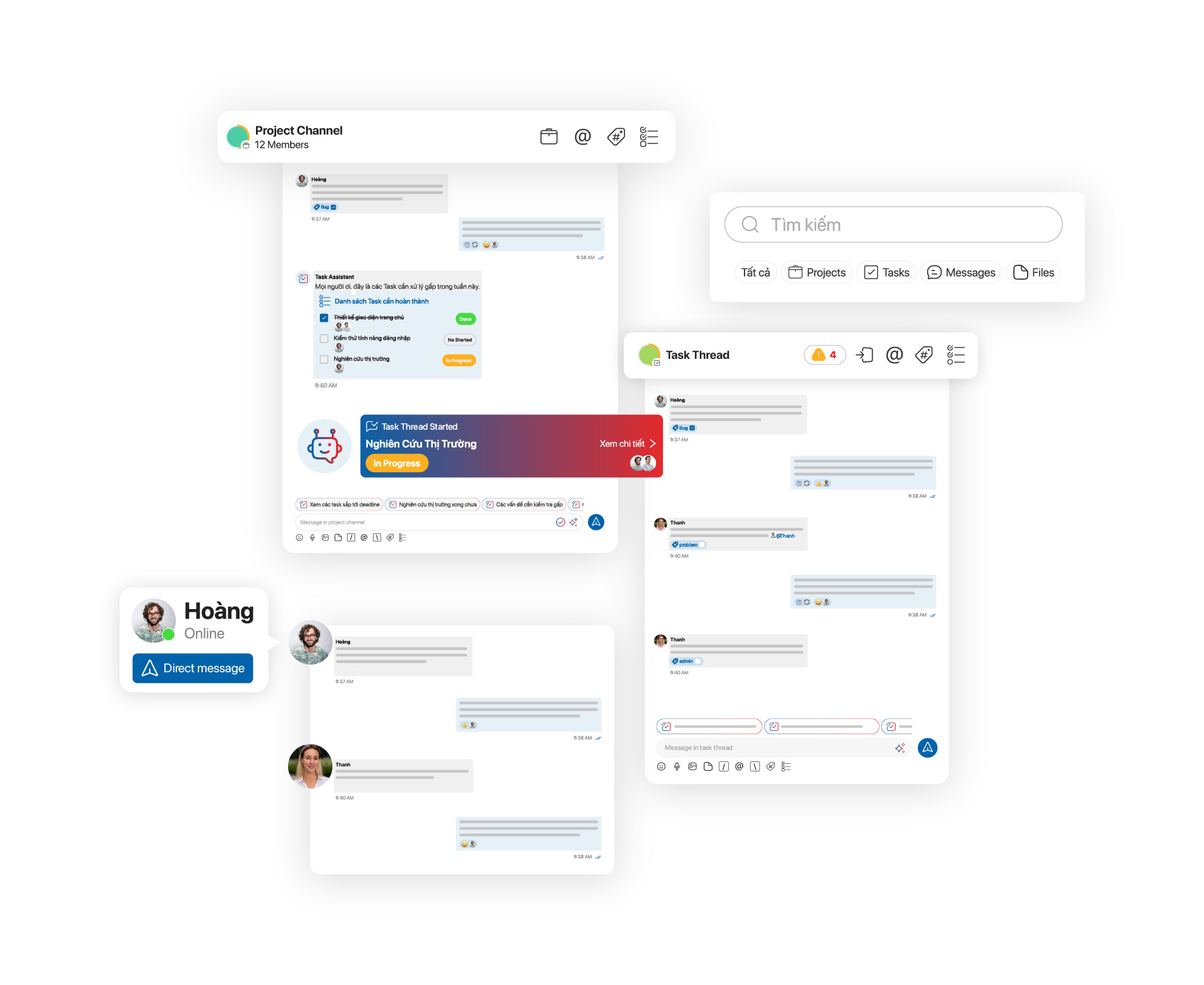
Project Channel is the central workspace of a project, where all related information is maintained within a single continuous flow. It is not only a place for team communication, but also a space to store documents, update progress, record decisions, and monitor all project activities.
When entering a Project Channel, every team member can quickly understand which stage the project is in, what the team is currently focusing on, and which tasks are being carried out. All information stays within the correct context instead of being scattered across multiple tools.
The most important aspect of Project Channel is that it creates a “shared source of context” for the entire team. New members joining the project do not need to repeatedly ask for information, managers do not need to manually summarize updates, and important discussions do not get lost among countless messages.
Task Thread: The Context of Individual Tasks
If Project Channel holds the overall picture, Task Thread is where each specific piece of work is handled in a focused manner.
Each Task Thread is connected to a specific task and contains all related information, including task details, timeline, status, attached files, assignees, and related discussions. This allows every task to become an independent workspace where all updates are stored according to the task’s actual workflow.
Instead of reading through the entire project conversation to find relevant information, users only need to open the thread of the task they are working on to access all necessary context. This significantly reduces information overload and minimizes the risk of missing important requests during collaboration.
Task Thread also improves clarity in responsibility. When each task has assigned executors, reviewers, and all discussions happen within the same thread, tracking progress and reviewing decisions becomes much more transparent.
Project Channel vs Task Thread: What’s the Difference?
| Project Channel | Task Thread |
| Manages the context of the entire project | Manages the context of individual tasks |
| Focuses on overall communication and coordination | Focuses on handling specific tasks |
| Contains multiple tasks and discussion flows | Revolves around a single task |
| Helps teams monitor overall progress | Helps assignees stay focused on the task |
| Maintains context at the project level | Maintains context at the execution level |
| Suitable for coordination across multiple members | Suitable for focused task collaboration |
Simply put, Project Channel answers the question: “How is this project progressing?”, while Task Thread answers: “How is this specific task being handled?”. These two layers do not replace each other but work together to maintain context from the overall project level down to execution details.
Why Are Both Layers of Context Necessary?
In many traditional working models, communication and work management are separated into different systems. Teams may communicate heavily in chats but lack connection to actual tasks. On the other hand, task management tools often lack the communication context needed to fully understand the work.
When Project Channel and Task Thread are connected, the entire workflow becomes much more seamless. Overall information is maintained at the project level, while individual tasks are handled within dedicated threads. This significantly reduces constant context switching — one of the major reasons productivity declines in digital work environments.
More importantly, this structure also allows AI to provide more effective support. Instead of only seeing fragmented chat messages, AI can understand both the overall project context and the details of each task to deliver more accurate assistance.
More Than Just Chat or Task Management
The biggest difference in ChaTask is not simply adding another chat feature or another task management system, but the way the entire workspace is organized around context.
In this model, chat is no longer just for communication, tasks are no longer separated from discussions, and AI is no longer outside the workflow. Everything is connected within the same workspace, where information remains in the correct context from beginning to end.
Project Channel and Task Thread are the two foundational layers that make this possible. One layer maintains the overall project view, while the other ensures each task is handled in a focused and continuous way. When both layers work together, teams can collaborate more clearly, manage progress more effectively, and significantly reduce the risk of losing information during coordination.