A company grows from 30 to 100 employees, opens several new branches, and consistently reports higher revenue year after year. From the outside, these may appear to be positive signs of business development.
However, if operating costs increase faster than revenue, profits fail to improve, and the management structure becomes increasingly complex, is the company truly growing?
This is an important question for organizations entering a period of expansion. After all, business growth is not simply about becoming bigger, but also about generating greater value from the resources available.
What Is the Difference Between Business Growth and Business Expansion?
Business expansion is often identified through directly observable changes: an increase in the number of employees, the establishment of new branches, entry into additional markets, or greater production capacity.
Business growth, meanwhile, can be measured through increases in revenue, profits, market share, or company value. However, to assess the quality of growth, businesses must also consider resource efficiency, profitability, and the sustainability of their business models.
These two concepts are closely related, but they are not entirely the same.
A company may expand its operations to meet market demand. However, if the additional costs exceed the value generated, that expansion may not deliver the expected economic benefits.
Conversely, a business can increase revenue and profits without proportionally increasing its workforce or physical infrastructure, for example, by improving processes, increasing productivity, or optimizing its product portfolio.
This does not mean that business expansion is inherently negative. The key question is whether the company can turn its expansion investments into long-term competitiveness and stronger business performance.

When Revenue Increases but Efficiency Does Not Improve
Revenue is often one of the first indicators used to evaluate a company's development. However, looking at revenue alone can lead to an incomplete assessment.
Consider the following hypothetical example:
|
Indicator |
Year 1 |
Year 2 |
|
Revenue |
VND 50 billion |
VND 70 billion |
|
Total Costs |
VND 40 billion |
VND 60 billion |
|
Profit |
VND 10 billion |
VND 10 billion |
|
Number of Employees |
50 |
80 |
|
Profit Margin |
20% |
14.3% |
In this case, revenue increased by 40%, and the workforce grew by 60%, but profit remained unchanged. The profit margin declined from 20% to approximately 14.3%.
The company significantly expanded its business operations, yet its financial performance did not improve proportionally.
This example alone is not enough to conclude that the company is operating inefficiently. Rising costs may result from strategic investments, such as product development, distribution network expansion, or entry into new markets. These investments may not generate immediate profits during the current reporting period.
However, if revenue continues to increase while profit margins steadily decline over an extended period without a clear prospect of improvement, the company should reassess the quality of its growth.
Signs That a Business Is Expanding Faster Than Its Operational Capabilities
1. The Workforce Is Growing, but Productivity Is Not Improving
Hiring additional employees is a common response to increasing workloads. However, if every expansion requires the company to add employees at a rate equal to or greater than the increase in output, it should evaluate the scalability of its operating model.
For example, a department may need to double its workforce to handle a workload that has increased by only 50%. This could reflect differences in the nature of the work, but it might also indicate that processes are not sufficiently standardized or that resources are not being allocated effectively.
Rather than focusing solely on employee headcount, businesses should monitor the value generated per employee, output per working hour, and the quality of deliverables.

2. The Management Structure Is Becoming Increasingly Complex
As a business develops, the establishment of additional management levels and specialized departments is often unavoidable.
However, expanding the organizational structure does not always lead to better decision-making.
If a simple issue must pass through multiple approval levels, responsibilities between departments are unclear, or response times become longer, coordination costs can increase significantly.
At that point, the company is not only managing more work but also allocating more resources to maintaining the operation of its own management structure.
3. Fixed Costs Are Increasing Faster Than Revenue-Generating Capacity
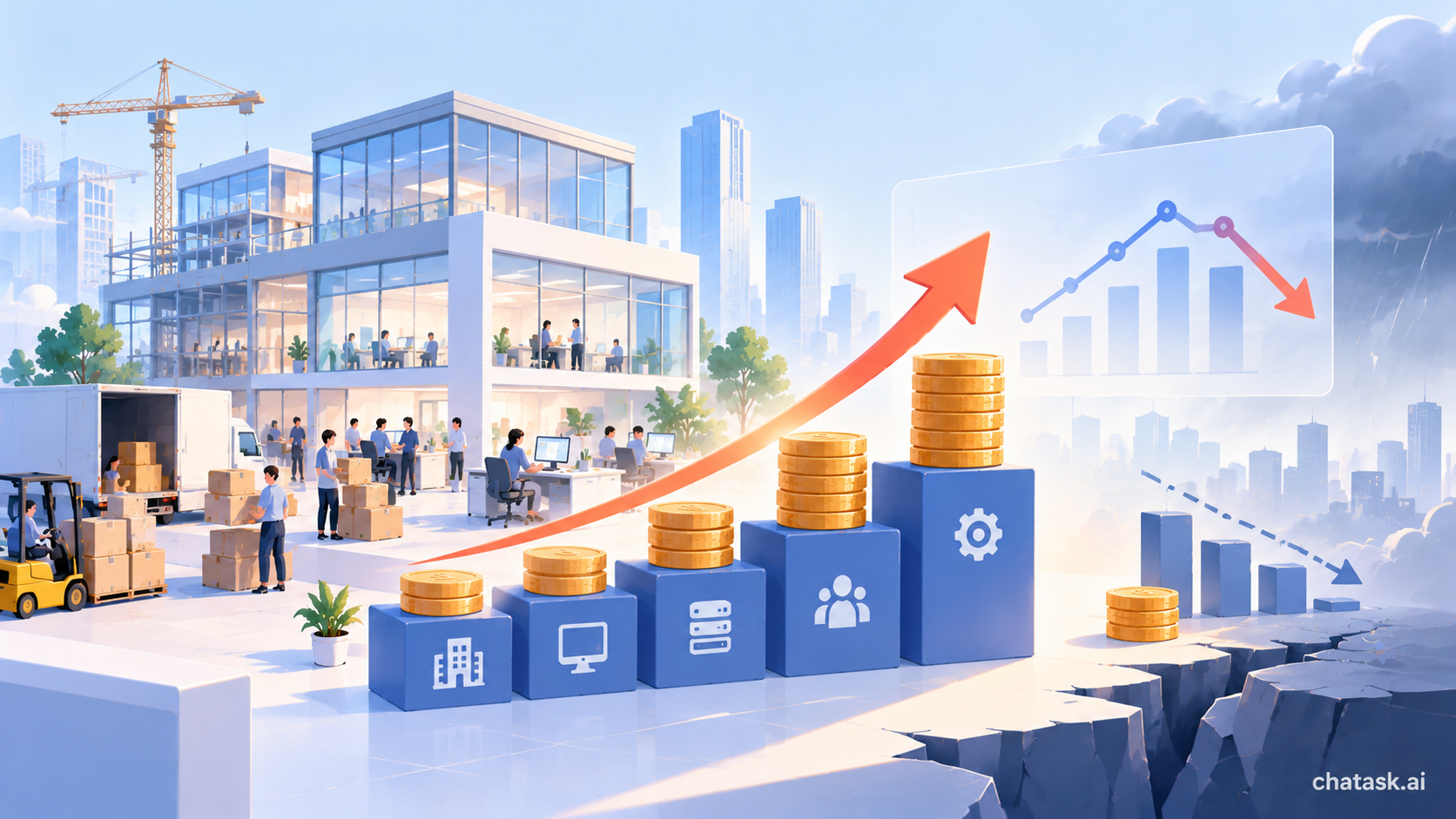
Expanding office space, investing in equipment, implementing technology systems, and recruiting employees all create new financial obligations.
Some of these expenses may be necessary to prepare for the next stage of development. However, when fixed costs rise too quickly, the business may become more vulnerable to market fluctuations.
If customer demand declines or revenue falls short of expectations, a larger operating structure can place considerable pressure on profits and cash flow.
Therefore, before making expansion decisions, businesses should evaluate not only potential revenue but also their ability to maintain operations under less favorable business scenarios.
4. Business Operations Are Becoming Increasingly Dependent on Leadership Intervention
Another warning sign appears when a company grows in size, but most important decisions still depend on a small number of individuals.
Leaders must constantly handle unexpected issues, resolve conflicts between departments, or directly supervise tasks that could otherwise be delegated.
This suggests that management capabilities may not have developed at the same pace as the organization.
A scalable operating model needs clear processes, appropriate delegation mechanisms, and sufficiently transparent information systems so that departments can operate independently within their areas of responsibility.
Which Metrics Should Businesses Use to Evaluate Genuine Growth?
No single metric can fully reflect the quality of business growth. Companies should combine several groups of indicators to develop a comprehensive understanding.
Revenue and profitability: Monitor revenue growth alongside gross profit margin, operating profit margin, and net profit. This helps determine whether the business is becoming more effective at converting revenue into financial results.
Labor productivity: Track revenue, value added, or output per employee, depending on the characteristics of the industry. Revenue per employee is a straightforward management metric, but it should not be considered fully equivalent to labor productivity as defined in economics.
Capital efficiency: Evaluate the company's ability to generate profits from invested capital, assets, and additional resources allocated during expansion.
Cash flow: Monitor operating cash flow, working capital requirements, and the ability to meet financial obligations. A company may report accounting profits while experiencing persistent cash flow pressure, which can still create operational risks.
Customer quality and revenue sustainability: Examine customer retention rates, contract renewal rates, customer acquisition costs, and the value customers generate over time.
More importantly, these indicators should be monitored across multiple reporting periods and compared with businesses in the same industry, rather than being assessed based on the results of a single year.

How Can Businesses Expand While Maintaining Sustainable Growth?
Define Clear Objectives Before Expanding
Businesses need to clarify why they want to expand: to meet existing demand, enter new markets, increase production capacity, or build long-term competitive advantages.
Each objective requires a different approach to resource allocation and different measures of success.
For example, opening new branches should not be evaluated solely by the number of new locations. The decision should also consider expected revenue, operating costs, payback periods, and the company's ability to serve customers effectively.
Standardize Operating Models Before Scaling Them
A process that is inefficient on a small scale can generate significantly higher costs when replicated across a larger organization.
Therefore, businesses need to identify which activities can be standardized, which steps can be automated, and which decisions should be delegated.
Establishing consistent processes is not intended to eliminate flexibility. Instead, it helps organizations maintain quality and efficiency as their operational workload increases.
Invest in Productivity Instead of Simply Adding Resources
When demand increases, hiring more employees or investing in additional equipment is not always the best first option.
Businesses can evaluate opportunities to improve productivity through employee training, adjustments to task allocation, the elimination of unnecessary activities, or the adoption of technology.
The objective is to increase the value generated from existing resources while maintaining work quality and appropriate working conditions.
Build the Ability to Adapt to Change
Sustainable growth does not mean that revenue and profits must increase steadily during every period.
Businesses may deliberately accept lower profit margins in the short term to invest in long-term capabilities. However, these decisions should be supported by financial plans, evaluation milestones, and the flexibility to make adjustments when market conditions change.
An organization with a strong foundation not only knows how to expand when opportunities arise but also has the ability to adjust its pace of development when necessary.
Growth Is Not Just About Becoming Bigger
Business expansion is an important part of the development journey for many companies. However, employee headcount, the number of branches, or revenue growth alone cannot fully reflect an organization's overall health.
A business that develops effectively must simultaneously strengthen its revenue-generating capabilities, control costs, use resources efficiently, and maintain the ability to adapt to market changes.
Sometimes, the most important decision is not how many branches to open, how many employees to hire, or how much revenue to generate. Instead, it is determining whether the current business model is strong enough to be scaled further.
Because sustainable growth is not simply about doing more with more resources, but about building an organization capable of generating greater value as it grows.