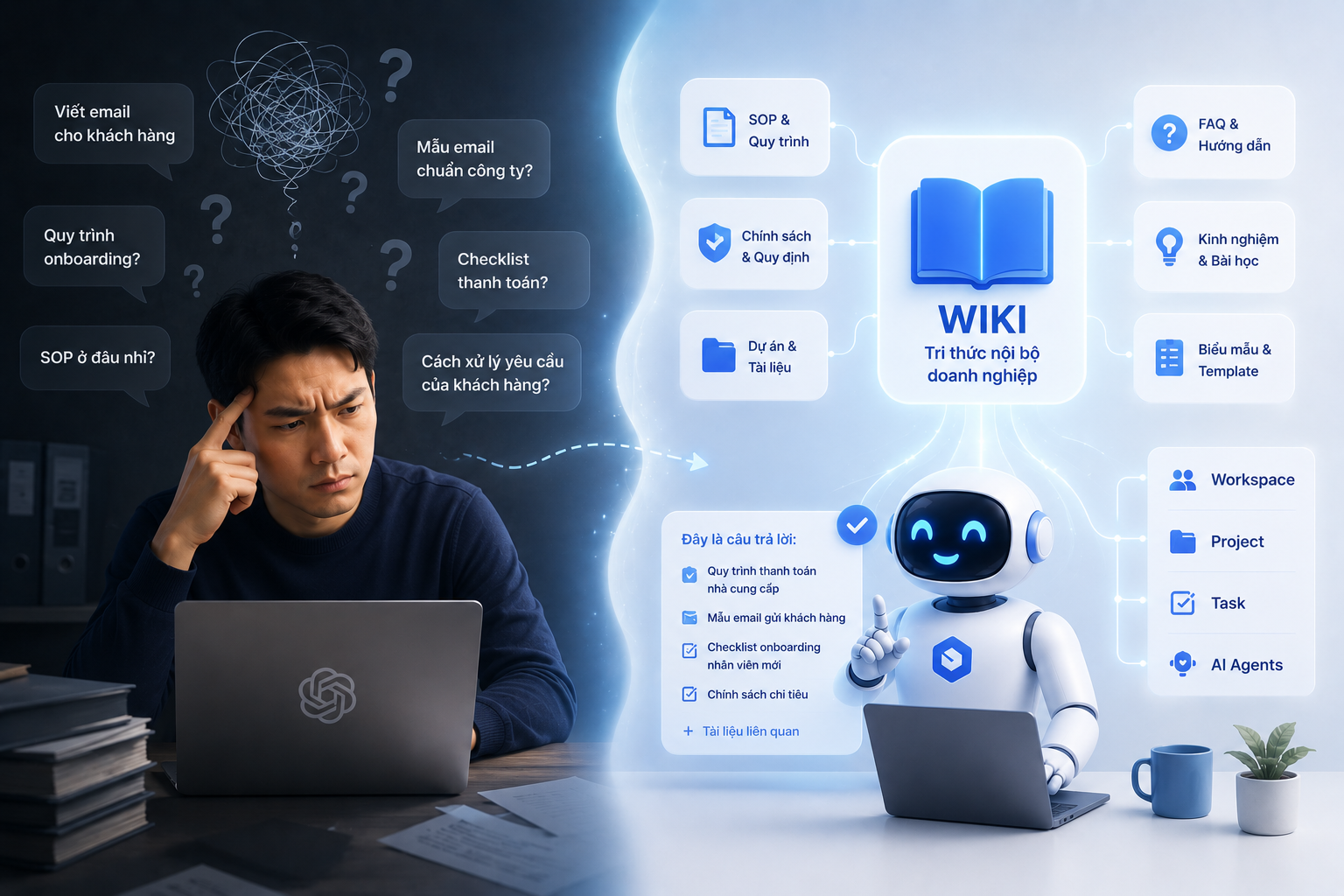
You've probably experienced this before. You clearly remember that your company has a document explaining the supplier payment process. You even remember a colleague sharing it during a meeting not long ago. Yet after spending nearly ten minutes searching through Google Drive, emails, and chat groups, you still can't find it.
Eventually, you open your team chat and ask a coworker, "Where is the supplier payment procedure?" Within minutes, they send you the exact document you've been searching for all morning.
This isn't an unusual situation. Every day, hundreds of similar questions are asked across organizations, even though the required documents already exist.
Keyword Search Used to Work Well
For many years, most document management systems relied on keyword-based search. If you wanted to find a contract, you searched for "contract." If you needed onboarding materials, you typed "onboarding." If you were looking for a payment form, you searched by the file name or a few words you remembered from the document.
When companies managed only a small number of documents, this approach worked quite well. As long as users remembered the file name or a specific keyword, they could usually find what they needed within seconds.
Today's businesses, however, are no longer dealing with a few hundred documents. Many organizations now manage tens of thousands of files created over many years by different departments and stored across multiple systems.
The Problem Is That People Don't Think in Keywords
What's interesting is that employees rarely think the way a search engine does. They don't remember the exact file name or document title. Instead, they remember the problem they are trying to solve.
A procurement employee asks, "What should I do if a supplier delivers late?" An HR specialist asks, "Where is the onboarding checklist for new employees?" A project manager asks, "What documents are required for project acceptance?"
These are real business questions, not keyword searches. If the system can only search for exact words appearing inside documents, the results are often disappointing.

Businesses Don't Lack Documents. They Lack Connected Knowledge.
In reality, the answer to a business question is rarely contained in a single document. To answer a question about the supplier payment process, an employee may need information from an SOP, a payment request form, the company's financial policy, and several guidelines covering exceptional cases.
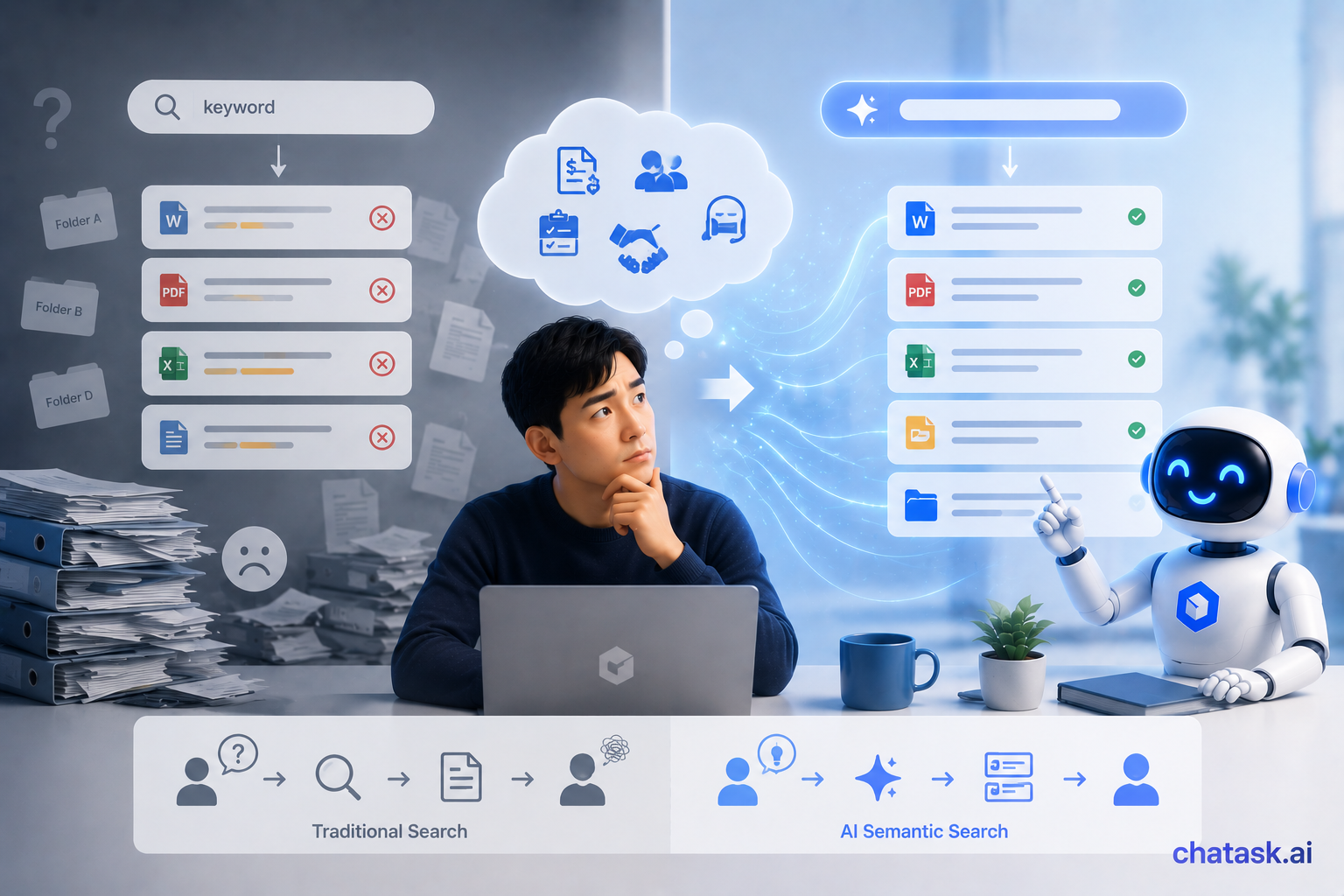
With traditional search, users must open each document, read through the content, compare the information, and piece everything together themselves. What they truly need is not five separate documents—they need one complete answer that tells them what to do next.
Businesses Need to Search by Meaning, Not by Keywords
When people work, they think about objectives rather than keywords. They want to prepare a quotation, onboard a new employee, complete a project handover, or resolve a customer complaint. They don't care what the document is called or where it is stored.
A modern search system should understand that intention. Instead of matching only exact keywords, AI can interpret the user's question, understand its context, and retrieve the most relevant documents—even if they don't contain the exact phrase that was typed.
This is why AI-powered search is gradually replacing traditional keyword search in modern organizations.
From Finding Documents to Finding Answers
Imagine an employee asking AI, "What should I do if a supplier delivers fewer items than ordered?" A traditional search engine will likely return dozens of documents containing words such as "supplier," "delivery," or "shortage."
An AI system, however, can read multiple relevant documents, understand the intent behind the question, and generate a complete answer. At the same time, it can reference the SOPs, forms, and internal policies used to produce that answer.
Employees no longer have to assemble scattered pieces of information themselves. They receive exactly what they need immediately.
When Wiki Is Connected to AI, Search Becomes a Conversation
This is also where the role of Wiki begins to change. Wiki is no longer just a place to store documents. It becomes the knowledge foundation that AI can reference while supporting daily work.
Instead of remembering file names or storage locations, employees simply ask questions in natural language, just as they would ask a colleague. AI automatically finds the right documents, combines information from multiple sources, and responds using the company's internal knowledge.

Finding the Right Information Is Only the Beginning
In many situations, getting the right answer is not the final goal. Once employees understand the process, they still need to start the work itself.
For example, after asking about the onboarding process, AI can do more than display the documentation. It can create Tasks, recommend the appropriate checklist, attach training materials, and assign work to the relevant team members. Knowledge is no longer something employees simply read—it becomes the starting point for execution inside the Workspace.
Conclusion
For many years, keyword search helped businesses organize and retrieve large volumes of documents. However, as organizational knowledge continues to grow and work becomes increasingly complex, simply finding the right document is no longer enough.
What businesses truly need is the right answer, delivered in the right context and at the right time. When Wiki is connected with AI, organizations move beyond document search and begin unlocking their collective knowledge, allowing every question to lead directly to meaningful action and helping work get done faster and more efficiently.