One employee is responsible for 12 tasks. Another has only 5.
If managers look only at the numbers, they may conclude that the first employee is busier. However, those 12 tasks may be small assignments, while the other 5 may all be complex, have tight deadlines, and depend on multiple parties.
The number of tasks indicates how many assignments a person is responsible for, but it does not fully reflect the resources required to complete them. To accurately identify overloaded employees, managers need to look more deeply at effort, deadlines, available capacity, and the characteristics of each task.
Does Having More Tasks Mean Being Overloaded?
Not always. An employee may be responsible for many tasks, but most of them may be nearly complete or require only a short amount of time. Conversely, someone with fewer tasks may still be under considerable pressure if each task requires many hours of focused work, must be handled urgently, or is subject to constant changes.
The number of tasks also fails to reflect work performed outside the system. Meetings, customer support, training new employees, handling unexpected requests, and administrative duties all consume capacity but may not be recorded as tasks.
Therefore, using the number of tasks as the sole indicator can easily lead to two inaccurate conclusions: employees with fewer tasks are considered underutilized, while those with more tasks are automatically considered overloaded.
How Should Workload Be Understood?
Workload is the total amount of work a person needs to handle within a specific period. To determine whether that workload is appropriate, it must be compared with the person’s actual capacity during the same period.
Atlassian defines capacity planning as the process of matching work demand with the team’s actual time, skills, and availability. The objective is not to calculate how many tasks a person could theoretically take on, but to determine how much work they can realistically complete.
In simple terms: Workload is the work that needs to be done. Capacity is the actual ability to handle that work.
A person should only be considered overloaded when work demand exceeds or consistently approaches the limits of their capacity.

Why Is Counting Tasks Not Enough?
Each Task Requires a Different Level of Effort
The task “review a piece of content” and the task “develop a proposal for a client” are both counted as one task. However, the time and level of concentration required for each are entirely different.
This is why every task should have an Estimated Effort - the estimated amount of time or resources required for completion. For work already in progress, the system should focus on the remaining effort rather than the original total effort.
A task estimated at 20 hours but already close to completion should not continue to be counted in the same way as a task that has just started.
Deadlines Create Different Levels of Pressure
Two employees may each have 30 hours of work remaining, but their workload situations may not be the same.
If one employee has three weeks to complete the work, the workload may still be distributed reasonably. If the other must finish within four days, the risk of overload is significantly higher.
Workload must therefore be assessed within a specific time frame, such as the current week, the next two weeks, or a sprint. Without a defined time frame, effort figures reveal very little about whether the workload exceeds available capacity.
Interruptions Also Consume Resources
Working hours are not the same as the amount of time that can actually be dedicated to tasks.
According to the Microsoft Work Trend Index, the group of users receiving the highest volume of notifications may be interrupted on average every two minutes during core working hours. Constant meetings, emails, and messages mean that the actual amount of focused working time is lower than the number of hours shown on the calendar.
Therefore, an employee scheduled to work 40 hours per week does not necessarily have all 40 hours available for project tasks.
Complexity and Dependencies Are Not the Same for Every Task
Some tasks can be handled independently from beginning to end. Others depend on data, approvals, or results from multiple stakeholders.
Even when estimated effort is the same, tasks with multiple dependencies often create greater coordination pressure. The person responsible must follow up, update plans, and deal with changes beyond their direct control.
These factors are difficult to convert entirely into hours, but they should still be included as additional signals when evaluating workload.
A Basic Formula for Measuring Workload
One practical measurement method is to compare the total remaining Estimated Effort with the employee’s available capacity during the same period.
Workload rate = Total remaining Estimated Effort / Available capacity × 100%
Where:
Available capacity = Total scheduled working time – leave or absence – allocated fixed commitments – capacity reserved for other work.
For example, an employee has 40 scheduled working hours in a week. They take 4 hours of leave, spend 8 hours in meetings and on fixed commitments, and need to reserve another 4 hours for unexpected requests.
Their available capacity for the week is: 40 – 4 – 8 – 4 = 24 hours
If the total remaining effort of the tasks due that week is 30 hours, the workload rate will be:
30 / 24 × 100% = 125%
This figure shows that the assigned workload has exceeded the employee’s available capacity. The manager should reconsider priorities, deadlines, or how resources are allocated.
If the manager only sees that this employee has 6 tasks, the problem will not be as apparent as when effort is compared with capacity.

Should the Same Workload Threshold Be Used for Every Team?
A fixed threshold should not be applied across the entire organization.
Customer service teams often need to reserve capacity for unexpected requests. Software development teams need time to handle unplanned bugs. Meanwhile, teams working with stable processes may be able to forecast their workload more accurately.
Organizations can establish statuses such as Low, Balanced, High, and Overloaded, but the percentage ranges for each status should be adjusted according to the nature of the work.
In theory, a person with a 100% workload rate has used all their capacity. However, in an environment where urgent requests frequently arise, 100% leaves no room for unexpected changes and may already represent a risk signal.
The goal is not to keep everyone at 100% at all times. The goal is to allocate work at a sustainable level while maintaining an appropriate capacity buffer.
What Other Signals Should Be Monitored Besides Workload Rate?
Workload rate provides a quantitative perspective, but it cannot describe the employee’s entire working situation. Managers should compare it with several additional signals.
Multiple Deadlines Concentrated Within the Same Period
Total effort may still fall within the employee’s monthly capacity, but most of the work may be due within a single week. This concentration of deadlines can cause temporary overload even when the overall figure for the entire period appears normal.
Work Is Continuously Moved to the Next Period
Some tasks do not become overdue because their deadlines are repeatedly adjusted. If work is continuously moved to the following week, it may indicate that actual capacity is lower than planned or that the original effort was not estimated accurately.
The Proportion of Urgent Tasks Is Increasing
A growing number of high-priority requests can repeatedly disrupt the original plan. In this situation, the issue may not lie in employee productivity but in how the team receives and prioritizes requests.
Prolonged Overtime
An employee who completes every task on time may be considered a strong performer. However, if those results are only achieved through regular overtime, the actual workload is no longer sustainable.
The World Health Organization defines burnout as the result of chronic workplace stress that has not been successfully managed. WHO and the ILO also report that working 55 hours or more per week is associated with a higher risk of stroke and death from ischemic heart disease compared with working 35–40 hours per week.
Employees Themselves Report That They Have No Capacity Left
Data can help managers identify problems, but it cannot replace direct communication. Estimated Effort may be inaccurate, task requirements may have changed, or employees may be performing work that has not been recorded.
When the data and the employee’s feedback do not match, managers should investigate the cause instead of automatically assuming that one side is wrong.

What Should Managers Do When an Employee Is Overloaded?
The purpose of measuring workload is not to label employees but to support resource allocation decisions.
Managers should first identify which tasks account for most of the workload. Not every assignment has the same priority or impact.
Several options can be considered:
-
Transfer part of the work to another team member who has available capacity and the appropriate skills.
-
Adjust priorities and postpone tasks that do not need to be handled immediately.
-
Divide a large task into smaller parts so multiple people can collaborate.
-
Adjust the deadline when the original time frame is no longer feasible.
-
Reduce the number of meetings or fixed commitments during peak periods.
-
Clarify dependencies so that the task owner does not have to follow up with too many parties independently.
Managers should not simply ask employees to “try harder” when the data shows that their workload has exceeded their ability to handle it. Without corrective action, a workload dashboard only helps the organization see the problem - it does not solve it.
Workload Data Should Not Become an Employee Scoring Tool
A high workload does not mean high performance. A low workload does not automatically mean that an employee is underperforming.
Someone with a low workload may be waiting for input, may have just completed a major phase, or may be reserving capacity for unexpected work. An employee with a high workload may simply have been assigned too much work rather than working more effectively.
Workload data should be used to answer questions such as:
-
Does the work allocation need to be adjusted?
-
Are the current deadlines realistic?
-
Does the team have enough capacity to take on another project?
-
Which tasks should be prioritized or postponed?
-
Which team members need support?
If workload rate becomes an individual performance KPI, employees may try to keep the figure high or enter Estimated Effort in ways that benefit them. The data will then no longer accurately reflect the team’s actual capacity.
How Does ChaTask Help Managers Understand Workload?
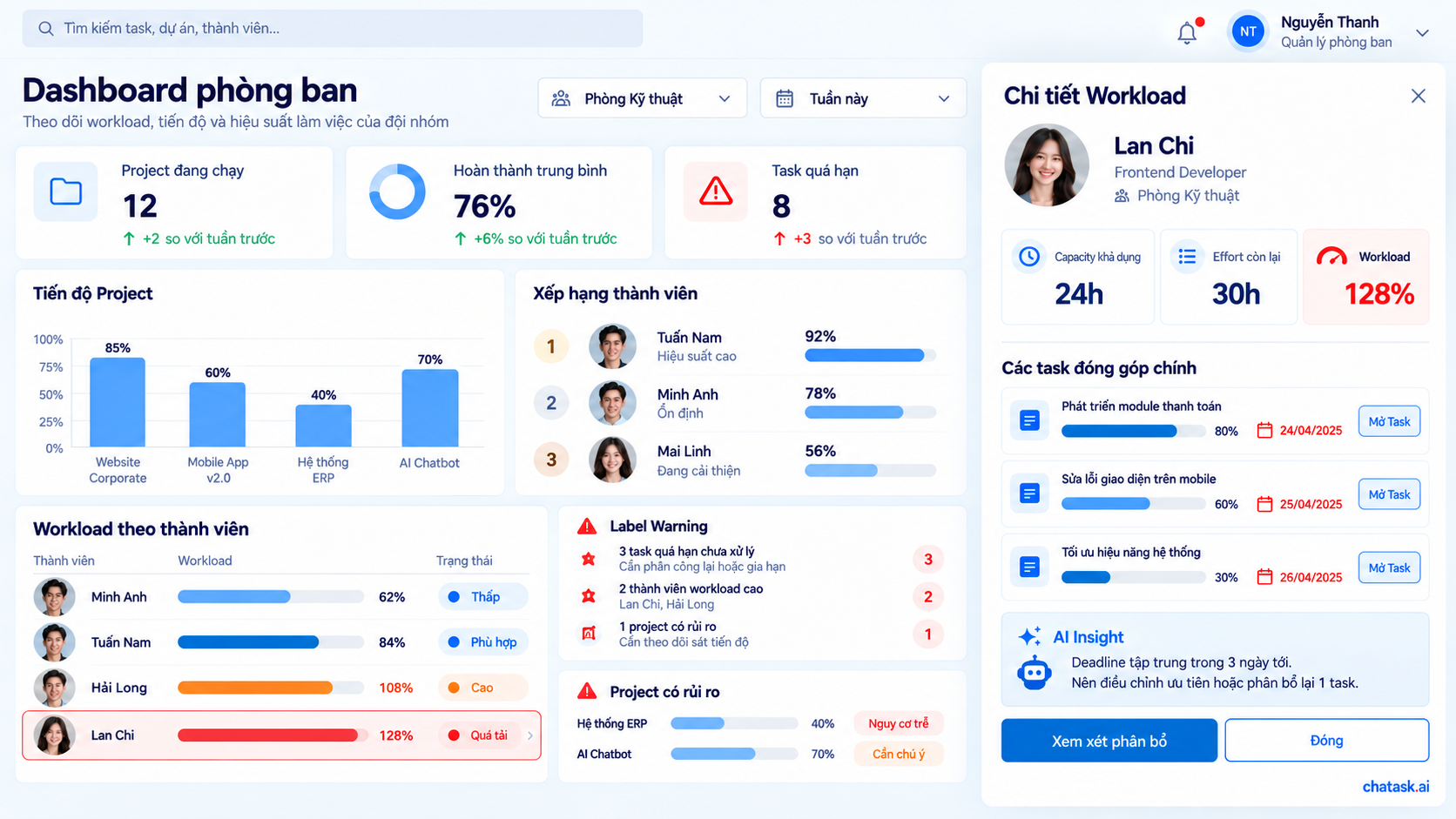
In ChaTask, data about tasks, assignees, deadlines, and progress is generated throughout the work process. Using this data, the department dashboard can help managers monitor each team member’s workload over a defined period.
Instead of displaying only the number of tasks, workload should be calculated based on remaining effort and available capacity. Each employee can be shown with a status such as Low, Balanced, High, or Overloaded, helping managers quickly identify cases that require attention.
When a manager selects an employee, they can drill down into the tasks contributing to the workload, the relevant deadlines, and any missing data. If there is insufficient information to calculate workload, the system should display a clear message instead of showing 0% or automatically assigning a status.
AI can also help analyze signals such as concentrated deadlines, tasks that are repeatedly delayed, or unusual increases in workload. However, decisions about transferring work, changing deadlines, or adjusting resources still need to be made by managers with consideration of the actual context.
Measure Workload to Allocate Work More Effectively
Counting tasks is a simple way to form an initial impression, but it is not enough to conclude whether an employee is underutilized or overloaded.
A meaningful view of workload must combine remaining effort, available capacity, deadlines, and the practical characteristics of the work. The data should also be considered alongside employee feedback instead of being treated as an absolute conclusion.
When measured correctly, workload does more than indicate who has a lot of work. It helps managers answer a more important question: does the team genuinely have enough capacity to deliver what the organization has committed to?